.png)
Every day, doctors make decisions that carry enormous responsibility. Years of education, clinical experience, and evidence-based thinking prepare them to evaluate complex situations under pressure. While these qualities are invaluable in medicine, investing rewards a very different mindset.
Successful investing is built on patience, discipline, and consistency rather than quick decision-making. This is why even highly accomplished professionals can fall into psychological traps that quietly impact long-term wealth creation. Behavioral finance explains that these unconscious biases influence financial decisions regardless of intelligence or experience.
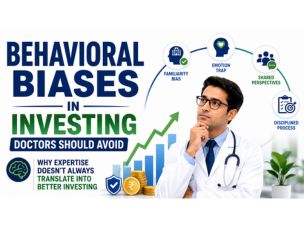
The Familiarity Bias
Years of clinical excellence build a strong sense of judgment and clarity in decision-making. At times, this familiarity with the healthcare ecosystem can extend into areas like investing.
It’s natural to feel that understanding hospitals, pharma companies, or medical trends offers an edge in selecting investments. While this perspective is valuable, investment outcomes are influenced by a wider set of factors—such as valuations, market cycles, diversification, and broader economic conditions.
In some cases, this can lead to a more concentrated portfolio or a tendency to rely on a limited set of ideas, which may not always align with long-term investment goals.
The Emotion Trap
Money is emotion, because it represents years of hard work and sacrifice. This is why loss aversion affects even experienced professionals. Many investors continue holding underperforming investments simply because accepting a loss feels uncomfortable, while profitable investments are often sold too early to secure gains. Similarly, investments that are bought to commemorate life achievements can be difficult to part ways with.
Another common psychological trap is recency bias, where recent market events begin to influence long-term decisions. A prolonged market rally creates excessive optimism, while a temporary correction triggers fear and causes investors to stop SIPs or shift entirely to safer assets. Markets move in cycles, but financial goals usually do not. Allowing short-term emotions to dictate long-term investment decisions often reduces overall returns.
Shared Perspectives in Investing
Doctors frequently exchange investment ideas among colleagues, professional circles, conferences, and social networks. This can be valuable in discovering new opportunities.
At the same time, commonly discussed ideas can sometimes feel more compelling simply because they are widely shared. Pairing these insights with independent evaluation can help ensure decisions stay aligned with long-term goals.
Medical training also builds a bias toward timely action, which is essential in patient care. In investing, however, consistency and patience tend to play a larger role. A steady, plan-driven approach often delivers better outcomes than frequent changes.
Building a Process That Keeps Biases in Check
Behavioral biases cannot be eliminated completely, but they can be managed through a disciplined investment framework. Every doctor should build a process that includes:
1. Clearly defined financial goals.
2. Strategic asset allocation aligned with risk tolerance.
3. Regular portfolio reviews instead of reacting to daily market movements. 4. Automated investing to reduce emotional decision-making.
5. Diversification rather than concentrated bets driven by conviction or familiarity.
A well-designed system allows logic to guide decisions even when emotions are running high.
The Key Takeaway
Doctors rely on evidence-based protocols because they consistently improve patient outcomes. Investing deserves the same disciplined approach. While market movements are beyond anyone’s control, the quality of investment decisions is not. Long-term wealth is created not by predicting every market trend but by recognising behavioural biases, following a structured financial plan, and remaining committed to it through every market cycle. In investing, mastering your own behaviour is often a greater advantage than trying to master the market itself.