


What is Semaglutide? Uses, Benefits & Mechanism Explained
Over the past few years, few therapies have generated as much attention in both clinical practice and public conversations as semaglutide. Originally developed for managing type 2 diabetes, it has now become a key player in obesity treatment as well—shifting how both conditions are approached globally, in line with evolving global treatment guidelines¹,².
But beyond the headlines and rapid adoption, what exactly is semaglutide, and why is it considered such a breakthrough?
What is Semaglutide?
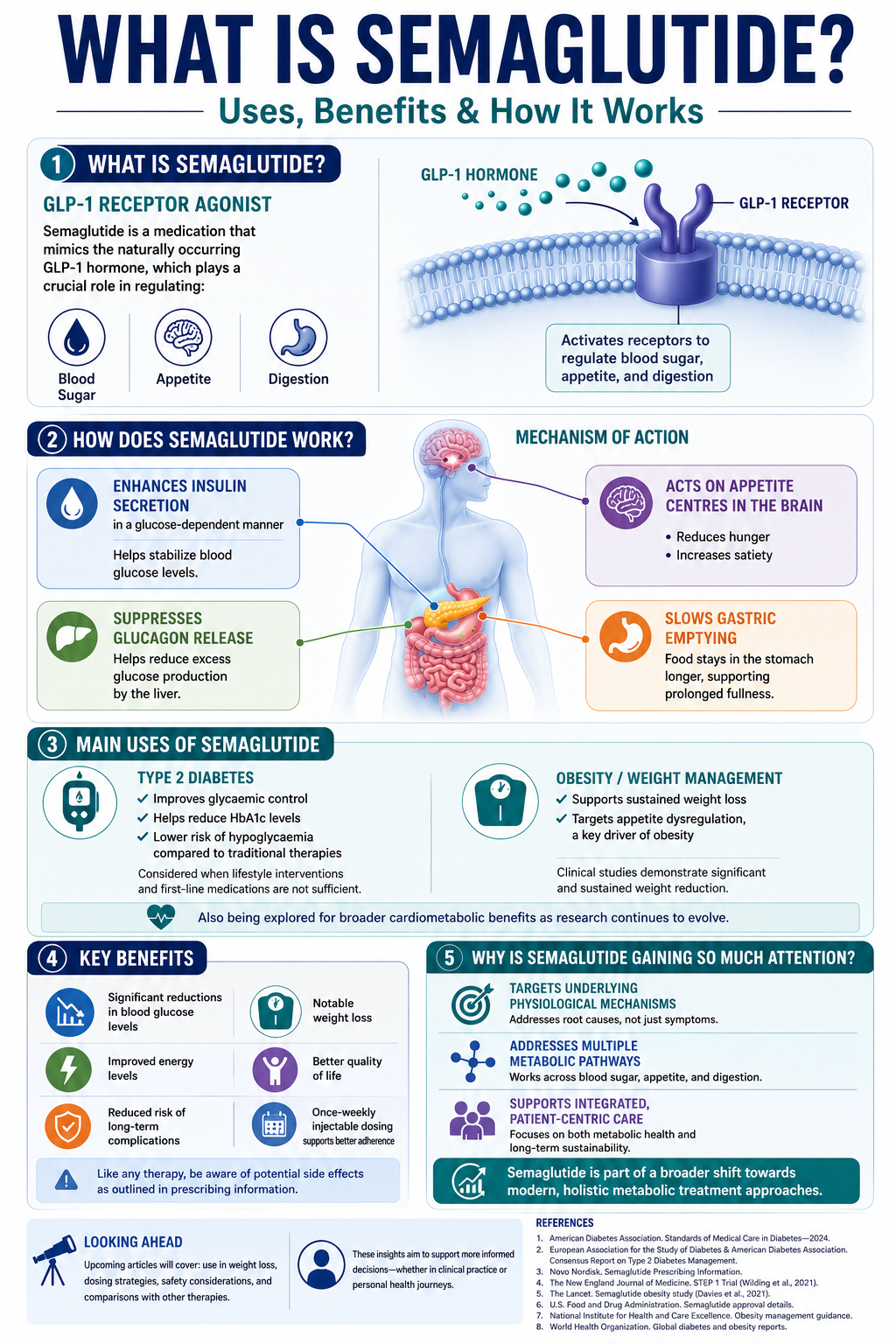
Semaglutide is a medication that belongs to a class of drugs known as GLP-1 receptor agonists. These drugs are designed to mimic a naturally occurring hormone in the body—glucagon-like peptide-1 (GLP-1)—which plays a crucial role in regulating blood sugar, appetite, and digestion³.
For patients, this essentially means better blood glucose control and, in many cases, meaningful weight reduction. For clinicians, it represents a therapy that addresses multiple metabolic pathways simultaneously rather than focusing on a single outcome, as highlighted in current diabetes care recommendations¹,².
How Does Semaglutide Work?
Semaglutide mimics the GLP-1 hormone and activates its receptors, leading to a cascade of metabolic effects. It enhances insulin secretion in a glucose-dependent manner, suppresses glucagon release, and slows gastric emptying³. Together, these actions help stabilize blood sugar levels.
At the same time, semaglutide acts on appetite centers in the brain, reducing hunger and increasing satiety—one of the key reasons behind its growing role in semaglutide for weight loss, supported by large clinical trials⁴,⁵.
What Are the Main Uses of Semaglutide?
Semaglutide is primarily used in two major therapeutic areas.
In type 2 diabetes, it helps improve glycaemic control and reduce HbA1c levels, often with a lower risk of hypoglycaemia compared to traditional therapies¹,². It is frequently considered when lifestyle interventions and first-line medications are not sufficient.
In obesity and weight management, semaglutide supports sustained weight loss by addressing appetite dysregulation—a key driver of obesity. Clinical studies have demonstrated significant and sustained weight reduction in patients receiving semaglutide⁴,⁵. If you’re exploring this further, understanding semaglutide for weight loss in detail can provide deeper insights into expected outcomes and treatment approaches.
As research continues to evolve, semaglutide is also being explored for broader cardiometabolic benefits, aligning with the growing global burden of metabolic diseases⁸.
Key Benefits of Semaglutide
What sets semaglutide apart is not just its efficacy, but the breadth of its benefits.
Patients often experience significant reductions in blood glucose levels alongside notable weight loss¹,⁴. For many, this translates into improved energy levels, better quality of life, and reduced risk of long-term complications.
From a clinical standpoint, semaglutide offers a well-studied safety and efficacy profile backed by large-scale trials⁴,⁵. Its once-weekly dosing (in injectable form) also supports better adherence compared to therapies requiring more frequent administration³.
Importantly, its ability to address both glycaemic control and weight positions it as a valuable option in managing interconnected metabolic conditions. However, like any therapy, it is equally important to be aware of potential semaglutide side effects, as outlined in regulatory and prescribing information³,⁶.
Why is Semaglutide Gaining So Much Attention?
The rising global burden of diabetes and obesity has created a need for therapies that go beyond symptom management⁸. Semaglutide stands out because it targets underlying physiological mechanisms rather than isolated outcomes.
Its growing adoption reflects a broader shift in treatment approaches—towards integrated, patient-centric care that considers both metabolic health and long-term sustainability¹,².
At the same time, increased awareness has also led to comparisons with newer therapies.
Looking Ahead
As semaglutide continues to reshape treatment landscapes, understanding its role becomes essential for both clinicians and patients.
In upcoming articles, we’ll explore its use in weight loss in greater detail, dosing strategies and administration guidance, safety considerations, and how it compares with other therapies in its class.
These insights aim to support more informed decisions—whether in clinical practice or personal health journeys.
References
- American Diabetes Association. Standards of Medical Care in Diabetes—2024.
- European Association for the Study of Diabetes & American Diabetes Association. Consensus Report on Type 2 Diabetes Management.
- Novo Nordisk. Semaglutide Prescribing Information.
- The New England Journal of Medicine. STEP 1 Trial (Wilding et al., 2021).
- The Lancet. Semaglutide obesity study (Davies et al., 2021).
- U.S. Food and Drug Administration. Semaglutide approval details.
- National Institute for Health and Care Excellence. Obesity management guidance.
- World Health Organization. Global diabetes and obesity reports.