Searching...
Can't find what you're looking for. Try different keywords.


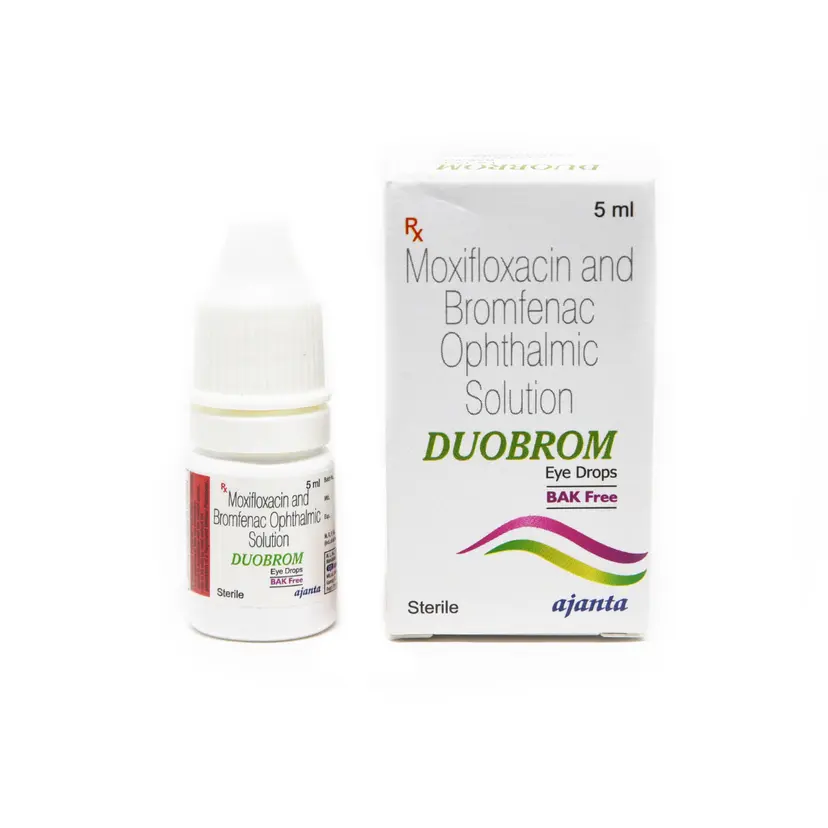

Dosage Form & Strength
BID
Duobrom is indicated for the treatment of CME & also used in Post Ocular Surgeries
Moxifloxacin The most frequently reported ocular adverse events were conjunctivitis, decreased visual acuity, dry eye, keratitis, ocular discomfort, ocular hyperemia, ocular pain, ocular pruritus, subconjunctival hemorrhage, and tearing. These events occurred in approximately 1-6% of patients. Nonocular adverse events reported at a rate of 1-4% were fever, increased cough, infection, otitis media, pharyngitis, rash, and rhinitis. Bromfenac The most common or most important reactions in the pooled studies were abnormal sensation in eye (0.5%), corneal erosion (mild or moderate) (0.4%), eye pruritus (0.4%), eye pain (0.3%) and eye redness (0.3%)
No interaction studies have been performed. No interactions with antibiotic eye drops used in conjunction with surgery have been reported
The half life of Moxifloxacin in Duobrom is 13 hours, the plasma concentration of Bromfenac following ocular administration in humans is unknown, so half life of Bromfenac in Duobrom is not applicable
Absorption Bromfenac efficiently permeates the cornea of cataract patients: A single dose resulted in a mean peak aqueous humour concentrations of 79±68 ng/ml at 150-180 minutes after dosing. Concentrations were maintained for 12 hours in aqueous humour with measurable levels up to 24 hours in major ocular tissues including the retina. Following twice daily dosing with bromfenac eye drops plasma concentrations were not quantifiable. Distribution Bromfenac shows high binding to plasma proteins. In vitro, the 99.8% were bound to proteins in human plasma. No biological relevant melanin binding was observed in vitro. Studies in rabbits using radio-labelled bromfenac have demonstrated that highest concentrations after topical administration are observed in the cornea followed by the conjunctiva and the aqueous humour. Only low concentrations were observed in the lens and vitreous. Biotransformation In vitro studies indicate that bromfenac is mainly metabolised by CYP2C9, which is absent in both iris-ciliary body and retina/choroid and the level of this enzyme in the cornea is less than 1% compared to the corresponding hepatic level. Elimination After ocular administration the half-life of bromfenac in aqueous humour is 1.4 h indicating rapid elimination.
Pregnancy Since there are no adequate and well-controlled studies in pregnant women, moxifloxacin and bromfenac combination ophthalmic solution should be used during pregnancy only if the potential benefit justifies the potential risk to the fetus. Lactation Caution should be exercised when moxifloxacin and bromfenac combination ophthalmic solution is administered to a nursing woman.
Bromfenac: Renal impairment: Bromfenac has not been studied in patients with hepatic disease or renal impairment.
Bromfenac: hepatic impairment: Bromfenac has not been studied in patients with hepatic disease or renal impairment.
Pediatric Use Safety and efficacy in pediatric patients have not been established.
Bromfenac: Use in adults, including the elderly The dose is one drop of Bromfenac in the affected eye(s) twice daily, beginning the next day after cataract surgery and continuing through the first 2 weeks of the postoperative period. The treatment should not exceed 2 weeks as safety data beyond this is not available. Geriatric Use No overall differences in safety and effectiveness have been observed between elderly and younger patients.
Subscribe to our newsletter and be the first to receive insights, updates, and expert tips on optimizing your financial management.