Searching...
Can't find what you're looking for. Try different keywords.


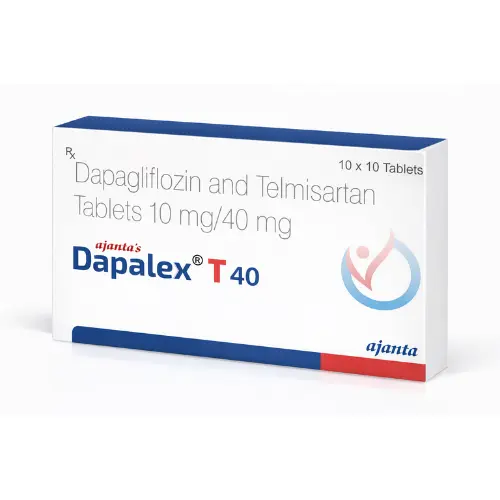

Dapagliflozin
10 mg
Telmisartan
40 mg
Dosage Form & Strength
One tablet once daily, taken orally, with or without food, preferably at the same time ach day.
Nursing Mothers: Choose to discontinue nursing or Dapalex T 40 Half Life: Dapagliflozin: The mean plasma terminal half-life for dapagliflozin is approximately 12.9 hours following a single oral dose of Dapalex T 40. Telmisartan: Telmisartan shows a terminal elimination half life of approximately 24 hours.
1. CKD associated with Type 2 Diabetes Mellitus 2. Patients at risk of progression of kidney disease and cardiovascular events.
“1. History of serious hypersensitivity reaction to Dapalex T 40 2. Severe renal imapirment (eGFR less than 30 mL/min/1.73 m2) in patients who are being treated for glycemic control without established cardiovascular disease or cardiovascular risk factors. 3. Patients on dialysis. 4. Co-administration of Dapalex with Aliskiren in patients with diabetes is contraindicated.”
1. Female genial mycotic infections 2. Nasopharyngitis 3. Urinary tract infections 4. Back pain 5. Sinusitis 6. Diarrhea
1. Volume depletion: Before initiating Dapalex T 40, assess volume status and renal function in the elderly, patients with renal impairment or low systolic blood pressure, and in patients on diuretics. Monitor for signs and symptoms during therapy. 2. Ketoacidosis in Patients with Diabetes Mellitus: Assess patients who present with signs and symptoms of metabolic acidosis for ketoacidosis regardless of blood glucose level. If suspected, discontinue Dapalex T, evaluate and treat promptly. Before initiating Dapalex T, consider risk factors for ketoacidosis. Patients on Dapalex T 40may require monitoring and temporary discontinuation of therapy in clinical situations known to predispose to ketoacidosis. 3. Urosepsis and Pyelonephritis: Evaluate for signs and symptoms of urinary tract infections and treat promptly, if indicated. 4. Hypoglycemia: Consider a lower dose of insulin or the insulin secretagogue to reduce the risk of hypoglycemia when used in combination with Dapalex T 40. 5. Necrotizing Fasciitis of the Perineum (Fournier’s Gangrene): Serious, life-threatening cases have occurred in patients with diabetes, both females and males. Assess patients presenting with pain or tenderness, erythema, or swelling in the genital or perineal area, along with fever or malaise. If suspected, institute prompt treatment. 6. Genital Mycotic Infections: Monitor and treat if indicated. 7. Monitor the patients with impaired hepatic or renal function carefully 8. Avoid concomitant use of an ACE inhibitor and Angiotensin receptor blocker.
1. Positive Urine Glucose Test Monitoring glycemic control with urine glucose tests is not recommended in patients taking SGLT2 inhibitors as SGLT2 inhibitors increase urinary glucose excretion and will lead to positive urine glucose tests. Use alternative methods to monitor glycemic control. 2. Interference with 1,5-anhydroglucitol (1,5-AG) Assay Monitoring glycemic control with 1,5-AG assay is not recommended as measurements of 1,5-AG are unreliable in assessing glycemic control in patients taking SGLT2 inhibitors. Use alternative methods to monitor glycemic control. 3. NSAIDS: Increased risk of renal impairment and loss of antihypertensive effect. 4. Do not co-administer aliskiren with Dapalex T 40 in patients with diabetes 5. Digoxin: Dapalex T 40increases peak plasma concentration of digoxin 6. Dapalex T 40administered concomitantly with lithium may increase serum lithium concentrations and cause toxicity.
Dapagliflozin: Sodium-glucose cotransporter 2 (SGLT2), expressed in the proximal renal tubules, is responsible for the majority of the reabsorption of filtered glucose from the tubular lumen. Dapagliflozin is an inhibitor of SGLT2. By inhibiting SGLT2, dapagliflozin reduces reabsorption of filtered glucose and lowers the renal threshold for glucose, and thereby increases urinary glucose excretion. Dapagliflozin also reduces sodium reabsorption and increases the delivery of sodium to the distal tubule. This may influence several physiological functions including, but not restricted to, lowering both pre- and afterload of the heart and downregulation of sympathetic activity. Temisartan: Angiotensin II is formed from angiotensin I in a reaction catalyzed by angiotensin-converting enzyme (ACE, kininase II). Angiotensin II is the principal pressor agent of the renin angiotensin system, with effects that include vasoconstriction, stimulation of synthesis and release of aldosterone, cardiac stimulation, and renal reabsorption of sodium. Telmisartan blocks the vasoconstrictor and aldosterone-secreting effects of angiotensin II by selectively blocking the binding of angiotensin II to the AT1 receptor in many tissues, such as vascular smooth muscle and the adrenal gland. Its action is therefore independent of the pathways for angiotensin II synthesis.
Dapagliflozin: 1. Absorption: Following oral administration of dapagliflozin, the maximum plasma concentration (Cmax) is usually attained within 2 hours under fasting state. The absolute oral bioavailability of dapagliflozin following the administration of a 10 mg dose is 78%. Dapagliflozin can be administered with or without food. 2. Distribution: Dapagliflozin is approximately 91% protein bound. Protein binding is not altered in patients with renal or hepatic impairment. 3. Metabolism: The metabolism of dapagliflozin is primarily mediated by UGT1A9. Dapagliflozin is extensively metabolized, primarily to yield dapagliflozin 3-O-glucuronide, which is an inactive metabolite. 4. Elimination: Dapagliflozin and related metabolites are primarily eliminated via the renal pathway. In urine, less than 2% of the dose is excreted as parent drug. In feces, approximately 15% of the dose is excreted as parent drug. The mean plasma terminal half-life (t½) for dapagliflozin is approximately 12.9 hours following a single oral dose of Dapagliflozin 10 mg. Telmisartan: 1. Absorption: Following oral administration, peak concentrations (Cmax) of telmisartan are reached in 0.5 to 1 hour after dosing. Food slightly reduces the bioavailability of telmisartan, with a reduction in the area under the plasma concentration-time curve (AUC) of about 6% with the 40 mg tablet. The absolute bioavailability of telmisartan is dose dependent. At 40 mg the bioavailability is 42%. 2. Distribution: Telmisartan is highly bound to plasma proteins (>99.5%), mainly albumin and α1 – acid glycoprotein. Plasma protein binding is constant over the concentration range achieved with recommended doses. The volume of distribution for telmisartan is approximately 500 liters indicating additional tissue binding. 3. Metabolism: Telmisartan is metabolized by conjugation to form a pharmacologically inactive acyl glucuronide; the glucuronide of the parent compound is the only metabolite that has been identified in human plasma and urine. After a single dose, the glucuronide represents approximately 11% of the measured radioactivity in plasma. The cytochrome P450 isoenzymes are not involved in the metabolism of telmisartan. 4. Excretion: Following either intravenous or oral administration of 14C-labeled telmisartan, most of the administered dose (>97%) was eliminated unchanged in feces via biliary excretion; only minute amounts were found in the urine (0.91% and 0.49% of total radioactivity, respectively). Total plasma clearance of telmisartan is >800 mL/min. Terminal half-life and total clearance appear to be independent of dose.
Absorption: Dapagliflozin: Following oral administration of dapagliflozin, the maximum plasma concentration (Cmax) is usually attained within 2 hours under fasting state. Administration of dapagliflozin with a high-fat meal decreases its Cmax by up to 50% and prolongs Tmax by approximately 1 hour, but does not alter AUC as compared with the fasted state. These changes are not considered to be clinically meaningful and dapagliflozin can be administered with or without food. Telmisartan: Following oral administration, peak concentrations (Cmax) of telmisartan are reached in 0.5 to 1 hour after dosing. Food slightly reduces the bioavailability of telmisartan, with a reduction in the area under the plasma concentration-time curve (AUC) of about 6% with the 40 mg tablet. The absolute bioavailability of telmisartan is dose dependent. At 40 mg the bioavailability is 42%. —x-x— Bioavailability: Dapagliflozin: The absolute oral bioavailability of dapagliflozin following the administration of a 10 mg dose is 78%. Telmisartan: The absolute bioavailability of telmisartan is dose dependent. At 40 mg the bioavailability is 42%. —x-x— Metabolism: Dapagliflozin: The metabolism of dapagliflozin is primarily mediated by UGT1A9; CYP-mediated metabolism is a minor clearance pathway in humans. Dapagliflozin is extensively metabolized, primarily to yield dapagliflozin 3-O-glucuronide, which is an inactive metabolite. Dapagliflozin 3-O-glucuronide accounted for 61% of a 50 mg [14C]-dapagliflozin dose and is the predominant drug-related component in human plasma. Telmisartan: Telmisartan is metabolized by conjugation to form a pharmacologically inactive acyl glucuronide; the glucuronide of the parent compound is the only metabolite that has been identified in human plasma and urine. After a single dose, the glucuronide represents approximately 11% of the measured radioactivity in plasma. The cytochrome P450 isoenzymes are not involved in the metabolism of telmisartan. —x-x— Excretion: Dapagliflozin: Dapagliflozin and related metabolites are primarily eliminated via the renal pathway. In urine, less than 2% of the dose is excreted as parent drug. In feces, approximately 15% of the dose is excreted as parent drug. Telmisartan: Following either intravenous or oral administration of 14C-labeled telmisartan, most of the administered dose (>97%) was eliminated unchanged in feces via biliary excretion; only minute amounts were found in the urine (0.91% and 0.49% of total radioactivity, respectively). Total plasma clearance of telmisartan is >800 mL/min. Terminal half-life and total clearance appear to be independent of dose.
1. Dapalex T 40is not recommended during the second and third trimesters of pregnancy. 2. When pregnancy is detected, discontinue Dapalex T 40as soon as possible.
No dosage adjustment is necessary in patients with decreased renal function.
No dose adjustment is recommended for patients with mild, moderate, or severe hepatic impairment. However, the benefit-risk for the use of dapagliflozin in patients with severe hepatic impairment should be individually assessed since the safety and efficacy of Dapalex T 40 have not been specifically studied in this population. Careful monitoring in patients with biliary obstructive disorders or hepatic insufficiency should be done.
Safety and effectiveness of Dapalex T 40 in pediatric patients under 18 years of age have not been established.
No dosage change is recommended based on age
Subscribe to our newsletter and be the first to receive insights, updates, and expert tips on optimizing your financial management.