Searching...
Can't find what you're looking for. Try different keywords.


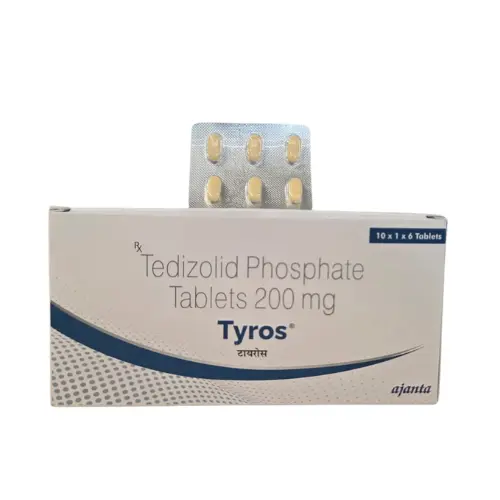

Tedizolid phosphate
200 mg
Dosage Form & Strength
200 mg administered once daily orally for 6 days as specified
Elderly (≥65 years) No dosage adjustment is required . The clinical experience in patients ≥75 years is limited. Hepatic impairment No dosage adjustment is required Renal impairment No dosage adjustment is required
Treatment of acute bacterial skin and skin structure infections (ABSSSI)
Hypersensitivity to the active substance or to any of the excipients listed
The most common adverse reactions (>2%) in adult patients are nausea, headache, diarrhea, infusion- or injection-related adverse reactions, vomiting, and dizziness. (6.1) • The most common adverse reactions (>2%) in pediatric patients (12 years to less than 18 years of age) are phlebitis and increased hepatic transaminases. (6.1) • The most common adverse reactions (>2%) in pediatric patients (less than 12 years of age) are infusion- or injection-related adverse reactions and vomiting.
Patients with neutropenia: The safety and efficacy ofTedizolid in patients with neutropenia (neutrophil counts <1000 cells/mm3) have not been adequately evaluated. In an animal model of infection, the antibacterial activity of Tedizolid was reduced in the absence of granulocytes. Consider alternative therapies in neutropenic patients. • Clostridioides difficile-associated diarrhea: Evaluate if diarrhea occurs. ABSSIs – Duration 6days
In a clinical study comparing the single dose (10 mg) pharmacokinetics of rosuvastatin (Breast Cancer Resistant Protein [BCRP] substrate) alone or in combination with tedizolid phosphate (once-daily 200 mg oral dose), rosuvastatin AUC and Cmax increased by approximately 70% and 55%, respectively, when co-administered with tedizolid phosphate. Therefore, orally administered tedizolid phosphate can result in inhibition of BCRP at the intestinal level. If possible, an interruption of the co-administered BCRP substrate medicinal product (such as imatinib, lapatinib, methotrexate, pitavastatin, rosuvastatin, sulfasalazine, and topotecan) should be considered during the 6 days of treatment with oral tedizolid phosphate. In a clinical study comparing the single dose (2 mg) pharmacokinetics of midazolam (CYP3A4 substrate) alone or in combination with tedizolid phosphate (once-daily 200 mg oral dose for 10 days), midazolam AUC and Cmax when co-administered with tedizolid phosphate were 81% and 83% of midazolam AUC and Cmax when administered alone, respectively. This effect is not clinically meaningful, and no dose adjustment for co-administered CYP3A4 substrates is necessary during tedizolid phosphate treatment. Pharmacodynamic interactions Monoamine oxidase inhibition Tedizolid is a reversible inhibitor of monoamine oxidase (MAO) in vitro; however, no interaction is anticipated when comparing the IC50 for MAO-A inhibition and the anticipated plasma exposures in man. Drug interaction studies to determine effects of 200 mg oral tedizolid phosphate at steady-state on pseudoephedrine and tyramine pressor effects were conducted in healthy volunteers. No meaningful changes in blood pressure or heart rate with pseudoephedrine were observed in the healthy volunteers, and no clinically relevant increase in tyramine sensitivity was observed. Potential serotonergic interactions The potential for serotonergic interactions has not been studied in either patients or healthy volunteers (see sections 4.4 and 5.2). Post-marketing experience: there have been reports of patients experiencing serotonin syndrome while taking tedizolid and serotonergic agents (antidepressants, opioids) which resolved on discontinuation of one or both medications.
Tedizolid phosphate is an oxazolidinone phosphate prodrug. The antibacterial activity of tedizolid is mediated by binding to the 50S subunit of the bacterial ribosome resulting in inhibition of protein synthesis. Tedizolid is primarily active against Gram-positive bacteria. Tedizolid is bacteriostatic against enterococci, staphylococci, and streptococci in vitro
Oral and intravenous tedizolid phosphate is a prodrug that is rapidly converted by phosphatases to tedizolid, the microbiologically active moiety. Only the pharmacokinetic profile of tedizolid is discussed in this section. Pharmacokinetic studies were conducted in healthy volunteers and population pharmacokinetic analyses were conducted in patients from Phase 3 studies. Absorption At steady-state, tedizolid mean (SD) Cmax values of 2.2 (0.6) and 3.0 (0.7) mcg/mL and AUC values of 25.6 (8.5) and 29.2 (6.2) mcg·h/mL were similar with oral and IV administration of tedizolid phosphate, respectively. The absolute bioavailability of tedizolid is above 90%. Peak plasma tedizolid concentrations are achieved within approximately 3 hours after dosing after oral administration of tedizolid phosphate under fasted conditions. Peak concentrations (Cmax) of tedizolid are reduced by approximately 26% and delayed by 6 hours when tedizolid phosphate is administered after a high-fat meal relative to fasted, while total exposure (AUC0-∞) is unchanged between fasted and fed conditions. Distribution The average binding of tedizolid to human plasma proteins is approximately 70-90%. The mean steady-state volume of distribution of tedizolid in healthy adults (n=8) following a single intravenous dose of tedizolid phosphate 200 mg ranged from 67 to 80 L. Biotransformation Tedizolid phosphate is converted by endogenous plasma and tissue phosphatases to the microbiologically active moiety, tedizolid. Other than tedizolid, which accounts for approximately 95% of the total radiocarbon AUC in plasma, there are no other significant circulating metabolites. When incubated with pooled human liver microsomes, tedizolid was stable suggesting that tedizolid is not a substrate for hepatic CYP450 enzymes. Multiple sulfotransferase (SULT) enzymes (SULT1A1, SULT1A2, and SULT2A1) are involved in the biotransformation of tedizolid, to form an inactive and non-circulating sulphate conjugate found in the excreta. Elimination Tedizolid is eliminated in excreta, primarily as a non-circulating sulphate conjugate. Following single oral administration of 14C-labeled tedizolid phosphate under fasted conditions, the majority of elimination occurred via the liver with 81.5% of the radioactive dose recovered in faeces and 18% in urine, with most of the elimination (> 85%) occurring within 96 hours. Less than 3% of tedizolid phosphate administered dose is excreted as active tedizolid. The elimination half-life of tedizolid is approximately 12 hours and the intravenous clearance is 6-7 L/h. Bioavailability: Approx 91%
There are no data from the use of tedizolid phosphate in pregnant women
Subscribe to our newsletter and be the first to receive insights, updates, and expert tips on optimizing your financial management.