Searching...
Can't find what you're looking for. Try different keywords.


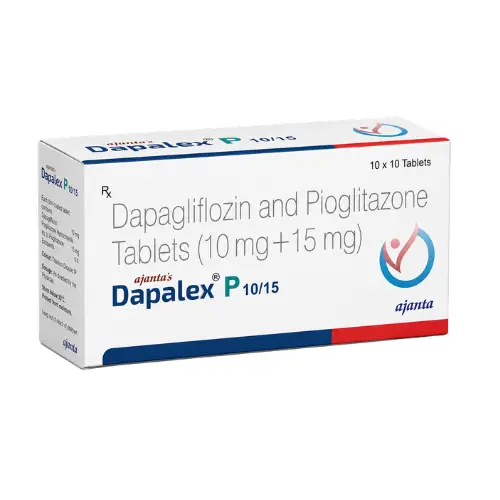

Dapagliflozin
10 mg
Pioglitazone
15 mg
1. Dapagliflozin Innovator Brand: Farxiga / Forxiga 2. Pioglitazone Innovator brand: Actos
One tablet orally once daily, taken with or without food. It should be taken regularly at the same time each day for optimal glycemic control.
Dapalex P 15 should not be administered by a breast-feeding woman. Half Life: Dapagliflozin: The mean plasma terminal half-life for dapagliflozin is approximately 12.9 hours following a single oral dose of Dapalex P 15. Pioglitazone: The mean serum half-life of pioglitazone and total pioglitazone ranges from 3 to 7 hours and 16 to 24 hours, respectively.
For the treatment of Type 2 Diabetes Mellitus in adults as an adjunct to diet and exercise to improve glycemic control.
1. History of serious hypersensitivity reaction to Dapalex P 15 2. Severe renal imapirment (eGFR less than 30 mL/min/1.73 m2) in patients who are being treated for glycemic control without established cardiovascular disease or cardiovascular risk factors. 3. Patients on dialysis.
1. Female genial mycotic infections 2. Nasopharyngitis 3. Urinary tract infections
1. Volume depletion: Before initiating Dapalex P 15, assess volume status and renal function in the elderly, patients with renal impairment or low systolic blood pressure, and in patients on diuretics. Monitor for signs and symptoms during therapy. 2. Ketoacidosis in Patients with Diabetes Mellitus: Assess patients who present with signs and symptoms of metabolic acidosis for ketoacidosis regardless of blood glucose level. If suspected, discontinue Dapalex P 15, evaluate and treat promptly. Before initiating Dapalex P 15, consider risk factors for ketoacidosis. Patients on Dapalex P 15 require monitoring and temporary discontinuation of therapy in clinical situations known to predispose to ketoacidosis. 3. Urosepsis and Pyelonephritis: Evaluate for signs and symptoms of urinary tract infections and treat promptly, if indicated. 4. Hypoglycemia: Consider a lower dose of insulin or the insulin secretagogue to reduce the risk of hypoglycemia when used in combination with Dapalex P 15. 5. Necrotizing Fasciitis of the Perineum (Fournier’s Gangrene): Serious, life-threatening cases have occurred in patients with diabetes, both females and males. Assess patients presenting with pain or tenderness, erythema, or swelling in the genital or perineal area, along with fever or malaise. If suspected, institute prompt treatment. 6. Genital Mycotic Infections: Monitor and treat if indicated. 7. Ovulation: In premenopausal anovulatory patients with insulin resistance, treatment with Dapalex P 15 may result in resumption of ovulation. As a consequence of their improved insulin sensitivity, these patients may be at risk for pregnancy if adequate contraception is not used. 8. Hematologic: Dapalex P 15 may cause decrease in hemoglobin and hematocrit. 9. Edema: Dapalex P 15 should be used with caution in patients with edema. 10. Cardiac: Dapalex P 15 is not indicated in patients with NYHA Class III or IV cardiac status. 11. Hepatic effects: Therapy with Dapalex P 15 should not be initiated if the patient exhibits clinical evidence of active liver disease pr the ALT levels exceed 2.5 times the upper limit of normal.
1. Positive Urine Glucose Test Monitoring glycemic control with urine glucose tests is not recommended in patients taking SGLT2 inhibitors as SGLT2 inhibitors increase urinary glucose excretion and will lead to positive urine glucose tests. Use alternative methods to monitor glycemic control. 2. Interference with 1,5-anhydroglucitol (1,5-AG) Assay Monitoring glycemic control with 1,5-AG assay is not recommended as measurements of 1,5-AG are unreliable in assessing glycemic control in patients taking SGLT2 inhibitors. Use alternative methods to monitor glycemic control. 3. Oral Contraceptives: Administration of another thiazolidinedione with an oral contraceptive containing ethinyl estradiol and norethindrone reduced the plasma concentrations of both hormones by approximately 30%, which could result in loss of contraception. Therefore, additional caution regarding contraception should be exercised in patients receiving Dapalex P 15 and an oral contraceptive.
Dapagliflozin: Sodium-glucose cotransporter 2 (SGLT2), expressed in the proximal renal tubules, is responsible for the majority of the reabsorption of filtered glucose from the tubular lumen. Dapagliflozin is an inhibitor of SGLT2. By inhibiting SGLT2, dapagliflozin reduces reabsorption of filtered glucose and lowers the renal threshold for glucose, and thereby increases urinary glucose excretion. Dapagliflozin also reduces sodium reabsorption and increases the delivery of sodium to the distal tubule. This may influence several physiological functions including, but not restricted to, lowering both pre- and afterload of the heart and downregulation of sympathetic activity. Pioglitazone: Pioglitazone is a thiazolidinedione antidiabetic agent that depends on the presence of insulin for its mechanism of action. Pioglitazone decreases insulin resistance in the periphery and in the liver resulting in increased insulin-dependent glucose disposal and decreased hepatic glucose output. Unlike sulfonylureas, pioglitazone is not an insulin secretagogue. Pioglitazone is a potent and highly selective agonist for peroxisome proliferator-activated receptor-gamma (PPARg). PPAR receptors are found in tissues important for insulin action such as adipose tissue, skeletal muscle, and liver. Activation of PPARg nuclear receptors modulates the transcription of a number of insulin responsive genes involved in the control of glucose and lipid metabolism.
Dapagliflozin: 1. Absorption: Following oral administration of dapagliflozin, the maximum plasma concentration (Cmax) is usually attained within 2 hours under fasting state. The absolute oral bioavailability of dapagliflozin following the administration of a 10 mg dose is 78%. Dapagliflozin can be administered with or without food. 2. Distribution: Dapagliflozin is approximately 91% protein bound. Protein binding is not altered in patients with renal or hepatic impairment. 3. Metabolism: The metabolism of dapagliflozin is primarily mediated by UGT1A9. Dapagliflozin is extensively metabolized, primarily to yield dapagliflozin 3-O-glucuronide, which is an inactive metabolite. 4. Elimination: Dapagliflozin and related metabolites are primarily eliminated via the renal pathway. In urine, less than 2% of the dose is excreted as parent drug. In feces, approximately 15% of the dose is excreted as parent drug. The mean plasma terminal half-life (t½) for dapagliflozin is approximately 12.9 hours following a single oral dose of Dapagliflozin 10 mg. Pioglitazone: 1. Absorption: Following oral administration, in the fasting state, pioglitazone is first measurable in serum within 30 minutes, with peak concentrations observed within 2 hours. Food slightly delays the time to peak serum concentration to 3 to 4 hours, but does not alter the extent of absorption. 2. Distribution: The mean apparent volume of distribution (Vd/F) of pioglitazone following single-dose administration is 0.63 + 0.41 (mean + SD) L/kg of body weight. Pioglitazone is extensively protein bound (>99%) in human serum, principally to serum albumin. Pioglitazone also binds to other serum proteins, but with lower affinity. Metabolites M-III and M-IV also are extensively bound (>98%) to serum albumin. 3. Metabolism: Pioglitazone is extensively metabolized by hydroxylation and oxidation; the metabolites also partly convert to glucuronide or sulfate conjugates. In addition to pioglitazone, M-III and M-IV are the principal drug-related species found in human serum following multiple dosing. At steady state, in both healthy volunteers and in patients with type 2 diabetes, pioglitazone comprises approximately 30% to 50% of the total peak serum concentrations and 20% to 25% of the total AUC. 4. Excretion: Following oral administration, approximately 15% to 30% of the pioglitazone dose is recovered in the urine. Renal elimination of pioglitazone is negligible, and the drug is excreted primarily as metabolites and their conjugates. It is presumed that most of the oral dose is excreted into the bile either unchanged or as metabolites and eliminated in the feces. The mean serum half-life of pioglitazone and total pioglitazone ranges from 3 to 7 hours and 16 to 24 hours, respectively. Pioglitazone has an apparent clearance, CL/F, calculated to be 5 to 7 L/hr.
Absorption: Dapagliflozin: Following oral administration of dapagliflozin, the maximum plasma concentration (Cmax) is usually attained within 2 hours under fasting state. Administration of dapagliflozin with a high-fat meal decreases its Cmax by up to 50% and prolongs Tmax by approximately 1 hour, but does not alter AUC as compared with the fasted state. These changes are not considered to be clinically meaningful and dapagliflozin can be administered with or without food. Pioglitazone: Following oral administration, in the fasting state, pioglitazone is first measurable in serum within 30 minutes, with peak concentrations observed within 2 hours. Food slightly delays the time to peak serum concentration to 3 to 4 hours, but does not alter the extent of absorption. —x-x— Bioavailability: Dapagliflozin: The absolute oral bioavailability of dapagliflozin following the administration of a 10 mg dose is 78%. Pioglitazone: The absolute bioavailability of pioglitazone is approximately 83%. —x-x— Metabolism: Dapagliflozin: The metabolism of dapagliflozin is primarily mediated by UGT1A9; CYP-mediated metabolism is a minor clearance pathway in humans. Dapagliflozin is extensively metabolized, primarily to yield dapagliflozin 3-O-glucuronide, which is an inactive metabolite. Dapagliflozin 3-O-glucuronide accounted for 61% of a 50 mg [14C]-dapagliflozin dose and is the predominant drug-related component in human plasma. Pioglitazone: Pioglitazone is extensively metabolized by hydroxylation and oxidation; the metabolites also partly convert to glucuronide or sulfate conjugates. In addition to pioglitazone, M-III and M-IV are the principal drug-related species found in human serum following multiple dosing. At steady state, in both healthy volunteers and in patients with type 2 diabetes, pioglitazone comprises approximately 30% to 50% of the total peak serum concentrations and 20% to 25% of the total AUC. —x-x— Excretion: Dapagliflozin: Dapagliflozin and related metabolites are primarily eliminated via the renal pathway. In urine, less than 2% of the dose is excreted as parent drug. In feces, approximately 15% of the dose is excreted as parent drug. Pioglitazone: Following oral administration, approximately 15% to 30% of the pioglitazone dose is recovered in the urine. Renal elimination of pioglitazone is negligible, and the drug is excreted primarily as metabolites and their conjugates. It is presumed that most of the oral dose is excreted into the bile either unchanged or as metabolites and eliminated in the feces. The mean serum half-life of pioglitazone and total pioglitazone ranges from 3 to 7 hours and 16 to 24 hours, respectively. Pioglitazone has an apparent clearance, CL/F, calculated to be 5 to 7 L/hr.
Dapalex P 15 is not recommended during the second and third trimesters of pregnancy.
No dosage adjustment is necessary in patients with decreased renal function.
Dapalex P 15 should not be initiated if the patient exhibits clinical evidence of active liver disease or serum transaminases level exceed 2.5 times the upper limit of normal.
Safety and effectiveness of Dapalex P 15 in pediatric patients under 18 years of age have not been established.
No dosage change is recommended based on age
Subscribe to our newsletter and be the first to receive insights, updates, and expert tips on optimizing your financial management.