Searching...
Can't find what you're looking for. Try different keywords.


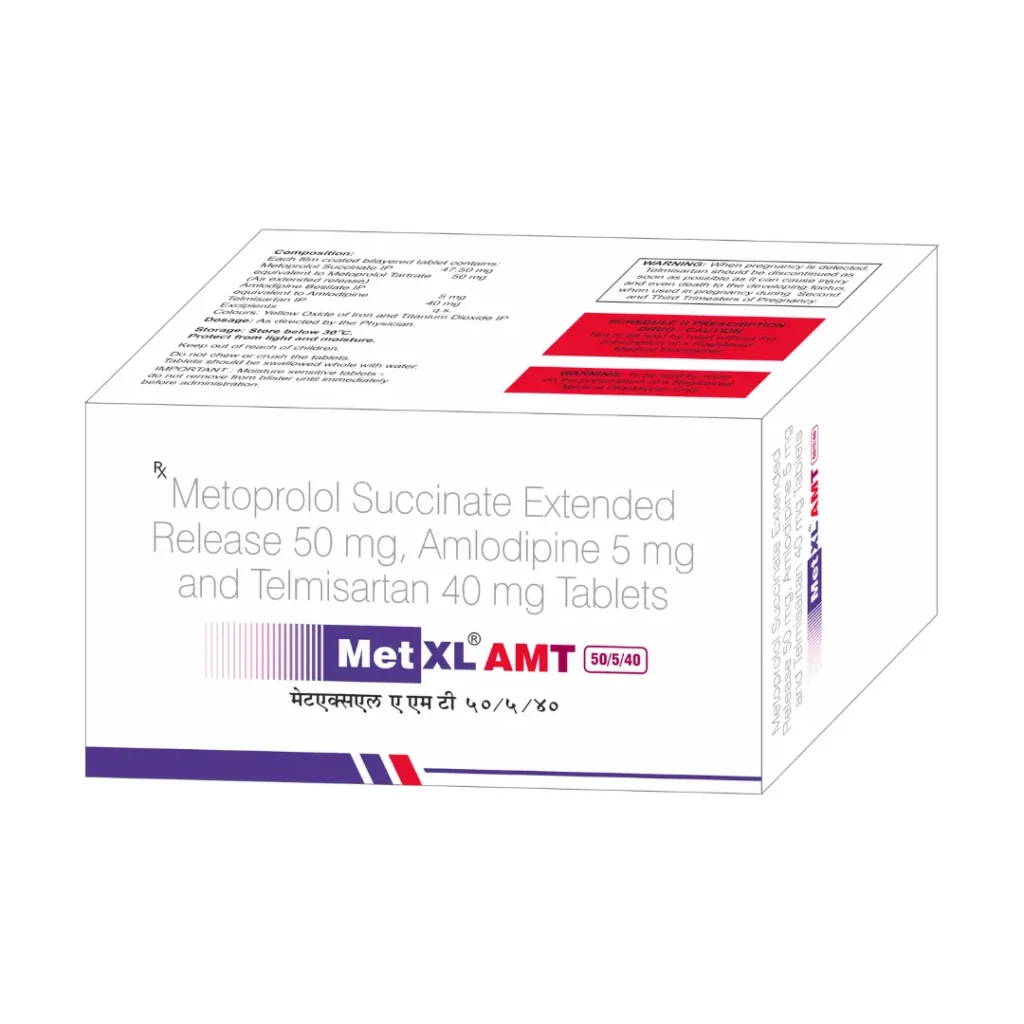

Metoprolol Succinate
50mg
Amlodipine
5mg
Telmisartan
40mg
Dosage Form & Strength
The dose of MetXL AMT is 1 tablet daily
MetXL AMT is a combination of telmisartan an angiotensin – 2 receptor blocker, amlodipine a dihydropyridine calcium channel blocker, and Metoprolol a beta-blocker indicated for the treatment of hypertension, to lower blood pressure. Lowering blood pressure reduces the risk of fatal and nonfatal cardiovascular events, primarily strokes and myocardial infarctions.
• In patients with known hypersensitivity to the active substance or to any of the excipients. • In severe bradycardia, second- or third-degree heart block, cardiogenic shock, decompensated heart failure, sick sinus syndrome (unless a permanent pacemaker is in place). • Shock (including cardiogenic shock) • Obstruction of the outflow tract of the left ventricle (e.g. high-grade aortic stenosis) • Haemodynamically unstable heart failure after acute myocardial infarction • Second and third trimesters of pregnancy • Biliary obstructive disorders • Severe hepatic impairment • The concomitant use of telmisartan with aliskiren-containing products is contraindicated in patients with diabetes mellitus or renal impairment (GFR < 60 ml/min/1.73 m2).
Amlodipine The most common adverse reaction to amlodipine is edema which occurred in a dose related manner. Other adverse experiences not dose related but reported with an incidence >1.0% are fatigue, nausea, abdominal pain, and somnolence. Metoprolol The most common adverse reactions: tiredness, dizziness, depression, shortness of breath, bradycardia, hypotension, diarrhea, pruritus, rash. Telmisartan Hypertension: The most common adverse events (≥1%) reported in hypertension trials are back pain, sinusitis, and diarrhea. Cardiovascular risk reduction: The serious adverse events (≥1%) reported in cardiovascular risk reduction trials were intermittent claudication and skin ulcer.
Amlodipine Hypotension Symptomatic hypotension is possible, particularly in patients with severe aortic stenosis. Because of the gradual onset of action, acute hypotension is unlikely. Increased Angina or Myocardial Infarction Worsening angina and acute myocardial infarction can develop after starting or increasing the dose of amlodipine, particularly in patients with severe obstructive coronary artery disease. Patients with Hepatic Failure Because amlodipine is extensively metabolized by the liver and the plasma elimination half-life (t 1/2) is 56 hours in patients with impaired hepatic function, titrate slowly when administering amlodipine to patients with severe hepatic impairment. Metoprolol Abrupt Cessation of Therapy Following abrupt cessation of therapy with certain beta-blocking agents, exacerbations of angina pectoris and, in some cases, myocardial infarction have occurred. When discontinuing chronically administered metoprolol succinate extended-release tablets, particularly in patients with ischemic heart disease, gradually reduce the dosage over a period of 1 to 2 weeks and monitor the patient. If angina markedly worsens or acute coronary ischemia develops, promptly reinstate metoprolol succinate extended-release tablets, and take measures appropriate for the management of unstable angina. Warn patients not to interrupt therapy without their physician’s advice. Because coronary artery disease is common and may be unrecognized, avoid abruptly discontinuing metoprolol succinate extended-release tablets in patients treated only for hypertension. Heart Failure Worsening cardiac failure may occur during up-titration of metoprolol succinate extended-release tablets. If such symptoms occur, increase diuretics and restore clinical stability before advancing the dose of metoprolol succinate extended-release tablets. It may be necessary to lower the dose of metoprolol succinate extended-release tablets or temporarily discontinue it. Such episodes do not preclude subsequent successful titration of metoprolol succinate extended-release tablets. Bronchospastic Disease Patients with bronchospastic diseases should, in general, not receive beta-blockers. Because of its relative beta1- cardio-selectivity, however, metoprolol succinate extended-release tablets may be used in patients with bronchospastic disease who do not respond to, or cannot tolerate, other antihypertensive treatment. Because beta1-selectivity is not absolute, use the lowest possible dose of metoprolol succinate extended-release tablets. Bronchodilators, including beta2-agonists, should be readily available or administered concomitantly. Bradycardia Bradycardia, including sinus pause, heart block, and cardiac arrest have occurred with the use of metoprolol succinate extended-release tablets. Patients with first-degree atrioventricular block, sinus node dysfunction, conduction disorders (including Wolff-Parkinson-White) or on concomitant drugs that cause bradycardia, may be at increased risk. Monitor heart rate in patients receiving metoprolol succinate extended-release tablets. If severe bradycardia develops, reduce or stop metoprolol succinate extended-release tablets. Pheochromocytoma If metoprolol succinate extended-release tablets are used in the setting of pheochromocytoma, it should be given in combination with an alpha-blocker, and only after the alpha-blocker has been initiated. Administration of beta-blockers alone in the setting of pheochromocytoma has been associated with a paradoxical increase in blood pressure due to the attenuation of beta-mediated vasodilatation in skeletal muscle. Major Surgery Avoid initiation of a high-dose regimen of extended-release metoprolol in patients undergoing non-cardiac surgery, since such use in patients with cardiovascular risk factors has been associated with bradycardia, hypotension, stroke, and death. Chronically administered beta-blocking therapy should not be routinely withdrawn prior to major surgery; however, the impaired ability of the heart to respond to reflex adrenergic stimuli may augment the risks of general anesthesia and surgical procedures. Hypoglycemia Beta-blockers may prevent early warning signs of hypoglycemia, such as tachycardia, and increase the risk for severe or prolonged hypoglycemia at any time during treatment, especially in patients with diabetes mellitus or children and patients who are fasting (i.e., surgery, not eating regularly, or are vomiting). If severe hypoglycemia occurs, patients should be instructed to seek emergency treatment. Thyrotoxicosis Beta-adrenergic blockade may mask certain clinical signs of hyperthyroidism, such as tachycardia. Abrupt withdrawal of beta-blockade may precipitate a thyroid storm. Peripheral Vascular Disease Beta-blockers can precipitate or aggravate symptoms of arterial insufficiency in patients with peripheral vascular disease. Anaphylactic Reaction While taking beta-blockers, patients with a history of severe anaphylactic reactions to a variety of allergens may be more reactive to repeated challenge and may be unresponsive to the usual doses of epinephrine used to treat an allergic reaction. Telmisartan Fetal Toxicity Use of drugs that act on the renin-angiotensin system during the second and third trimesters of pregnancy reduces fetal renal function and increases fetal and neonatal morbidity and death. Resulting oligohydramnios can be associated with fetal lung hypoplasia and skeletal deformations. Potential neonatal adverse effects include skull hypoplasia, anuria, hypotension, renal failure, and death. When pregnancy is detected, discontinue telmisartan as soon as possible. Hypotension In patients with an activated renin-angiotensin system, such as volume- or salt-depleted patients (e.g., those being treated with high doses of diuretics), symptomatic hypotension may occur after initiation of therapy with telmisartan. Either correct this condition prior to administration of telmisartan, or start treatment under close medical supervision with a reduced dose. If hypotension does occur, the patient should be placed in the supine position and, if necessary, given an intravenous infusion of normal saline. A transient hypotensive response is not a contraindication to further treatment, which usually can be continued without difficulty once the blood pressure has stabilized. Hyperkalemia Hyperkalemia may occur in patients on ARBs, particularly in patients with advanced renal impairment, heart failure, on renal replacement therapy, or on potassium supplements, potassium-sparing diuretics, potassium-containing salt substitutes or other drugs that increase potassium levels. Consider periodic determinations of serum electrolytes to detect possible electrolyte imbalances, particularly in patients at risk. Impaired Hepatic Function As the majority of telmisartan is eliminated by biliary excretion, patients with biliary obstructive disorders or hepatic insufficiency can be expected to have reduced clearance. Initiate telmisartan at low doses and titrate slowly in these patients. Impaired Renal Function As a consequence of inhibiting the renin-angiotensin-aldosterone system, anticipate changes in renal function in susceptible individuals. In patients whose renal function may depend on the activity of the renin-angiotensin-aldosterone system (e.g., patients with severe congestive heart failure or renal dysfunction), treatment with angiotensin-converting enzyme (ACE) inhibitors and angiotensin receptor antagonists has been associated with oliguria and/or progressive azotemia and (rarely) with acute renal failure and/or death. Similar results have been reported with telmisartan. In studies of ACE inhibitors in patients with unilateral or bilateral renal artery stenosis, increases in serum creatinine or blood urea nitrogen were observed. There has been no long-term use of telmisartan in patients with unilateral or bilateral renal artery stenosis, but anticipate an effect similar to that seen with ACE inhibitors. Dual Blockade of the Renin-Angiotensin-Aldosterone System (RAS) Dual blockade of the RAS with angiotensin-receptor blockers, ACE inhibitors, or aliskiren is associated with increased risks of hypotension, hyperkalemia, and changes in renal function (including acute renal failure) compared to monotherapy. In most patients no benefit has been associated with using two RAS inhibitors concomitantly. In general, avoid combined use of RAS inhibitors. Closely monitor blood pressure, renal function, and electrolytes in patients on telmisartan and other agents that affect the RAS. Do not co-administer aliskiren with telmisartan in patients with diabetes. Avoid concomitant use of aliskiren with telmisartan in patients with renal impairment (GFR <60 mL/min/1.73m2).
Drug-Drug Interactions: Inform your doctor if you are taking nonsteroidal anti-inflammatory drugs (aspirin, ibuprofen), antihistamines (diphenhydramine), water tablets (furosemide), anticonvulsants (phenobarbital), medicines used to lower high blood pressure (verapamil, diltiazem, nifedipine), drugs to treat irregular heartbeat (quinidine, amiodarone, propafenone, disopyramide), antidiabetic drugs (insulin), or other medicines. Drug-Food Interactions: Amlodipine may interact with grapefruit or grapefruit juice as it may increase the risk of severe low blood pressure. Also, it may interact with St. John’s wort (an herbal supplement used to treat depression). Drug-Disease Interactions: If you have blood circulation or heart problems, Prinzmetal’s angina (painful feeling in the chest in periods of rest), asthma, chronic obstructive pulmonary disease (COPD), breathing problems, phaeochromocytoma (tumour in the adrenal gland), low blood pressure, diabetes, metabolic acidosis (increased acidity of the blood), slow heart rate, psoriasis (severe skin rashes), kidney, or liver problems, inform your doctor before taking Met XL Amt 50/5/40 Tablet
Antihypertensive – Metoprolol is a beta blocker, or an antagonist of the β-adrenergic receptors. It is specifically a selective antagonist of the β1-adrenergic receptor and has no intrinsic sympathomimetic activity Telmisartan is an angiotensin II receptor blocker (ARB). It works by blocking a substance in the body that causes blood vessels to tighten. As a result, telmisartan relaxes the blood vessels. This lowers blood pressure and increases the supply of blood and oxygen to the heart Amlodipine is a dihydropyridine calcium antagonist (calcium ion antagonist or slow-channel blocker) that inhibits the influx of calcium ions into both vascular smooth muscle and cardiac muscle
Extended-release metoprolol (Metoprolol succinate) – 5 to 7 hours half-life of Amlodipine is approximately 30 to 50 hours half-life of telmisartan is approximately 24 hours
Absorption: Metoprolol – The peak plasma levels following once-daily administration of metoprolol succinate extended-release average one-fourth to one-half the peak plasma levels obtained following a corresponding dose of conventional metoprolol, administered once daily or in divided doses. At steady state the average bioavailability of metoprolol following administration of metoprolol succinate extended-release, across the dosage range of 50 to 400 mg once daily, was 77% relative to the corresponding single or divided doses of conventional metoprolol Telmisartan – Following oral administration, peak concentrations (C max) of telmisartan are reached in 0.5 to 1 hour after dosing. Food slightly reduces the bioavailability of telmisartan, with a reduction in the area under the plasma concentration-time curve (AUC) of about 6% with the 40 mg tablet and about 20% after a 160 mg dose. The absolute bioavailability of telmisartan is dose dependent Amlodipine – After oral administration of therapeutic doses of amlodipine, absorption produces peak plasma concentrations between 6 and 12 hours. Absolute bioavailability has been estimated to be between 64 and 90%. The bioavailability of amlodipine is not altered by the presence of food Metabolism: Metoprolol – Metoprolol goes through significant first-pass hepatic metabolism which covers around 50% of the administered dose.1 The metabolism of metoprolol is mainly driven by the activity of CYP2D63 and to a lesser extent due to the activity of CYP3A4. The metabolism of metoprolol is mainly represented by reactions of hydroxylation and O-demethylation Amlodipine – Amlodipine is heavily (approximately 90%) converted to inactive metabolites via hepatic breakdown with 10% of the parent compound and 60% of the metabolites found excreted in the urine. Ex vivo studies have shown that about 93% of the circulating drug is bound to plasma proteins in hypertensive patients Telmisartan – Minimally metabolized by conjugation to form a pharmacologically inactive acyl-glucuronide, the glucuronide of the parent compound is the only metabolite that has been identified in human plasma and urine. The cytochrome P450 isoenzymes are not involved in the metabolism of telmisartan Excretion: Metoprolol – Metoprolol is mainly excreted via the kidneys. From the eliminated dose, less than 5% is recovered unchanged Amlodipine – Elimination from the plasma occurs in a biphasic with a terminal elimination half-life of about 30–50 hours. Steady-state plasma levels of amlodipine are reached after 7-8 days of consecutive daily dosing Label. Amlodipine is 10% excreted as unchanged drug in the urine. Amlodipine can be initiated at normal doses in patients diagnosed with renal failure Telmisartan – Following either intravenous or oral administration of 14C-labeled telmisartan, most of the administered dose (>97%) was eliminated unchanged in feces via biliary excretion; only minute amounts were found in the urine (0.91% and 0.49% of total radioactivity, respectively)
Subscribe to our newsletter and be the first to receive insights, updates, and expert tips on optimizing your financial management.