Searching...
Can't find what you're looking for. Try different keywords.


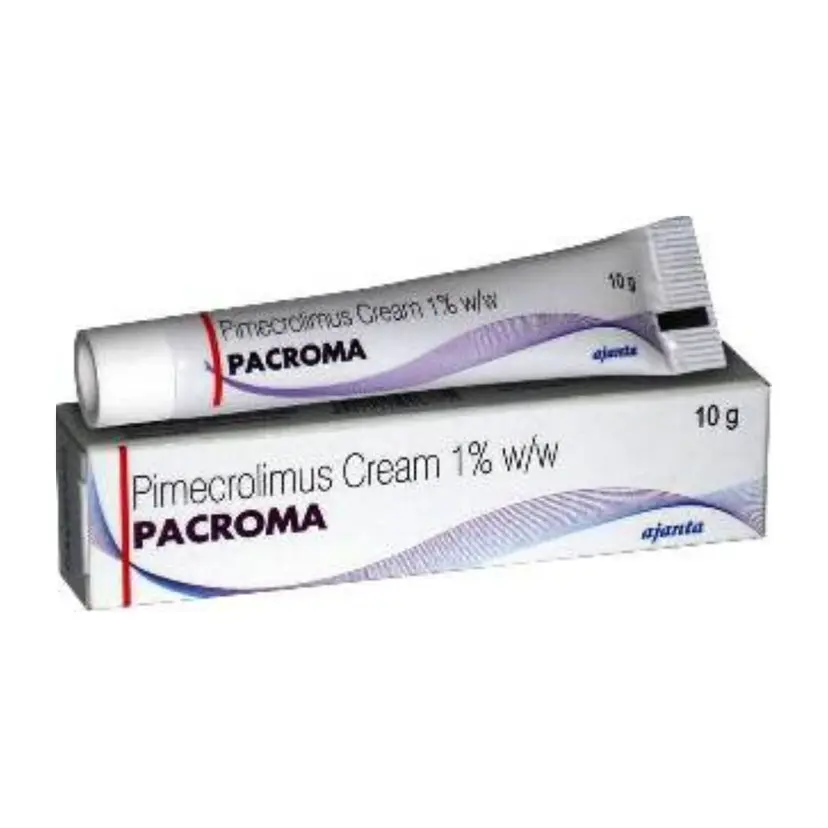

Pimecrolimus
1%
Pacroma is indicated for the treatment of Psoriasis & Vitiligo
Commonly reported side effects of pimecrolimus topical include: application site reaction and localized burning.
Potential interactions between Elidel and other drugs, including immunizations, have not been systematically evaluated. Due to the very low blood levels of pimecrolimus detected in some patients after topical application, systemic drug interactions are not expected, but cannot be ruled out. The concomitant administration of known CYP3A family of inhibitors in patients with widespread and/or erythrodermic disease should be done with caution. Some examples of such drugs are erythromycin, itraconazole, ketoconazole, fluconazole, calcium channel blockers and cimetidine
Pimecrolimus is a lipophilic anti-inflammatory ascomycin macrolactam derivative and a cell selective inhibitor of the production and release of pro-inflammatory cytokines. Pimecrolimus binds with high affinity to macrophilin-12 and inhibits the calcium-dependent phosphatase calcineurin. As a consequence, it blocks the synthesis of inflammatory cytokines in T cells. Pimecrolimus exhibits high anti-inflammatory activity in animal models of skin inflammation after topical and systemic application. In the pig model of allergic contact dermatitis, topical pimecrolimus is as effective as potent corticosteroids. Unlike corticosteroids, pimecrolimus does not cause skin atrophy in pigs and does not affect Langerhans´cells in murine skin. Pimecrolimus neither impairs the primary immune response nor affects lymph nodes in murine allergic contact dermatitis. Topical pimecrolimus penetrates similarly into, but permeates much less through human skin than corticosteroids, indicating a very low potential of pimecrolimus for systemic absorption. In conclusion, pimecrolimus has a skin-selective pharmacological profile different from corticosteroids.
No evidence of skin mediated drug metabolism was identified in vivo using the minipig or in vitro using stripped human skin; so half life of Topical Pimecrolimus in Pacroma is not applicable
Absorption in adults The highest pimecrolimus blood concentration after systemic exposure was 1.4 ng/ml. Metabolism No metabolism of pimecrolimus was observed in human skin in vitro. Excretion Active substance-related radioactivity was excreted principally via the faeces (78.4%) and only a small fraction (2.5%) was recovered in urine.
Pregnancy There are no adequate data from the use of Pimecrolimus in pregnant women. Animal studies using dermal application do not indicate direct or indirect harmful effects with respect to embryonal/fetal development. Studies in animals after oral application have shown reproductive toxicity. Based on the minimal extent of pimecrolimus absorption after topical application of Pimecrolimus, the potential risk for humans is considered limited. However, Pimecrolimus should not be used during pregnancy. Lactation Animal studies on milk excretion after topical application were not conducted and the use of Pimecrolimus in breastfeeding women has not been studied. It is not known whether pimecrolimus is excreted in the milk after topical application. However, based on the minimal extent of pimecrolimus absorption after topical application of Pimecrolimus, the potential risk for humans is considered limited. Caution should be exercised when Pimecrolimus is administered to breastfeeding women. Breastfeeding mothers may use Pimecrolimus but should not apply Pimecrolimus to the breast in order to avoid unintentional oral uptake by the newborn.
Subscribe to our newsletter and be the first to receive insights, updates, and expert tips on optimizing your financial management.