Searching...
Can't find what you're looking for. Try different keywords.


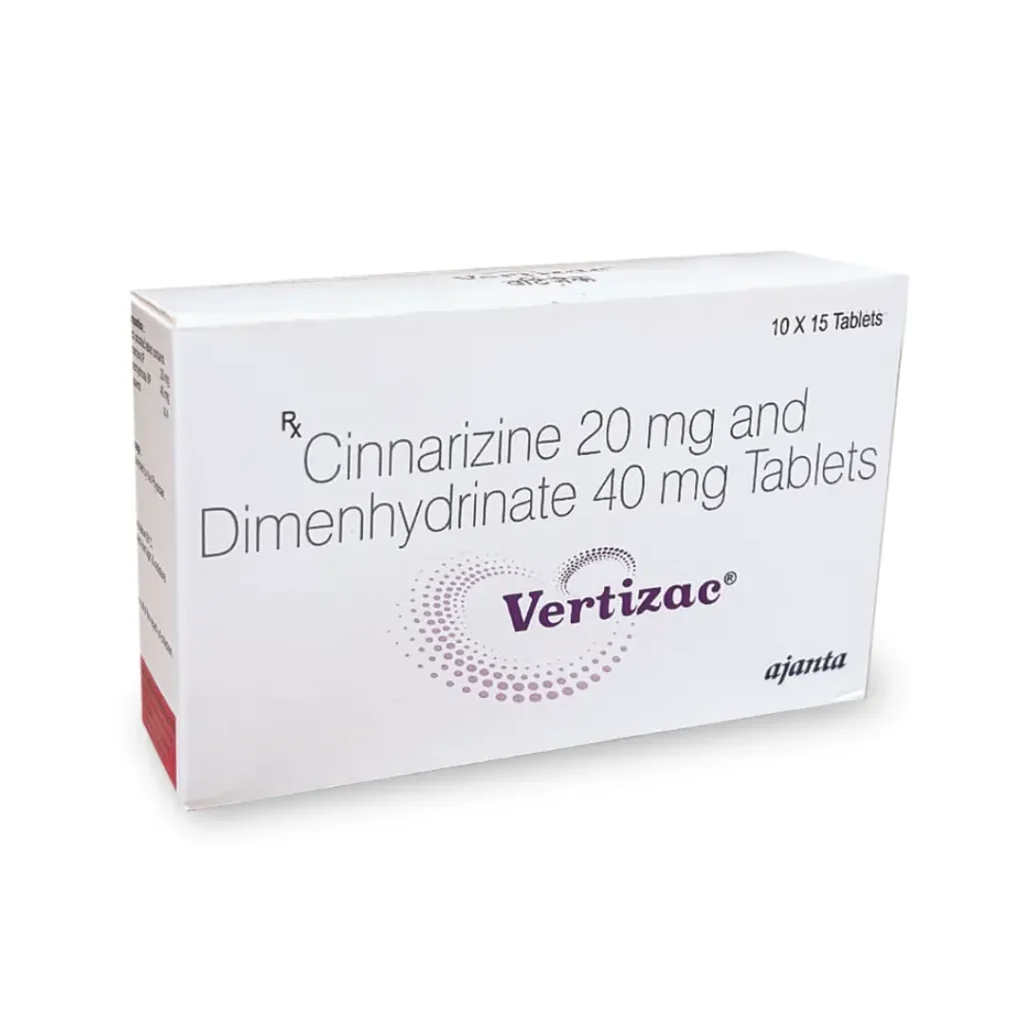

Cinnarizine
20mg
Dimenhydrinate
40mg tablets
Dosage Form & Strength
One tablet three times daily
Vertizac is indicated for the symptomatic treatment of vertigo
The most frequently occurring adverse effects are somnolence (including drowsiness, tiredness, fatigue, daze) occurring in about 8% of patients and dry mouth occuring in about 5% of patients in clinical trials. These reactions are usually mild and disappear within a few days even if treatment is continued.
Dimenhydrinate, the chlorotheophylline salt of diphenhydramine, acts as antihistamine with anticholinergic (antimuscarinic) properties, exerting parasympatholytic and centrallydepressant effects The substance exhibits anti-emetic and antivertiginous effects through influencing the chemoreceptor trigger zone in the region of the 4th ventricle Dimenhydrinate thus acts predominantly on the central vestibular system Due to its calcium antagonistic properties, cinnarizine acts mainly as a vestibular sedative through inhibition of the calcium influx into the vestibular sensory cells. Cinnarizine thus acts predominantly on the peripheral vestibular system Both cinnarizine and dimenhydrinate are known to be effective in the treatment of vertigo The combination product is more effective than the individual compounds in the population studied
The half life of Betahistine in Vertizac is 3.5 hours; half lif of Cinnarizine in Vertizac is 3.4–60 hours depending on age
Absorption and distribution: Dimenhydrinate rapidly releases its diphenhydramine moiety after oral administration. Diphenhydramine and cinnarizine are rapidly absorbed from the gastro-intestinal tract. Maximum plasma concentrations (Cmax) of cinnarizine and diphenhydramine are reached in humans within 2 – 4 hours. The plasma elimination half-lives of both substances range from 4 to 5 hours, when given either alone or as the combination product. Metabolism: Cinnarizine and diphenhydramine are extensively metabolised in the liver. The metabolism of cinnarizine involves ring hydroxylation reactions that are in part catalysed by CYP2D6 and Ndesalkylation reactions of low CYP-enzyme specificity. The main pathway in the diphenhydramine metabolism is the sequential N-demethylation of the tertiary amine. Studies in human liver microsomes in vitro indicate the involvement of various CYP-enzymes, including CYP2D6. Elimination: Cinnarizine is mainly eliminated via the faeces (40-60%) and to a lower extent also in urine, mainly in the form of metabolites conjugated with glucuronic acid. The major route of elimination of diphenhydramine is in the urine, mainly in the form of metabolites, with the deaminated compound, diphenylmethoxy acetic acid, being the predominant metabolite (40-60%).
Pregnancy: The safety of Vertizac in human pregnancy has not been established. Animal studies are insufficient with respect to effects on pregnancy, embryonal/foetal development and postnatal development. The teratogenic risk of the single actives dimenhydrinate/diphenhydramine and cinnarizine is low. No teratogenic effects were observed in animal studies. Dimenhydrinate may have an oxytocic effect and may shorten labour. Vertizac should not be used during pregnancy. Lactation: Dimenhydrinate and cinnarizine are excreted in human breast milk. Vertizac should not be taken by women who are breast feeding.
Renal Impairement: Vertizac should be used with caution in patients with mild to moderate renal impairment. Vertizac should not be used by patients with a creatinine clearance of < 25mL/min (severe renal impairment).
Hepatic impairment: No studies in patients with hepatic impairment are available. Vertizac should not be used by patients with severe hepatic impairment.
Children and adolescents under the age of 18 years: Vertizac is not recommended in children and adolescents under the age of 18 years because there are no data available on the use of Vertizac in this age group.
Elderly: Dosage as for adults.
Subscribe to our newsletter and be the first to receive insights, updates, and expert tips on optimizing your financial management.