Searching...
Can't find what you're looking for. Try different keywords.


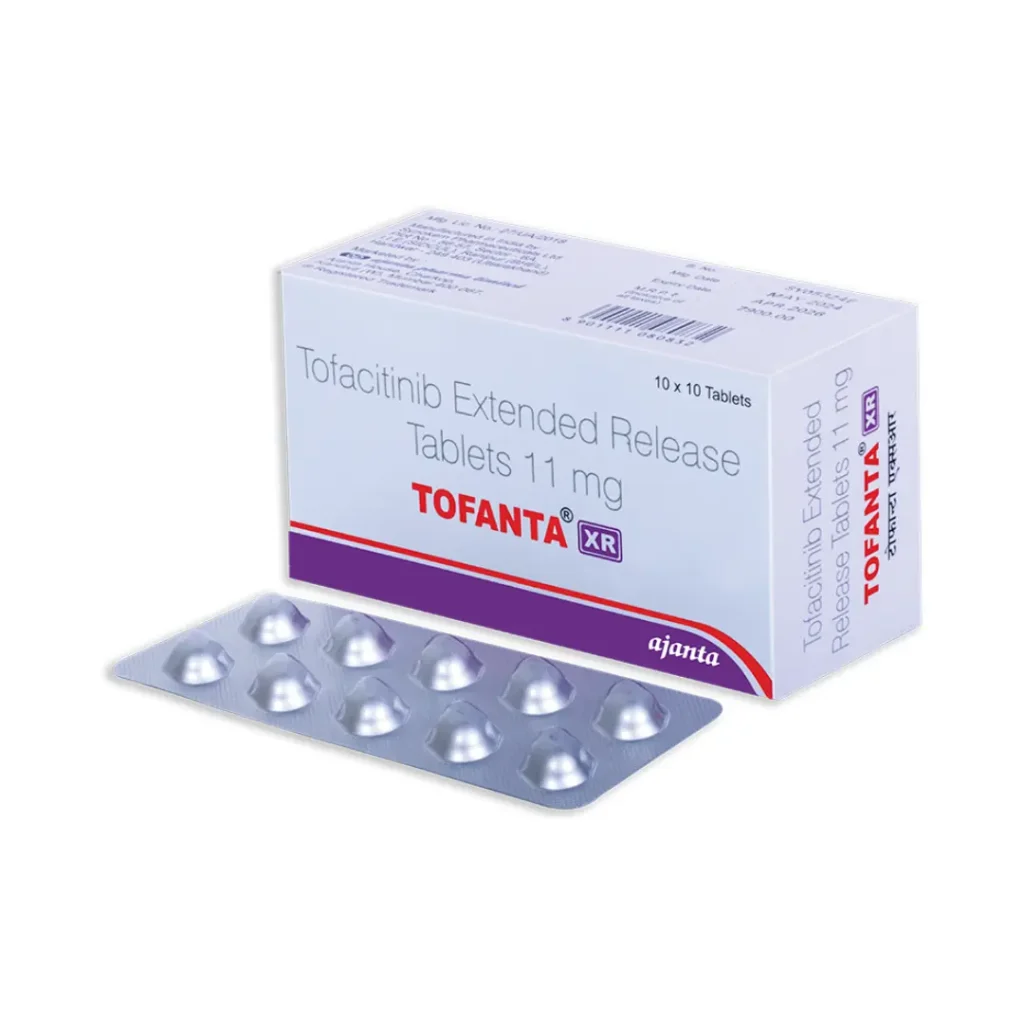
Rheumatoid arthritis and psoriatic arthritis The recommended dose is 5 mg administered twice daily, which should not be exceeded. Rheumatoid arthritis- Switching between 5mg to 11mg PR Patients treated with tofacitinib 5 mg film-coated tablets twice daily may be switched to tofacitinib 11 mg prolonged-release tablets once daily on the day following the lastdose of tofacitinib 5 mg film-coated tablets. Patients treated with tofacitinib 11 mg prolonged-release tablets once daily may be switched to tofacitinib 5 mg film-coated tablets twice daily on the day following the lastdose of tofacitinib 11 mg prolonged-release tablets.
Contraindicated in pregnancy and lactation, severe hepatic impairment No dose adjustment in mild and moderate renal impairment. In Sever renal imairment, dose should be reduced to 5 mg once daily when the indicated dosein the presence of normal renal function is 5 mg twice daily. Dose should be reduced to 5 mg twice daily when the indicateddose in the presence of normal renal function is 10 mg twice daily. Patients with severe renal impairment (including patients undergoing haemodialysis) should remain on a reduced dose even after haemodialysis
Tofanta is indicated for the treatment of Rheumatoid and Psoriatic arthritis
The most commonly reported adverse reactions during the first 3 months in controlled clinical trials (occurring in greater than or equal to 2% of patients treated with tofacitinib monotherapy or in combination with DMARDs) were upper respiratory tract infections, headache, diarrhea and nasopharyngitis.
Potent inhibitors of Cytochrome P450 3A4 (CYP3A4) (e.g., ketoconazole): Reduce dose to 5 mg once daily.One or more concomitant medications that result in both moderate inhibition of CYP3A4 and potent inhibition of CYP2C19 (e.g., fluconazole): Reduce dose to 5 mg once daily. Potent CYP inducers (e.g., rifampin): May result in loss of or reduced clinical response
Tofanta (Tofacitinib) is an inhibitor of Janus kinases, a group of intracellular enzymes involved in signalling pathways that affect hematopoiesis and immune cell function. Tofanta (Tofacitinib) is a partial and reversible janus kinase (JAK) inihibitor that will prevent the body from responding to cytokine signals. By inhibiting JAKs, tofacitinib prevents the phosphorylation and activation of STATs. The JAK-STAT signalling pathway is involved in the transcription of cells involved in hematopoiesis, and immune cell function. Tofacitinib works therapeutically by inhibiting the JAK-STAT pathway to decrease the inflammatory response.
The PK profile of tofacitinib is characterised by rapid absorption (peak plasma concentrations are reached within 0.5-1 hour), rapid elimination (half-life of ~3 hours) and dose-proportional increases in systemic exposure. Steady state concentrations are achieved in 24-48 hours with negligible accumulation after twice daily administration. Tofacitinib is well-absorbed, with an oral bioavailability of 74%. Coadministration of tofacitinib with a high-fat meal resulted in no changes in AUC while C was reducedby 32%. Clearance mechanisms for tofacitinib are approximately 70% hepatic metabolism and 30% renal excretion of the parent drug. The metabolism of tofacitinib is primarilymediated by CYP3A4 with minor contribution from CYP2C19.
Preganacy:Contraindicated Breast-feeding : Contraindicated Fertility: Tofacitinib impaired female fertility but not male fertility
Renal Impairement: Dose adjustment for renal impairment Mild (50-80 mL/min) No dose adjustment required. Moderate (30-49 mL/min) No dose adjustment required. Severe (includingpatients undergoinghaemodialysis) < 30 mL/min Dose should be reduced to 5 mg once daily when the indicated dosein the presence of normal renal function is 5 mg twice daily. Dose should be reduced to 5 mg twice daily when the indicateddose in the presence of normal renal function is 10 mg twice daily. Patients with severe renal impairment should remain on a reduce ddose even after haemodialysis
Mild-No dose adjustment required. Moderate-Dose should be reduced to 5 mg once daily when the indicated dosein the presence of normal hepatic function is 5 mg twice daily. Dose should be reduced to 5 mg twice daily when the indicateddose in the presence of normal hepatic function is 10 mg twice daily. Severe-Tofacitinib should not be used in patients with severe hepaticimpairment
Paediatric population The safety and efficacy of tofacitinib in children aged 0 to less than 18 years have not been established.
No dose adjustment is required in patients aged 65 years and older. There are limited data in patients aged 75 years and older.
Subscribe to our newsletter and be the first to receive insights, updates, and expert tips on optimizing your financial management.