Searching...
Can't find what you're looking for. Try different keywords.


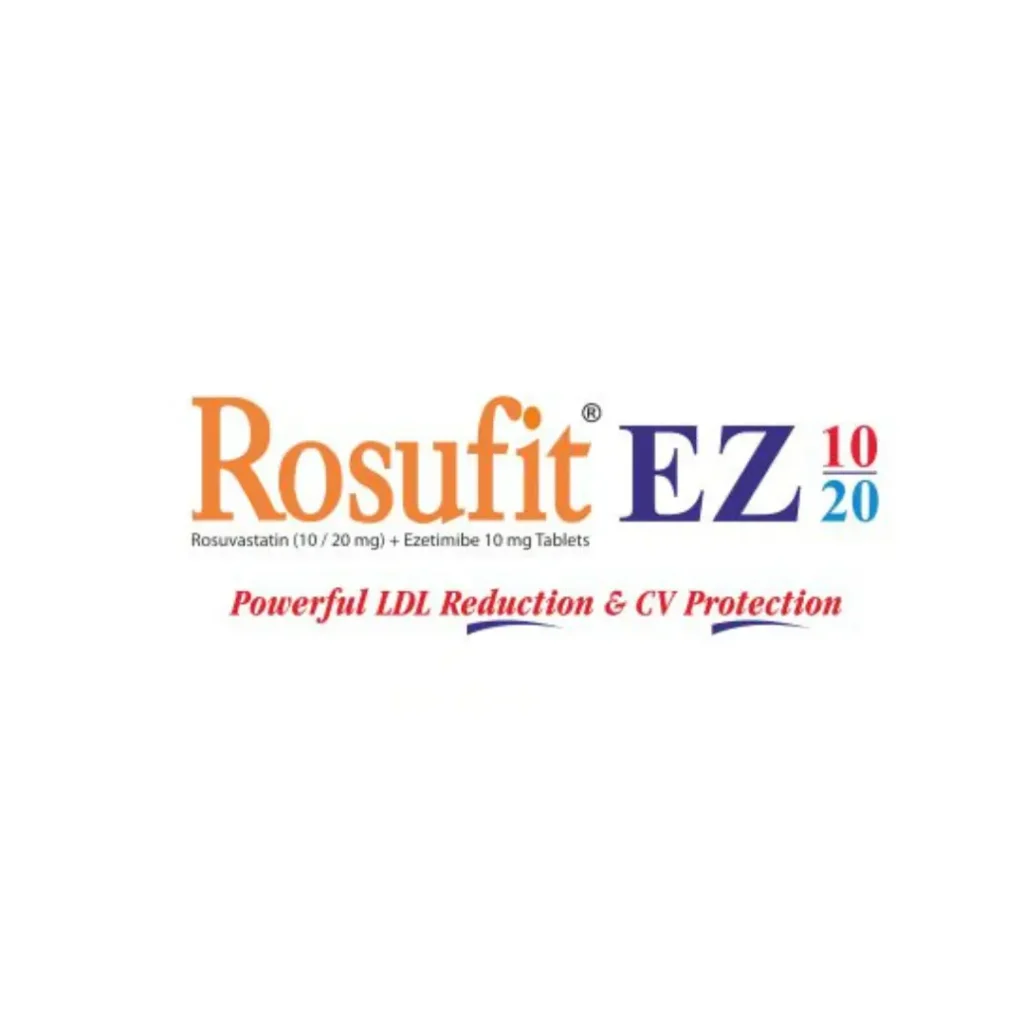

Rosuvastatin Calcium IP Equivalent to Rosuvastatin
10 mg
Ezetimibe IP
10 mg
Dosage Form & Strength
The recommended dosage is 1 tablet once daily or as directed by the Physician.
For the treatment of patients with primary hypercholesterolemia.
Ezetimibe & Rosuvastatin is contraindicated in patients with: ● in patients with hypersensitivity to the active substances (rosuvastatin, ezetimibe) or to any of the excipients listed. · in patients with active liver disease including unexplained, persistent elevations of serum transaminases and any serum transaminase elevation exceeding 3 times the upper limit of normal (ULN). · in patients with severe renal impairment (creatinine clearance <30 ml/min). · in patients with myopathy. · in patients receiving concomitant combination of sofosbuvir/velpatasvir/voxilaprevir · in patients receiving concomitant ciclosporin. · during pregnancy and lactation and in women of childbearing potential not using appropriate contraceptive measures.
● Myopathy and Rhabdomyolysis ● Hepatic Dysfunction
Myopathy and Rhabdomyolysis Ezetimibe & Rosuvastatin may cause myopathy (muscle pain, tenderness, or weakness with creatine kinase [CK] above ten times the upper limit of normal) and rhabdomyolysis. Acute kidney injury secondary to myoglobinuria and rare fatalities have occurred as a result of rhabdomyolysis with statins, including rosuvastatin. Risk Factors for Myopathy Risk factors for myopathy include age 65 years or greater, uncontrolled hypothyroidism, renal impairment, concomitant use with certain other drugs including other lipid-lowering therapies, and higher Ezetimibe & Rosuvastatin dosage; Asian patients on Ezetimibe & Rosuvastatin may be at higher risk for myopathy. The myopathy risk is greater in patients taking Ezetimibe & Rosuvastatin 40 mg/10 mg daily compared with lower Ezetimibe & Rosuvastatin dosages.Hepatic Dysfunction Increases in serum transaminases have occurred with rosuvastatin. In most cases, the elevations appeared soon after initiation, were transient, were not accompanied by symptoms, and resolved or improved on continued therapy or after a brief interruption in therapy. In a pooled analysis of placebocontrolled trials, increases in serum transaminases to more than three times the ULN occurred in 1.1% of patients taking rosuvastatin versus 0.5% of patients treated with placebo. Marked persistent increases of hepatic transaminases have also occurred with rosuvastatin. There have been rare postmarketing reports of fatal and non-fatal hepatic failure in patients taking statins, including rosuvastatin. Patients who consume substantial quantities of alcohol and/or have a history of liver disease may be at increased risk for hepatic injury. Consider liver enzyme testing before Ezetimibe & Rosuvastatin initiation and thereafter, when clinically indicated. Ezetimibe & Rosuvastatin is contraindicated in patients with acute liver failure or decompensated cirrhosis.
Avoid concomitant use of cyclosporine or gemfibrozil with Ezetimibe & Rosuvastatin.Cyclosporine increased rosuvastatin exposure 7-fold. In addition, ezetimibe and cyclosporine used concomitantly can increase exposure to both ezetimibe and cyclosporine. Gemfibrozil significantly increased rosuvastatin exposure and gemfibrozil may cause myopathy when given alone. The risk of myopathy and rhabdomyolysis is increased with concomitant use of cyclosporine or gemfibrozil with Ezetimibe & Rosuvastatin.Rosuvastatin plasma levels were significantly increased with concomitant administration of many anti-viral drugs, which increases the risk of myopathy and rhabdomyolysis.Fibrates may cause myopathy when given alone. The risk of myopathy and rhabdomyolysis is increased with concomitant use of fibrates with Ezetimibe & Rosuvastatin.Consider if the benefit of using fibrates concomitantly with Ezetimibe & Rosuvastatin outweighs the increased risk of myopathy and rhabdomyolysis.Cases of myopathy and rhabdomyolysis have occurred with concomitant use of niacin with rosuvastatin. Consider if the benefit of using niacin concomitantly with Ezetimibe & Rosuvastatin outweighs the increased risk of myopathy and rhabdomyolysis
Rosuvastatin Rosuvastatin is an inhibitor of HMG CoA-reductase, the rate-limiting enzyme that converts 3-hydroxy3-methylglutaryl coenzyme A to mevalonate, a precursor of cholesterol. In in vivo and in vitro studies, rosuvastatin produces its lipid-modifying effects in two ways. First, it increases the number of hepatic LDL receptors on the cell-surface to enhance uptake and catabolism of LDL. Second, rosuvastatin inhibits hepatic synthesis of VLDL, which reduces the total number of VLDL and LDL particles. Ezetimibe The molecular target of ezetimibe is the sterol transporter, Niemann-Pick C1-Like 1 (NPC1L1), which is involved in the intestinal uptake of cholesterol and phytosterols. Ezetimibe localizes at the brush border of the small intestine and inhibits the absorption of cholesterol, leading to a decrease in the delivery of intestinal cholesterol to the liver. This causes a reduction of hepatic cholesterol stores and an increase in clearance of cholesterol from the blood.
The elimination half-life (t1/2) of rosuvastatin is approximately 19 hours.Ezetimibe is primarily metabolized in the small intestine and liver via glucuronide conjugation with subsequent biliary and renal excretion. Minimal oxidative metabolism has been observed in all species evaluated. In humans, ezetimibe is rapidly metabolized to ezetimibe-glucuronide. Ezetimibe and ezetimibe- glucuronide are the major drug-derived compounds detected in plasma, constituting approximately 10 to 20% and 80 to 90% of the total drug in plasma, respectively. Both ezetimibe and ezetimibe-glucuronide are eliminated from plasma with a half-life of approximately 22 hours for both ezetimibe and ezetimibe- glucuronide.
Absorption: Rosuvastatin In clinical pharmacology studies in man, peak plasma concentrations of rosuvastatin were reached 3 to 5 hours following oral dosing. Both Cmax and AUC increased in approximate proportion to rosuvastatin dose. The absolute bioavailability of rosuvastatin is approximately 20%. The AUC of rosuvastatin does not differ following evening or morning drug administration. Administration of rosuvastatin with food did not affect the AUC of rosuvastatin. Ezetimibe After oral administration, ezetimibe is absorbed and extensively conjugated to a pharmacologically active phenolic glucuronide (ezetimibeglucuronide). After a single 10-mg dose of ezetimibe to fasted adults, mean ezetimibe peak plasma concentrations (Cmax) of 3.4 to 5.5 ng/mL were attained within 4 to 12 hours (Tmax). Ezetimibe-glucuronide mean Cmax values of 45 to 71 ng/mL were achieved between 1 and 2 hours (Tmax). There was no substantial deviation from dose proportionality between 5 and 20 mg. The absolute bioavailability of ezetimibe cannot be determined, as the compound is virtually insoluble in aqueous media suitable for injection. Concomitant food administration (high-fat or non-fat meals) had no effect on the extent of absorption of ezetimibe when administered as ezetimibe 10-mg tablets. The Cmax value of ezetimibe was increased by 38% with consumption of high-fat meals. Bioavailability: The absolute bioavailability of rosuvastatin is approximately 20%.The absolute bioavailability of ezetimibe cannot be determined, as the compound is virtually insoluble in aqueous media suitable for injection. Metabolism: Rosuvastatin is not extensively metabolized; approximately 10% of a radiolabeled dose is recovered as metabolite. The major metabolite is Ndesmethyl rosuvastatin, which is formed principally by cytochrome P450\ 2C9, and in vitro studies have demonstrated that N-desmethyl rosuvastatin has approximately one-sixth to one-half the HMG-CoA reductase inhibitory activity of the parent compound. Overall, greater than 90% of active plasma HMG-CoA reductase inhibitory activity is accounted for by the parent compound.Ezetimibe is primarily metabolized in the small intestine and liver via glucuronide conjugation with subsequent biliary and renal excretion. Minimal oxidative metabolism has been observed in all species evaluated. In humans, ezetimibe is rapidly metabolized to ezetimibe-glucuronide. Ezetimibe and ezetimibe- glucuronide are the major drug-derived compounds detected in plasma, constituting approximately 10 to 20% and 80 to 90% of the total drug in plasma, respectively. Excretion: Following oral administration, rosuvastatin and its metabolites are primarily excreted in the feces (90%).Ezetimibe was the major component in feces and accounted for 69% of the administered dose, while ezetimibe-glucuronide was the major component in urine and accounted for 9% of the administered dose.
Subscribe to our newsletter and be the first to receive insights, updates, and expert tips on optimizing your financial management.