Searching...
Can't find what you're looking for. Try different keywords.


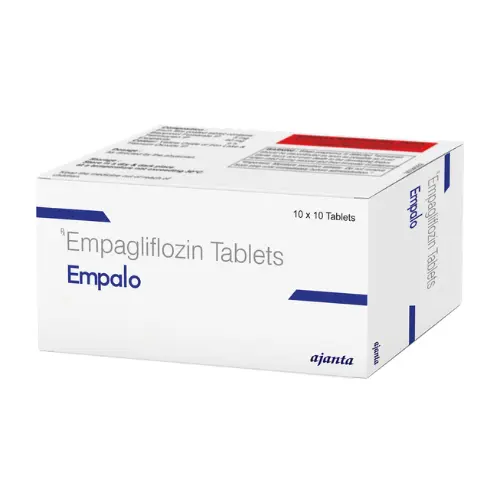

Empalo 10 Empagliflozin
10 mg
Empalo 25 Empagliflozin
25 mg
The recommended dose of Empalo is 10 mg once daily in the morning, taken with or without food. For additional glycemic control, the dose may be increased to 25 mg in patients tolerating Empalo.
Empalo is not recommended when breastfeeding Half-Life: The apparent terminal elimination half-life of empagliflozin was estimated to be 12.4 h
1. As an adjunct to diet and exercise to improve glycemic control in adults with type 2 diabetes Mellitus. 2. To reduce the risk of cardiovascular death and hospitalization for heart failure in adults with heart failure. 3. To reduce the risk of cardiovascular death in adults with type 2 diabetes mellitus and established cardiovascular disease.
1. Hypersensitivity to empagliflozin or any of the excipients in Empalo 2. Patient on dialysis 3. Empalo is not recommended in patients with an eGFR less than 30 mL/min/1.73m2.
1. Urinary tract infections 2. Female genital mycotic infections 3. Ketoacidosis 4. Volume depletion 5. Urosepsis and Pyelonephritis 6. Hypoglycemia with concomitant use with Insulin and Insulin Secretagogues 7. Necrotizing Fasciitis of the Perineum (Fournier’s Gangrene) 8. Hypersensitivity Reactions
1. Ketoacidosis: Assess patients who present with signs and symptoms of metabolic acidosis for ketoacidosis, regardless of blood glucose level. If suspected, discontinue Empalo, evaluate and treat promptly. Before initiating Empalo, consider risk factors for ketoacidosis. Patients on Empalo may require monitoring and temporary discontinuation of therapy in clinical situations known to predispose to ketoacidosis. 2. Volume Depletion: Before initiating Empalo, assess volume status and renal function in patients with impaired renal function, elderly patients, or patients on loop diuretics. Monitor for signs and symptoms during therapy. 3. Urosepsis and Pyelonephritis: Evaluate patients for signs and symptoms of urinary tract infections and treat promptly, if indicated. 4. Hypoglycemia: Consider lowering the dose of insulin secretagogue or insulin to reduce the risk of hypoglycemia when initiating Empalo. 5. Necrotizing Fasciitis of the Perineum (Fournier’s Gangrene): Serious life-threatening cases have occurred in both females and males. Assess patients presenting with pain or tenderness, erythema, or swelling in the genital or perineal area, along with fever or malaise. If suspected, institute prompt treatment. 6. Genital Mycotic Infections: Monitor and treat as appropriate 7. Hypersensitivity Reactions: Serious hypersensitivity reactions (e.g., angioedema) have occurred with Empalo. If hypersensitivity reactions occur, discontinue Empalo, treat promptly, and monitor until signs and symptoms resolve.
1. Diuretics: Coadministration of empagliflozin with diuretics resulted in increased urine volume and frequency of voids, which might enhance the potential for volume depletion. 2. Insulin or Insulin Secretagogues: The risk of hypoglycemia is increased when empagliflozin is used in combination with insulin secretagogues (e.g., sulfonylurea) or insulin. 3. Positive Urine Glucose Test: SGLT2 inhibitors increase urinary glucose excretion and will lead to positive urine glucose tests. 4. Interference with 1,5-anhydroglucitol Assay Measurements of 1,5-AG are unreliable in assessing glycemic control in patients taking SGLT2 inhibitors.
Empagliflozin: Empagliflozin is an inhibitor of the sodium-glucose co-transporter 2 (SGLT2), the predominant transporter responsible for reabsorption of glucose from the glomerular filtrate back into the circulation. By inhibiting SGLT2, empagliflozin reduces renal reabsorption of filtered glucose and lowers the renal threshold for glucose, and thereby increases urinary glucose excretion. Empagliflozin also reduces sodium reabsorption and increases the delivery of sodium to the distal tubule. This may influence several physiological functions such as lowering both pre-and afterload of the heart and downregulating sympathetic activity.
Empagliflozin: 1. Absorption After oral administration, peak plasma concentrations of empagliflozin were reached at 1.5 hours post-dose. Systemic exposure of empagliflozin increased in a dose proportional manner in the therapeutic dose range. The single-dose and steady-state pharmacokinetic parameters of empagliflozin were similar, suggesting linear pharmacokinetics with respect to time. Empagliflozin may be administered with or without food. 2. Distribution: The apparent steady-state volume of distribution was estimated to be 73.8 L based on a population pharmacokinetic analysis. Following administration of an oral [14C]-empagliflozin solution to healthy subjects, the red blood cell partitioning was approximately 36.8% and plasma protein binding was 86.2%. 3. Metabolism: No major metabolites of empagliflozin were detected in human plasma and the most abundant metabolites were three glucuronide conjugates (2-O-, 3-O-, and 6-O-glucuronide). Systemic exposure of each metabolite was less than 10% of total drug-related material. In vitro studies suggested that the primary route of metabolism of empagliflozin in humans is glucuronidation by the uridine 5′-diphospho glucuronosyltransferases UGT2B7, UGT1A3, UGT1A8, and UGT1A9. 4. Excretion: The apparent terminal elimination half-life of empagliflozin was estimated to be 12.4 h. Following administration of an oral [14C]-empagliflozin solution to healthy subjects, approximately 95.6% of the drug-related radioactivity was eliminated in feces (41.2%) or urine (54.4%).
Absorption: After oral administration, peak plasma concentrations of empagliflozin were reached at 1.5 hours post-dose. Systemic exposure of empagliflozin increased in a doseproportional manner in the therapeutic dose range. The single-dose and steady-state pharmacokinetic parameters of empagliflozin were similar, suggesting linear pharmacokinetics with respect to time. Empagliflozin may be administered with or without food. —x-x— Bioavailability: The absolute oral bioavailability of empagliflozin is approximately 78%. —x-x— Metabolism: No major metabolites of empagliflozin were detected in human plasma and the most abundant metabolites were three glucuronide conjugates (2-O-, 3-O-, and 6-O-glucuronide). Systemic exposure of each metabolite was less than 10% of total drug-related material. In vitro studies suggested that the primary route of metabolism of empagliflozin in humans is glucuronidation by the uridine 5′- —x-x— Excretion: The apparent terminal elimination half-life of empagliflozin was estimated to be 12.4 h. Following administration of an oral [14C]-empagliflozin solution to healthy subjects, approximately 95.6% of the drug-related radioactivity was eliminated in feces (41.2%) or urine (54.4%).
Advise females of the potential risk to a fetus especially during the second and third trimesters
The glucose lowering benefit of Empagliflozin 25 mg decreases in patients with worsening renal function. The risks of renal impairment, volume depletion adverse reactions and urinary tract infection-related adverse reactions increases with worsening renal function
Empalo may be used in patients with hepatic impairment.
The safety and effectiveness of Empalo have not been established in pediatric patients.
Empalo is expected to have diminished glycemic efficacy in elderly patients with renal impairment. The safety and efficacy of Empalo is similar for patients 65 years and younger and those older than 65 years.
Subscribe to our newsletter and be the first to receive insights, updates, and expert tips on optimizing your financial management.