Searching...
Can't find what you're looking for. Try different keywords.


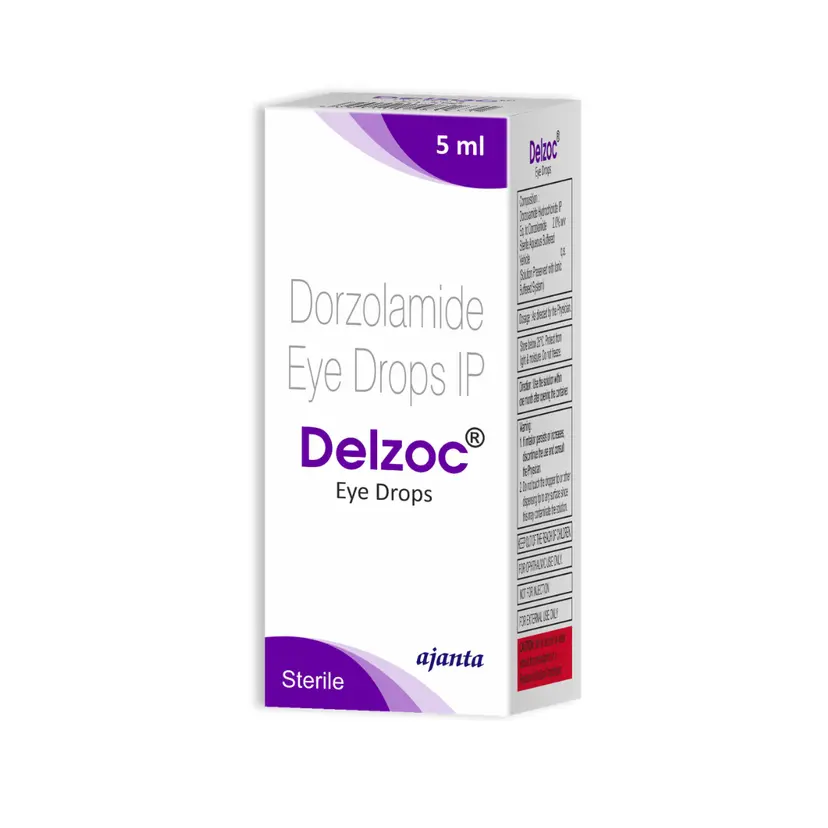

Dorzolamide
20 mg/ml Eye Drops
The dose is one drop of Dorzolamide Ophthalmic Solution in the affected eye(s) three times daily. Dorzolamide may be used concomitantly with other topical ophthalmic drug products to lower intraocular pressure. If more than one topical ophthalmic drug is being used, the drugs should be administered at least ten minutes apart.
‘Dorzolamide’ is indicated: • as adjunctive therapy to beta-blockers, • as monotherapy in patients unresponsive to beta-blockers or in whom beta-blockers are contraindicated, In the treatment of elevated intra-ocular pressure in: • ocular hypertension, • open angle glaucoma, • pseudoexfoliative glaucoma.
Hypersensitivity to the active substance or to any of the excipients Dorzolamide has not been studied in patients with severe renal impairment (CrCl < 30 ml/min) or with hyperchloraemic acidosis. Because dorzolamide and its metabolites are excreted predominantly by the kidney, dorzolamide is therefore contra-indicated in such patients.
The most frequent adverse events associated with Dorzoloamide were ocular burning, stinging, or discomfort immediately following ocular administration (approximately one-third of patients). Approximately one-quarter of patients noted a bitter taste following administration
Dorzolamide is a sulfonamide and, although administered topically, is absorbed systemically. Therefore, the same types of adverse reactions that are attributable to sulfonamides may occur with topical administration with Dorzolamide. Fatalities have occurred, although rarely, due to severe reactions to sulfonamides including Stevens-Johnson syndrome, toxic epidermal necrolysis, fulminant hepatic necrosis, agranulocytosis, aplastic anemia, and other blood dyscrasias. Sensitization may recur when a sulfonamide is readministered irrespective of the route of administration. If signs of serious reactions or hypersensitivity occur, discontinue the use of this preparation.
Specific drug interaction studies have not been performed with dorzolamide. In clinical studies, dorzolamide was used concomitantly with the following medications without evidence of adverse interactions: timolol ophthalmic solution, betaxolol ophthalmic solution and systemic medications, including ACE-inhibitors, calcium-channel blockers, diuretics, non-steroidal anti-inflammatory drugs including aspirin, and hormones (e.g. oestrogen, insulin, thyroxine). Association between dorzolamide and miotics and adrenergic agonists has not been fully evaluated during glaucoma therapy.
Carbonic anhydrase (CA) is an enzyme found in many tissues of the body including the eye. In humans, carbonic anhydrase exists as a number of isoenzymes, the most active being carbonic anhydrase II (CA-II) found primarily in red blood cells (RBCs) but also in other tissues. Inhibition of carbonic anhydrase in the ciliary processes of the eye decreases aqueous humor secretion. The result is a reduction in intra-ocular pressure (IOP). Dorzolamide 20mg/ml Eye Drops Solution BP contains dorzolamide hydrochloride, a potent inhibitor of human carbonic anhydrase II.
Unlike oral carbonic anhydrase inhibitors, topical administration of dorzolamide hydrochloride allows for the active substance to exert its effects directly in the eye at substantially lower doses and therefore with less systemic exposure. In clinical trials, this resulted in a reduction in IOP without the acid-base disturbances or alterations in electrolytes characteristic of oral carbonic anhydrase inhibitors. When topically applied, dorzolamide reaches the systemic circulation. To assess the potential for systemic carbonic anhydrase inhibition following topical administration, active substance and metabolite concentrations in red blood cells (RBCs) and plasma and carbonic anhydrase inhibition in RBCs were measured. Dorzolamide accumulates in RBCs during chronic dosing as a result of selective binding to CA-II while extremely low concentrations of free active substance in plasma are maintained. The parent active substance forms a single N-desethyl metabolite that inhibits CA-II less potently than the parent active substance but also inhibits a less active isoenzyme (CA-I). The metabolite also accumulates in RBCs where it binds primarily to CA-I. Dorzolamide binds moderately to plasma proteins (approximately 33%). Dorzolamide is primarily excreted unchanged in the urine; the metabolite is also excreted in urine. After dosing ends, dorzolamide washes out of RBCs non linearly, resulting in a rapid decline of active substance concentration initially, followed by a slower elimination phase with a half-life of about four months. When dorzolamide was given orally to simulate the maximum systemic exposure after long-term topical ocular administration, steady state was reached within 13 weeks. At steady state, there was virtually no free active substance or metabolite in plasma; CA inhibition in RBCs was less than that anticipated to be necessary for a pharmacological effect on renal function or respiration. Similar pharmacokinetic results were observed after chronic, topical administration of dorzolamide. However, some elderly patients with renal impairment (estimated CrCl 30-60 ml/min) had higher metabolite concentrations in RBCs, but no meaningful differences in carbonic anhydrase inhibition, and no clinically significant systemic side effects were directly attributable to this finding.
Subscribe to our newsletter and be the first to receive insights, updates, and expert tips on optimizing your financial management.