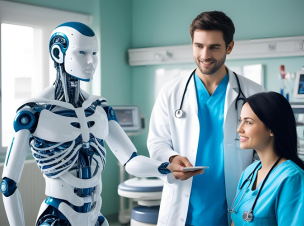
Artificial Intelligence (AI) is making a big splash in healthcare, helping doctors from make more accurate diagnoses to predicting patient outcomes and even streamlining administrative tasks, AI is becoming an important part of clinical practice. It’s like having a super-smart assistant that works behind the scenes to improve patient care, speed up treatments, and make healthcare more efficient. While the potential is exciting, there are also challenges to navigate, like ensuring data privacy and avoiding biases in AI models. But overall, the role of AI in healthcare is quickly growing and shaping the future of medicine.
Rapid advancement of AI technology is opening up exciting possibilities for its use in clinical practice, offering the potential to revolutionize healthcare services. As AI continues to evolve, it’s crucial to stay up-to-date on its role and gain the knowledge needed for effective implementation.
Let’s explore how AI can enhance various aspects of clinical practice:
AI in Diagnostics
AI algorithms, especially machine learning (ML) models, are making waves in healthcare by analysing medical images like X-rays, CT scans, and MRIs. They help spot early signs of diseases such as cancer, heart conditions, and neurological disorders. These AI systems are great at picking up on subtle patterns in images that might be overlooked by the human eye, making diagnoses quicker and more accurate. This means doctors can catch potential health issues earlier and act faster, ultimately improving patient outcomes.
A study conducted in South Korea compared AI’s ability to diagnose breast cancer with that of radiologists. The results were pretty impressive: with a sensitivity rate of 90% compared to 78% for radiologists, Even more striking, AI was better at spotting early-stage breast cancer, detecting it 91% of the time, while radiologists caught it 74% of the time. AI was able to detect breast cancer with a mass more accurately.
This shows just how much AI can boost accuracy in cancer detection!
AI is really stepping up in healthcare by helping doctors in analysing large amount of patient data. It can analyse everything from 2D and 3D medical images, to bio-signals such as ECGs, EEGs, and EMGs. It doesn’t stop there, AI also looks at vital signs (like heart rate, temperature, and blood pressure), lab results, and even the patient’s demographic and medical history. By processing all this information, AI can give doctors a clearer picture of a patient’s condition and help them make more accurate decisions. With AI’s help, doctors can predict health outcomes more reliably, choose the right treatments, and ultimately offer better, personalized care to each patient.
AI is making huge strides in genomic medicine, offering exciting possibilities for disease prediction, surveillance, and personalized care. By combining AI with genetic analysis, we can track emerging diseases like COVID-19 and identify genetic markers that make people more susceptible to certain conditions. Machine learning algorithms can spot these patterns in real-time data, helping with early detection of outbreaks and refining risk predictions for diseases.
AI’s role in genomics isn’t limited to just identifying disease risks. It can also predict traits, like eye colour or how someone might respond to certain medications, by analysing genetic data. One of the most powerful uses of AI in genomics is identifying genetic variants linked to specific traits or conditions, like autism spectrum disorder, by studying large genomic datasets. In oncology, AI helps classify cancers into molecular subtypes, making diagnosis and treatment more targeted and personalized.
Thanks to high-throughput sequencing and AI, personalized medicine is advancing faster than ever, and even drug discovery is benefiting. AI can sift through complex genomic and clinical data to uncover new drug targets or repurpose existing drugs for different uses. It’s also improving the process of predicting drug toxicity, which helps avoid costly failures in clinical trials. All in all, AI and genomics are working together to reshape the future of healthcare, making it more precise, personalized, and efficient.
Misdiagnoses are a major issue in healthcare, and they can have serious consequences, costing lives and leading to longer hospital stays. In fact, research has shown that diagnostic errors, especially in patients visiting the emergency department, contribute to higher mortality rates and extended hospitalizations. The good news is that AI can play a crucial role in improving early detection of life-threatening conditions. By quickly spotting red flags, AI can alert doctors so patients get the urgent care they need. AI is also great at helping optimize resources in the ED by predicting patient demand, suggesting the best treatment options (like medication, dosage, and urgency), and even estimating how long a patient might stay in the department. By analysing individual patient data, AI can help make care more efficient, reduce overcrowding, and ensure patients get the right treatment at the right time.
AI in Treatment
Precision medicine, or personalized treatment, is all about tailoring healthcare to each individual based on their unique characteristics, like genetics, lifestyle, and environment. The goal is to provide more effective, efficient, and safer treatments. AI is playing a huge role in advancing this field, as it can analyse complex data, predict outcomes, and help optimize treatment strategies.
One of the most exciting aspects of AI in precision medicine is its ability to predict how a patient will respond to certain treatments. For example, a study used gene expression data to predict how cancer patients would react to chemotherapy, with an accuracy of over 80%. AI has also been used to predict how patients will respond to antidepressants, using real-world data from electronic health records. This kind of prediction can help doctors make more informed decisions and personalize treatment even further.
AI is also revolutionizing dose optimization and therapeutic drug monitoring (TDM), enhancing patient safety and treatment outcomes. With AI, doctors can personalize dosages to fit each patient’s unique needs and predict potential issues, like adverse drug reactions, before they happen. For example, AI has outperformed doctors in predicting warfarin doses and prothrombin time (PT/INR), and platforms like CURATE.AI are even adjusting chemotherapy doses to improve patient responses while minimizing side effects. When it comes to TDM, AI can help predict how patients will react to certain medications, spot potential drug interactions, and prevent harmful reactions. As AI keeps advancing, it’s set to play an even bigger role in making treatments safer and more effective for everyone.
While AI in precision medicine shows a lot of promise, there’s still work to be done. More clinical research is needed to gather the data necessary to train AI models and ensure they work reliably in real-world settings. But as these technologies evolve, they have the potential to make healthcare more tailored and effective than ever before.
AI assistance in Managing Population Health
-
Predictive analytics and risk assessment
Predictive analytics, powered by AI and machine learning, is becoming a game-changer in population health management. By looking at patient data like medical history, demographics, and lifestyle, Predictive AI can help identify those at risk of chronic diseases or hospital readmissions, allowing for early interventions that can improve health outcomes and lower costs. Predictive AI also helps by spotting patterns in large amounts of data and automating tasks like patient outreach and care coordination.
-
Establishment of working groups, guidelines, and frameworks
AI is transforming how healthcare guidelines are created. It helps speed up the process by quickly analysing new data from clinical trials and real-world patient outcomes, which helps develop evidence-based guidelines faster. These guidelines are shaped with input from experts, making sure everything is ethically sound. Organizations like the FDA and the European Commission are working on frameworks to make sure AI is transparent and regulated properly. With AI providing insights based on tons of data, it can lead to better decisions, improved patient outcomes, and lower costs. But it’s important that these AI-generated guidelines are fair, unbiased, and backed by human expertise.
-
AI in drug information and consultation:
AI is revolutionizing drug information and decision-making in healthcare. By using technologies like machine learning, natural language processing, and data analytics, AI helps healthcare providers access up-to-date, evidence-based information quickly, improving efficiency and accuracy while reducing costs. AI-powered virtual assistants and chatbots handle routine queries, allowing professionals to focus on more complex cases. AI also generates personalized medication recommendations, considering factors like a patient’s medical history and lifestyle. With the potential to contribute $100 billion annually to the U.S. healthcare system, AI is transforming how healthcare providers make decisions, optimize treatments, and enhance patient care.
-
AI-Powered Patient Care: Virtual Healthcare Assistance
With the growing demand for healthcare services and limited resources, AI-powered virtual health assistants are making a huge difference in supporting healthcare providers. These digital assistants can perform a variety of tasks such as diagnosing symptoms, offering medical advice, reminding patients about medication, scheduling appointments, and monitoring vital signs. They also collect patient health data, which can be shared with healthcare professionals for better decision-making. By taking over routine tasks, virtual assistants help reduce the workload of healthcare providers, allowing them to focus on more complex cases and improving patient outcomes. Plus, they are always available, offering patients easy access to healthcare when needed, further improving the efficiency of healthcare delivery.
-
AI in Mental Health Support
AI is reshaping mental health care by offering more accessible, personalized, and round-the-clock support for individuals. AI-powered mental health apps, like Woebot, have shown success in assisting patients with conditions like depression and substance use disorders by providing tailored treatments and constant monitoring. These tools can aid in early detection and diagnosis, helping reduce the need for in-person appointments. However, challenges remain, such as ensuring AI doesn’t compromise the personal touch essential in mental health care or introduce biases from limited data. While AI in mental health care holds great promise, it’s important that it complements, rather than replaces, human professionals.
-
AI in Enhancing Patient Education and Reducing Healthcare Provider Burnout
AI is increasingly used in patient education to enhance understanding and engagement. AI-powered chatbots and applications provide personalized health information, helping patients understand their diagnoses, treatment options, and self-care steps. This is especially helpful in areas like chronic disease management and smoking cessation. For instance, patients with prostate cancer or diabetes have benefited from AI-driven communication assistants, which have helped increase their understanding of the condition and improve their adherence to treatment plans. As healthcare professionals face burnout, AI can alleviate some of their educational responsibilities, leaving more time for direct patient care. However, the challenge lies in ensuring the information provided is accurate, transparent, and respectful of patient privacy.
-
Are Individuals More Inclined Towards AI Than Human Healthcare Providers?
Public perception of AI in healthcare is crucial to its adoption. While some patients are open to using AI for diagnostics, monitoring, and decision support, many still prefer human healthcare providers for more sensitive or complex issues, such as mental health and end-of-life care. Studies show mixed feelings—while many are comfortable using AI for routine health management, they still want the reassurance of a human touch for personalized care. The key to successful integration of AI in healthcare lies in building trust with patients, educating them about the benefits and limitations of AI, and ensuring that AI tools complement, not replace, the human element in care.
AI has the power to transform healthcare by improving patient care and outcomes. With predictive analytics, it can make disease diagnosis and lab testing more accurate, efficient, and cost-effective. AI also supports population health management, provides real-time data, and helps optimize medication choices. It’s showing promise in virtual and mental health care as well. For AI to reach its full potential, collaboration between healthcare providers, researchers, and other stakeholders is essential to create strong systems and ethical guidelines while building trust with patients. Ongoing research and innovation are key to ensuring that AI leads to better patient outcomes, more efficient healthcare, and more personalized care for everyone.
Reference:
- Alowais SA, Alghamdi SS, Alsuhebany N, Alqahtani T, Alshaya AI, Almohareb SN, Aldairem A, Alrashed M, Bin Saleh K, Badreldin HA, Al Yami MS. Revolutionizing healthcare: the role of artificial intelligence in clinical practice. BMC medical education. 2023 Sep 22;23(1):689.
- Al-Antari MA. Artificial Intelligence for Medical Diagnostics-Existing and Future AI Technology! Diagnostics (Basel). 2023 Feb 12;13(4):688. doi: 10.3390/diagnostics13040688. PMID: 36832175; PMCID: PMC9955430.