


Year-End Money Check-Up: 10 Financial Decisions Every Doctor Must Make Before December 31
Unlike other professionals, December rarely feels like a break for doctors. Clinics are busy, patients keep coming, and somewhere between OPD hours and paperwork, the year just ends, and personal time becomes even more limited. Planning your finances is usually the last thing on the list. Most doctors step into the new year hoping things will work out better than the last one. That delay often creates pressure.
A year-end financial check-up is not about fixing everything at once. It is more like stopping for a moment and asking, “Where am I standing financially right now?” For doctors, this matters because income fluctuates from month to month, but expenses do not really care about it.
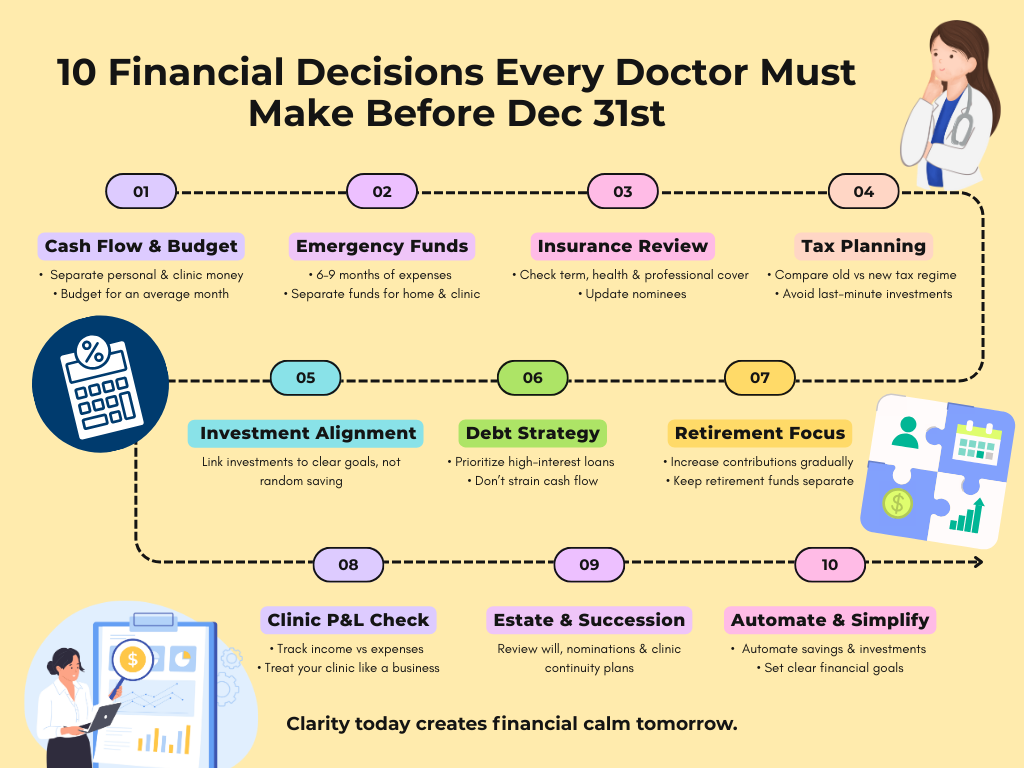
This new year, consider these ten decisions for better grip over your finances:
1. Understand Your Cash Flow and Set a Practical Budget:
Start by understanding how money flows in and out of your personal life and the clinic. Your income fluctuates every month, but your regular expenses stay the same. This gap is where financial stress usually begins.
To practically manage this stress better in 2026 with limited time, follow a fixed pattern:
1. Keep personal and clinic finances separate
2. Start with three bank accounts to manage a better flow of money.
3. One for income, one only for savings, and one for expenses. This should be followed for managing both personal and clinic finances.
4. While budgeting, look at your average month, not the best one, and build your budget around that.
Always remember Income – Savings = Expense, not the other way round.
2. Build and Recheck Your Emergency Reserves
An emergency fund should be different for both household and clinic expenses and it should cover at least 6–9 months of your expenses. You should review your reserves regularly what felt enough a few years ago may not be the same today. Liquidity is what buys you peace of mind during uncertainty.
3. Review Your Insurance Coverage Thoroughly
Most of your insurance policies get renewed automatically and usually you don’t check them.
Take a proper look at your term insurance, health insurance, and professional cover. See if the amounts still match your income and responsibilities.
Also, you should check for nominees. It sounds basic, but many people forget this step, and it creates a problem for you later.
4. Look at Taxes With a Forward View
You should avoid year-end investments to plan your taxes. Ask your CA to compare old vs new tax regimes based on real numbers. Review deductions and assess whether presumptive taxation still suits your practice. A forward-looking tax review reduces stress later.
5. Revisit Your Investment Strategy
It is worth taking a step back and seeing where your money is really invested. Most doctors save consistently, but over time those investments can end up scattered without a clear purpose.
Try connecting each investment to a specific goal such as your child’s education, expanding your clinic, or retirement. When money has a reason behind it, everything feels far more organised.
6. Plan Debt Prepayments Thoughtfully
Start by writing down all your loans along with their interest rates. High-interest loans deserve attention first, but there is no need to rush into closing them if it puts pressure on your monthly cash flow. In many cases, a balance between investing and prepaying loans works better than focusing on just one.
7. Strengthen Your Retirement Planning
Medical careers often take time to stabilize, which is why retirement planning tends to get postponed. That is exactly why it deserves attention now.
Even small, gradual increases in retirement investments can create a meaningful difference over time. Keeping retirement funds separate from other goals also helps avoid confusion later.
8. Review Your Clinic’s P&L
A clinic is not just a source of income, it is a business. Taking a clear look at what comes in and what goes out brings clarity. Expenses like staff salaries, rent, and supplies show the true picture. Once you see this clearly, deciding the next step becomes much easier.
9. Update Estate and Succession Plans
Estate planning is not only about the distant future. It matters today as well. Reviewing your will, nominations, and clinic succession plan helps protect both your family and the work you have built. A simple annual review can prevent a lot of stress later.
10. Automate Systems and Set Clear Goals
Automating savings, investments, insurance, and emergency funds reduces day-to-day effort. It keeps things moving even on the busiest days. Regularly revisiting your goals and keeping systems simple makes money management far easier.
Doctors spend their lives bringing structure and care into others’ lives. Bringing that same order into your finances can make a real difference. Taking these steps before December 31 can help you step into the new year feeling calmer, clearer, and more in control.