

Preoperative Aberrometry: Enhancing Cataract Surgery Outcomes with Advanced Technology
The evolution of technology in cataract surgery has significantly enhanced the precision of intraocular lens (IOL) selection and positioning, leading to better visual quality for patients. Among these advances, preoperative aberrometry has become a crucial tool for optimizing surgical outcomes by providing a detailed analysis of optical aberrations that go beyond standard visual acuity measures, such as the Snellen chart. Aberrometry not only helps refine the selection of IOLs but also aids in identifying patients who may benefit from or be contraindicated for certain types of lenses, particularly multifocal options.
Understanding Aberrometry and Optical Aberrations
Aberrometry is the study of optical aberrations, or flaws in the eye’s optical system that affect the quality of vision. Aberrations can be broadly classified into chromatic and monochromatic categories. The key focus in cataract surgery is often on monochromatic aberrations, particularly spherical aberrations, which impact how light is refracted through the lens, potentially leading to issues like distorted vision and reduced clarity.
In cataract surgery, aberrometry offers valuable insights into the patient’s unique ocular characteristics, allowing surgeons to tailor IOL selection to achieve optimal visual outcomes.
IOL Selection Based on Aberrometry: Spherical vs. Aspheric IOLs
One of the primary decisions in cataract surgery involves choosing between spherical and aspheric IOLs, based on the patient’s aberrometric profile.
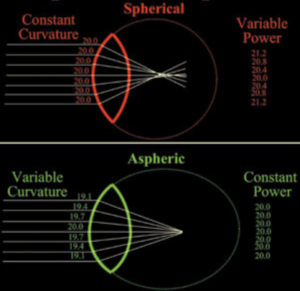
- Spherical IOLs have a uniform curvature across the entire lens surface, leading to peripheral light beams refracting differently compared to central light beams. This design can introduce positive spherical aberration, causing some loss of visual sharpness.
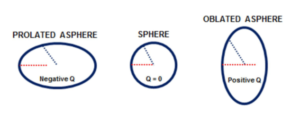
- Aspheric IOLs, on the other hand, have a curvature that varies from the center toward the edges of the lens. This difference compensates for spherical aberrations by reducing image distortion, thus improving overall visual quality. The asphericity, represented by the Q value, is directly related to the level of spherical aberration. A prolate lens (with a negative Q value) is more curved at the center and tends to produce sharper images, whereas an oblate lens (positive Q value) is flatter at the center and less suitable for patients with higher spherical aberrations.
The choice of IOL type largely depends on the aberrometric readings, with aspheric IOLs often recommended for patients with significant spherical aberrations. The Q value of an IOL and its impact on higher-order aberrations, particularly spherical aberrations, can guide surgeons in selecting the appropriate lens to improve the patient’s postoperative vision quality.
Measurement of asphericity and prolate and oblate surfaces
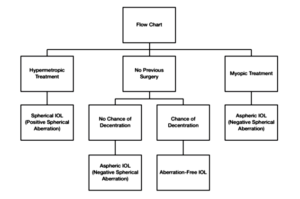
Flowchart for the choice of intraocular lens based on the corneal spherical aberration pattern.
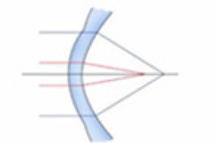
- Every lens has some degree of asphericity.
- Q value is directly proportional to the induction of a higher-order monochromatic aberration called spherical aberration.
- Due to difference between light refraction at the center and at the edges of the lens.
- Light beams refracted at the center will be focused on a given point and peripheral beams will be reflected on a different point.
- Spherical aberration suffers from image distortion and a consequent loss of visual quality.
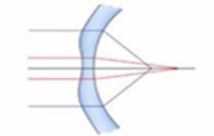
Preoperative cornea with negative asphericity and postoperative cornea after myopic photoablation with positive asphericity
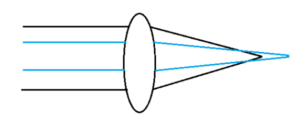
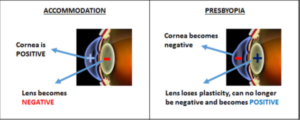
Optical aberrations in the processes of accommodation and presbyopia
Schematic diagram of the difference between a spherical lens (orange) and an aspherical lens (green).
Multifocal IOLs: Contraindications Based on Aberrometry
Multifocal IOLs can be a popular choice for patients seeking freedom from glasses after cataract surgery, as they offer multiple focal points for near, intermediate, and distance vision. However, they are not suitable for all patients. Aberrometry plays a key role in assessing whether a patient is a good candidate for multifocal lenses.
Patients with high levels of higher-order aberrations (HOAs), such as coma, may experience visual disturbances with multifocal lenses, including dysphotopsia, glare, and halos. These issues are particularly prevalent in patients with pre-existing aberrations, which can be exacerbated postoperatively, leading to dissatisfaction. Studies suggest a coma measurement cutoff of around 0.32 or 0.33 μm beyond which multifocal IOLs may be contraindicated. In such cases, alternative lens options are considered to enhance postoperative satisfaction and visual performance.
The Importance of Preoperative Aberrometry in Cataract Surgery
Incorporating aberrometry into preoperative planning allows surgeons to optimize cataract surgery outcomes by:
- Customizing IOL Selection: By analyzing the patient’s specific aberrometric profile, surgeons can make informed decisions between spherical and aspheric lenses, and assess the suitability of multifocal IOLs.
- Reducing Postoperative Complications: Aberrometry helps in identifying patients who may experience adverse visual symptoms post-surgery, thus avoiding potential dissatisfaction and the need for IOL replacement.
- Improving Visual Quality: Preoperative aberrometry facilitates enhanced visual outcomes by minimizing optical aberrations and ensuring a higher quality of postoperative vision, leading to greater patient satisfaction.
Conclusion
Preoperative aberrometry represents a significant advancement in cataract surgery, offering a comprehensive analysis of a patient’s ocular aberrations to refine surgical planning. By leveraging aberrometry data, surgeons can select the most suitable IOL type, whether spherical, aspheric, or multifocal, tailored to each patient’s unique visual needs. This technology not only contributes to better visual acuity and quality but also helps in managing patient expectations, reducing postoperative complications, and enhancing overall satisfaction.
References:
- Braga-Mele R, et al. Multifocal intraocular lenses: relative indications and contraindications for implantation. J Cataract Refract Surg. 2014;40(2):313–22.
- Masket S, Fram NR, Holladay JT. Influence of ophthalmic viscosurgical devices on intraoperative aberrometry. J Cataract Refract Surg. 2016;42(7):990–4.
- Hatch KM, Woodcock EC, Talamo JH. Intraocular lens power selection and positioning with and without intraoperative aberrometry. J Refract Surg. 2015 Apr;31(4):237–42.
- Canto AP, et al. Comparison of IOL power calculation methods and intraoperative wavefront aberrometer in eyes after refractive surgery. J Refract Surg. 2013;29(7):484–9.
- Ianchulev T, et al. Intraoperative refractive biometry for predicting intraocular lens power calculation after prior myopic refractive surgery. Ophthalmology. 2014;121(1):56–60.