Searching...
Can't find what you're looking for. Try different keywords.


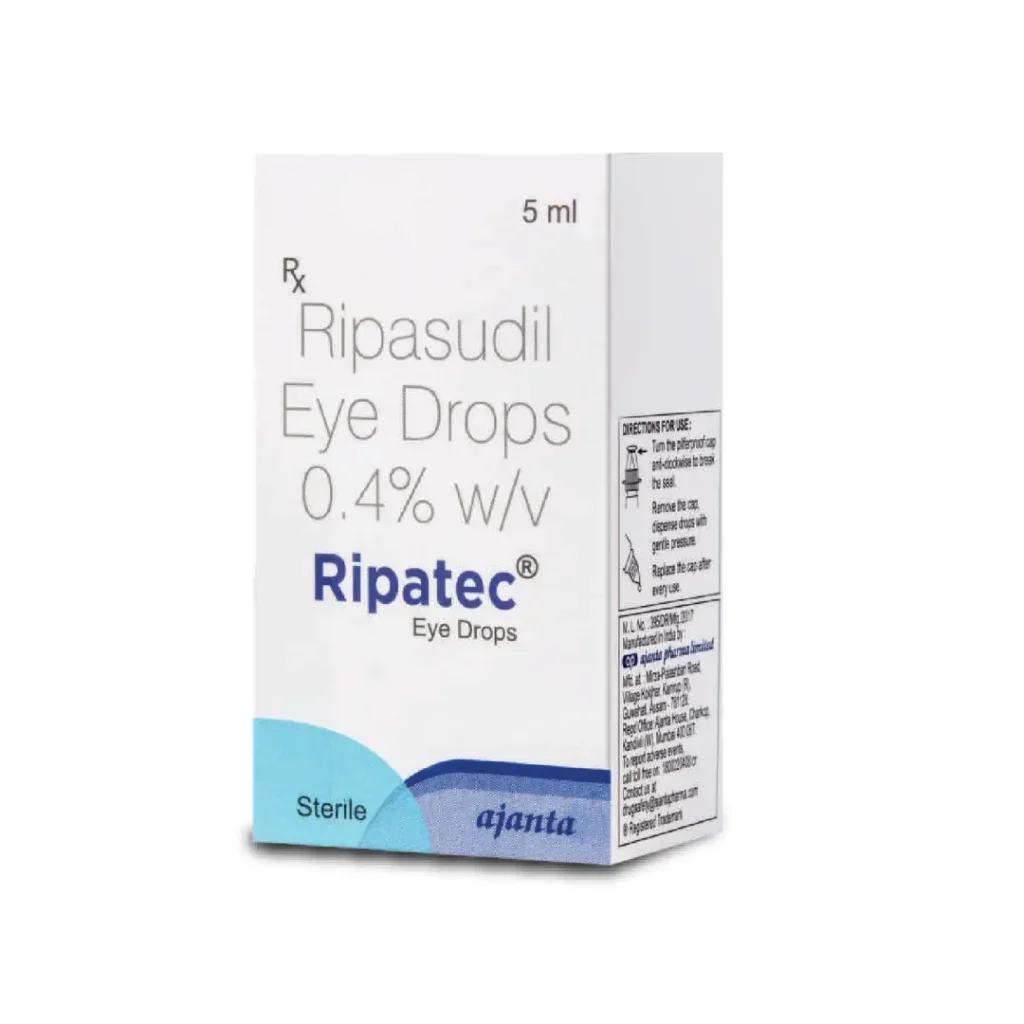

Repasudil
0.4%
Dosage Form & Strength
Apply 1 drop once a day, twice a day.
Pregnant women It should be given to pregnant women or women who may be pregnant only when the therapeutic benefit outweighs the risk. Lactating women Consider breastfeeding continuation or discontinuation in consideration of therapeutic benefit and breastfeeding benefit. Children No clinical trials have been conducted targeting efficacy and safety in children.
Ripatec is indicated for the treatment of Glaucoma & ocular hypertension
Conjunctival hyperemia, conjunctivitis (including allergicconjunctivitis), blepharitis (including allergic blepharitis),, eye irritation were common adverse effects observed in clinical trials with Repasudil
Ripasudil’s mechanism of action affects intraocular pressure, or IOP, by directly acting on the trabecular meshwork, thereby increasing conventional outflow through the Schlemm’s canal. More simply, it is an “out-flow” drug that reduces IOP by stimulating the movement of aqueous humour from the ciliary body away from the eye. It is a selective rho-associated coiled-coil-containing protein kinase 1 (ROCK1) inhibitor, where ROCK1 is “an important downstream effector of Rho guanosine trisphosphates (GTP), proteins that are significant in the contractile control of smooth muscle tissue.
Tmax(0.083 hr) Cmax(0.622 ng/mL) t1/2(0.455 hr) When the drug (50 μL) was monocularly instilled in male rabbits, the highest concentrations (68135.4 ng/g and 4126.39 ng / mL) were reached in 0.25 hours in the cornea and atrial water, and then quickly disappeared. In the lens, the highest concentration (154.37 ng/g) was reached in 0.5 hours, and then it disappeared gradually
pregnant women It should be given to pregnant women or women who may be pregnant only when the therapeutic benefit outweighs the risk. Lactating women Consider breastfeeding continuation or discontinuation in consideration of therapeutic benefit and breastfeeding benefit. It has been reported in animal experiments (rat: oral administration) that it is transferred to milk.
Children No clinical trials have been conducted targeting efficacy and safety in children.
Subscribe to our newsletter and be the first to receive insights, updates, and expert tips on optimizing your financial management.