Searching...
Can't find what you're looking for. Try different keywords.


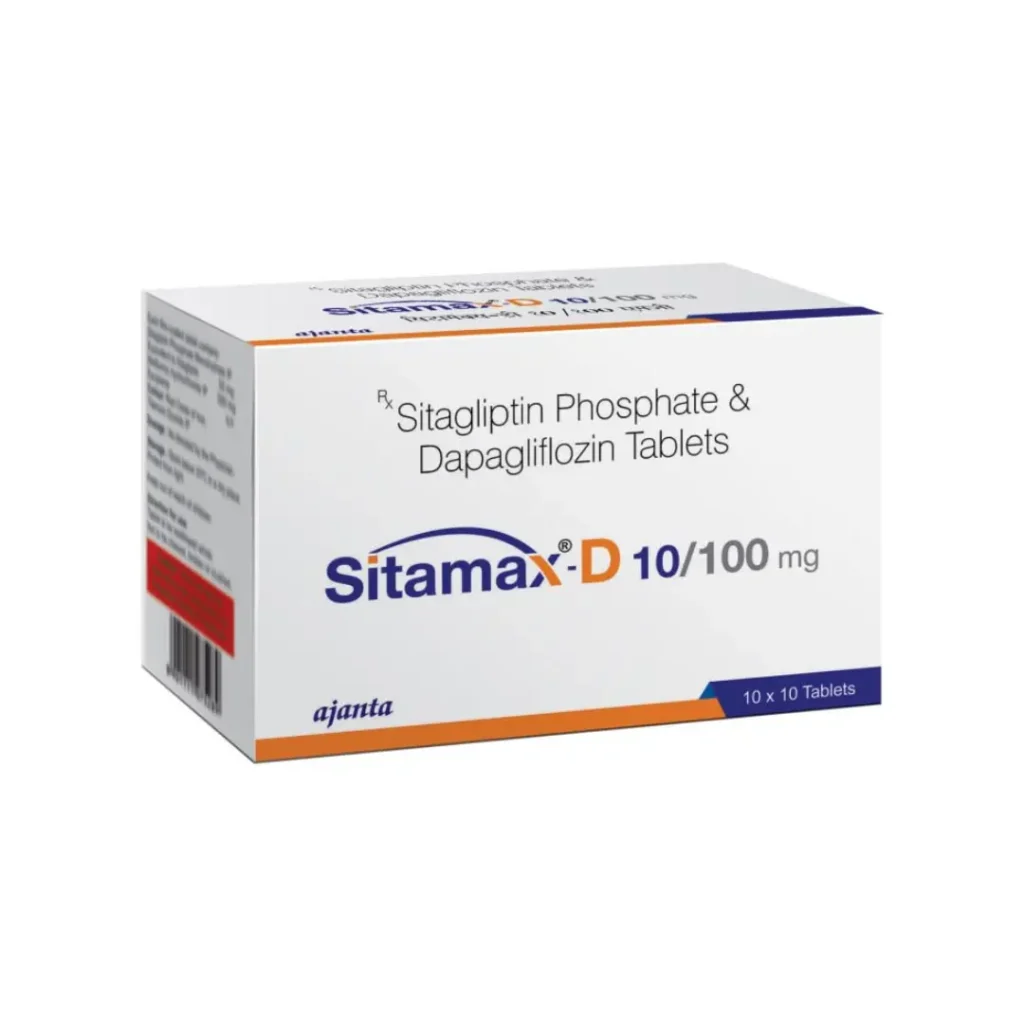

Dosage Form
Film Coated Tablet
Strength
5 mg/50 mg, 10 mg/50 mg, 5 mg/100 mg, 10 mg/100 mg
Dapagliflozin
5 mg / 10 mg
Sitagliptin
50 mg / 100 mg
Excipients/Colours
Titanium Dioxide IP + Ferric Oxide Red USP-NF
Composition
Dapagliflozin Propanediol Monohydrate equivalent to Dapagliflozin + Sitagliptin Phosphate Monohydrate equivalent to Sitagliptin
Dosage Form & Strength
Film Coated Tablet — 1 tablet once daily,Dapagliflozin 5/10 mg + Sitagliptin 50/100 mg; maximum daily dose: Dapagliflozin 10 mg + Sitagliptin 100 mg.
Sitagliptin-dapagliflozin fixed dose combination is indicated in adults aged 18 years and older with type 2 diabetes mellitus: • To improve glycaemic control when metformin and/or sulphonylurea (SU) and one of the monocomponents of Sitamax D do not provide adequate glycaemic control, • when already being treated with the free combination of dapagliflozin and sitagliptin.
Dapagliflozin and Sitagliptin is contraindicated in patients with: Patients with a history of hypersensitivity reaction to the active substance or to any of the excipients.
Sitagliptin Summary of the safety profile Serious adverse reactions including pancreatitis and hypersensitivity reactions have been reported. Hypoglycaemia has been reported in combination with sulphonylurea (4.7 %-13.8 %) and insulin (9.6 %). The most frequently reported adverse reactions across the clinical studies were genital infections.
Sitagliptin should not be used in patients with type 1 diabetes or for the treatment of diabetic ketoacidosis. Acute pancreatitis Use of DPP-4 inhibitors has been associated with a risk of developing acute pancreatitis. Patients should be informed of the characteristic symptom of acute pancreatitis: persistent, severe abdominal pain. Resolution of pancreatitis has been observed after discontinuation of sitagliptin (with or without supportive treatment), Post-marketing reports of serious hypersensitivity reactions in patients treated with sitagliptin have been reported. These reactions include anaphylaxis, angioedema, and exfoliative skin conditions including Stevens-Johnson syndrome Due to its mechanism of action, dapagliflozin increases diuresis, which may lead to the modest decrease in blood pressure, observed in clinical studies. It may be more pronounced in patients with very high blood glucose concentrations. Caution should be exercised in patients for whom a dapagliflozin-induced drop in blood pressure could pose a risk, such as patients on anti-hypertensive therapy with a history of hypotension or elderly patients. In case of intercurrent conditions that may lead to volume depletion (e.g. gastrointestinal illness), careful monitoring of volume status (e.g. physical examination, blood pressure measurements, laboratory tests including haematocrit and electrolytes) is recommended. Temporary interruption of treatment with dapagliflozin is recommended for patients who develop volume depletion until the depletion is corrected.Urinary glucose excretion may be associated with an increased risk of urinary tract infection; therefore, temporary interruption of dapagliflozin should be considered when treating pyelonephritis or urosepsis
Sitagliptin Effects of other medicinal products on sitagliptin Clinical data described below suggest that the risk for clinically meaningful interactions by co-administered medicinal products is low. In vitro studies indicated that the primary enzyme responsible for the limited metabolism of sitagliptin is CYP3A4, with contribution from CYP2C8. In patients with normal renal function, metabolism, including via CYP3A4, plays only a small role in the clearance of sitagliptin. Metabolism may play a more significant role in the elimination of sitagliptin in the setting of severe renal impairment or end-stage renal disease (ESRD). For this reason, it is possible that potent CYP3A4 inhibitors (i.e. ketoconazole, itraconazole, ritonavir, clarithromycin) could alter the pharmacokinetics of sitagliptin in patients with severe renal impairment or ESRD. The effect of potent CYP3A4 inhibitors in the setting of renal impairment has not been assessed in a clinical study. In vitro transport studies showed that sitagliptin is a substrate for p-glycoprotein and organic anion transporter-3 (OAT3). OAT3 mediated transport of sitagliptin was inhibited in vitro by probenecid, although the risk of clinically meaningful interactions is considered to be low. Concomitant administration of OAT3 inhibitors has not been evaluated in vivo. Metformin: Co-administration of multiple twice-daily doses of 1,000 mg metformin with 50 mg sitagliptin did not meaningfully alter the pharmacokinetics of sitagliptin in patients with type 2 diabetes. Cyclosporine: A study was conducted to assess the effect of cyclosporine, a potent inhibitor of p-glycoprotein, on the pharmacokinetics of sitagliptin. Co-administration of a single 100 mg oral dose of sitagliptin and a single 600 mg oral dose of cyclosporine increased the AUC and Cmax of sitagliptin by approximately 29 % and 68 %, respectively. These changes in sitagliptin pharmacokinetics were not considered to be clinically meaningful. The renal clearance of sitagliptin was not meaningfully altered. Therefore, meaningful interactions would not be expected with other p-glycoprotein inhibitors. Effects of sitagliptin on other medicinal products Digoxin: Sitagliptin had a small effect on plasma digoxin concentrations. Following administration of 0.25 mg digoxin concomitantly with 100 mg of sitagliptin daily for 10 days, the plasma AUC of digoxin was increased on average by 11 %, and the plasma Cmax on average by 18 %. No dose adjustment of digoxin is recommended. However, patients at risk of digoxin toxicity should be monitored for this when sitagliptin and digoxin are administered concomitantly. In vitro data suggest that sitagliptin does not inhibit nor induce CYP450 isoenzymes. In clinical studies, sitagliptin did not meaningfully alter the pharmacokinetics of metformin, glyburide, simvastatin, rosiglitazone, warfarin, or oral contraceptives, providing in vivo evidence of a low propensity for causing interactions with substrates of CYP3A4, CYP2C8, CYP2C9, and organic cationic transporter (OCT). Sitagliptin may be a mild inhibitor of p-glycoprotein in vivo. Dapagliflozin Pharmacodynamic interactions Diuretics Dapagliflozin may add to the diuretic effect of thiazide and loop diuretics and may increase the risk of dehydration and hypotension. Insulin and insulin secretagogues Insulin and insulin secretagogues, such as sulphonylureas, cause hypoglycaemia. Therefore, a lower dose of insulin or an insulin secretagogue may be required to reduce the risk of hypoglycaemia when used in combination with dapagliflozin in patients with type 2 diabetes mellitus. Pharmacokinetic interactions The metabolism of dapagliflozin is primarily via glucuronide conjugation mediated by UDP glucuronosyltransferase 1A9 (UGT1A9). In in vitro studies, dapagliflozin neither inhibited cytochrome P450 (CYP) 1A2, CYP2A6, CYP2B6, CYP2C8, CYP2C9, CYP2C19, CYP2D6, CYP3A4, nor induced CYP1A2, CYP2B6 or CYP3A4. Therefore, dapagliflozin is not expected to alter the metabolic clearance of coadministered medicinal products that are metabolised by these enzymes. Effect of other medicinal products on dapagliflozin Interaction studies conducted in healthy subjects, using mainly a single-dose design, suggest that the pharmacokinetics of dapagliflozin are not altered by metformin, pioglitazone, sitagliptin, glimepiride, voglibose, hydrochlorothiazide, bumetanide, valsartan, or simvastatin. Following coadministration of dapagliflozin with rifampicin (an inducer of various active transporters and drug-metabolising enzymes) a 22% decrease in dapagliflozin systemic exposure (AUC) was observed, but with no clinically meaningful effect on 24-hour urinary glucose excretion. No dose adjustment is recommended. A clinically relevant effect with other inducers (e.g. carbamazepine, phenytoin, phenobarbital) is not expected. Following coadministration of dapagliflozin with mefenamic acid (an inhibitor of UGT1A9), a 55% increase in dapagliflozin systemic exposure was seen, but with no clinically meaningful effect on 24-hour urinary glucose excretion. No dose adjustment is recommended. Effect of dapagliflozin on other medicinal products In interaction studies conducted in healthy subjects, using mainly a single-dose design, dapagliflozin did not alter the pharmacokinetics of metformin, pioglitazone, sitagliptin, glimepiride, hydrochlorothiazide, bumetanide, valsartan, digoxin (a P-gp substrate) or warfarin (S-warfarin, a CYP2C9 substrate), or the anticoagulatory effects of warfarin as measured by INR. Combination of a single dose of dapagliflozin 20 mg and simvastatin (a CYP3A4 substrate) resulted in a 19% increase in AUC of simvastatin and 31% increase in AUC of simvastatin acid. The increase in simvastatin and simvastatin acid exposures are not considered clinically relevant. Interference with 1,5-anhydroglucitol (1,5-AG) assay Monitoring glycaemic control with 1,5-AG assay is not recommended as measurements of 1,5-AG are unreliable in assessing glycaemic control in patients taking SGLT2 inhibitors. Use of alternative methods to monitor glycaemic control is advised
This medicinal product combines sitagliptin and dapagliflozin with complementary mechanisms of action to improve glycaemic control. Sitagliptin, through the selective inhibition of dipeptidyl peptidase-4 (DPP-4), enhances glucose-mediated insulin secretion (incretin effect). Dapagliflozin, a selective inhibitor of sodium-glucose co-transporter 2 (SGLT2), inhibits renal glucose reabsorption independently of insulin. Actions of both medicinal products are regulated by the plasma glucose level.
The mean plasma terminal half-life (t1/2) for dapagliflozin was 12.9 hours following a single oral dose of dapagliflozin 10 mg to healthy subjects. The apparent terminal t1/2 following a 100-mg oral dose of sitagliptin was approximately 12.4 hours.
Absorption: Dapagliflozin was rapidly and well absorbed after oral administration. Maximum dapagliflozin plasma concentrations (Cmax) were usually attained within 2 hours after administration in the fasted state. Geometric mean steady-state dapagliflozin Cmax and AUC values following once daily 10 mg doses of dapagliflozin were 158 ng/mL and 628 ng h/mL, respectively. The absolute oral bioavailability of dapagliflozin following the administration of a 10 mg dose is 78%. Administration with a high-fat meal decreased dapagliflozin Cmax by up to 50% and prolonged Tmax by approximately 1 hour, but did not alter AUC as compared with the fasted state. These changes are not considered to be clinically meaningful. Hence, Dapagliflozin can be administered with or without food. Bioavailability: The absolute oral bioavailability of dapagliflozin following the administration of a 10 mg dose is 78%. The absolute bioavailability of sitagliptin is approximately 87 %. Metabolism: The metabolism of dapagliflozin is primarily via glucuronide conjugation mediated by UDP glucuronosyltransferase 1A9 (UGT1A9).Sitagliptin is primarily eliminated unchanged in urine, and metabolism is a minor pathway. Approximately 79 % of sitagliptin is excreted unchanged in the urineIn vitro studies indicated that the primary enzyme responsible for the limited metabolism of sitagliptin was CYP3A4, with contribution from CYP2C8. Excretion: Elimination of sitagliptin occurs primarily via renal excretion and involves active tubular secretion. Sitagliptin is a substrate for human organic anion transporter-3 (hOAT-3), which may be involved in the renal elimination of sitagliptin. Dapagliflozin and related metabolites are primarily eliminated via urinary excretion with less than 2% as unchanged dapagliflozin.
Subscribe to our newsletter and be the first to receive insights, updates, and expert tips on optimizing your financial management.