Searching...
Can't find what you're looking for. Try different keywords.


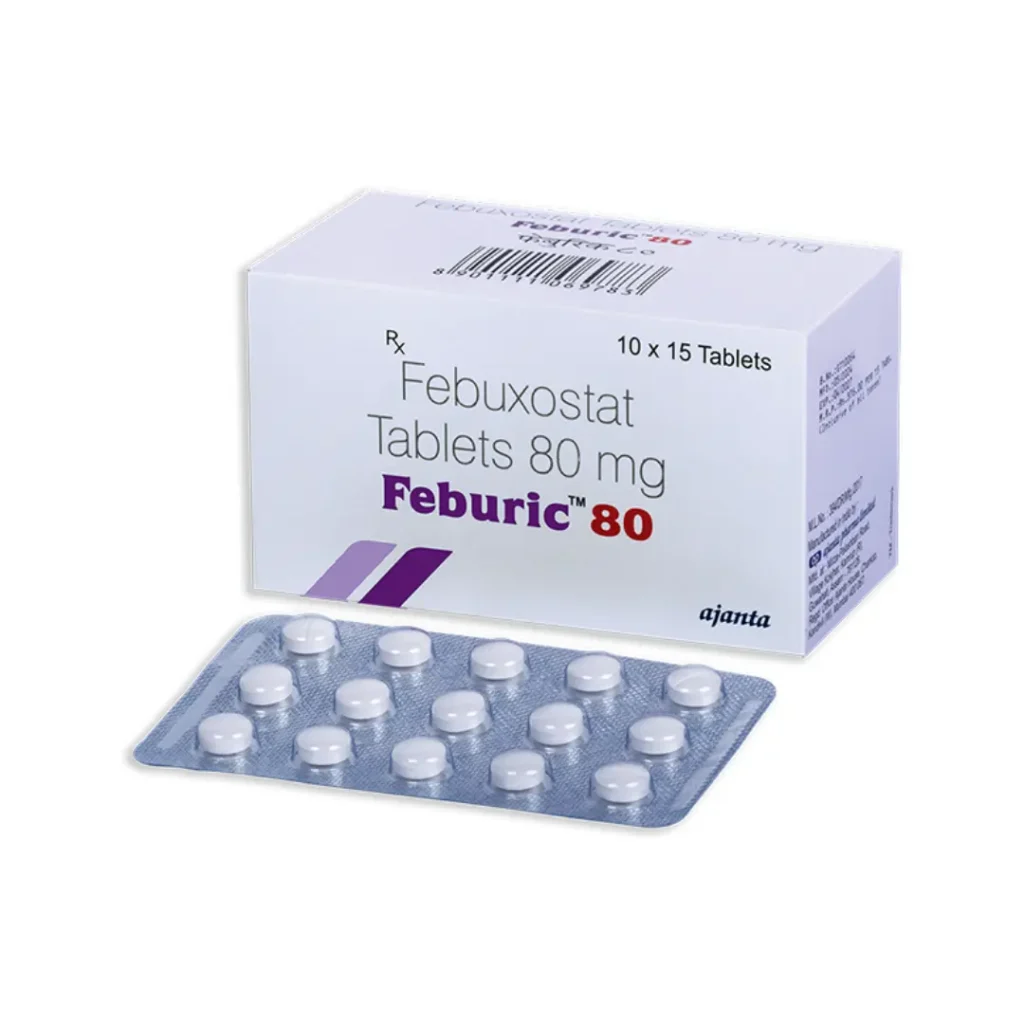

Febuxostat
80
Dosage Form & Strength
40 mg once daily → 80 mg after 2 weeks if sUA ≥6 mg/dL
There is insufficient data in patients with severe renal impairment. No studies have been conducted in patients with severe hepatic impairment. Caution should be exercised in these patients. Febuxostat should be used during pregnancy only if the potential benefit justifies the potential risk to the fetus. caution should be exercised when administered to a nursing woman.
Feburic is indicated for the treatment of chronic hyperuricaemia in conditions where urate deposition has already occurred (including a history, or presence of, tophus and/or gouty arthritis). Feburic is also indicated for the prevention and treatment of hyperuricaemia in adult patients undergoing chemotherapy for haematologic malignancies at intermediate to high risk of Tumor Lysis Syndrome (TLS).
Adverse reactions occurring in at least 1% of febuxostat-treated patients, and at least 0.5% greater than placebo, are liver function abnormalities, nausea, arthralgia, and rash.
With Azathioprine it may enhance side effects such as myelosuppression With Mercaptopurine hydrate, Febuxostat is known to increase the blood concentration of mercaptopurine by inhibiting xanthine oxidase, which is a metabolite of azathioprine, which is a metabolizing enzyme of mercaptopurine. Since this drug also has a xanthine oxidase inhibitory effect, there is a similar possibility
Uric acid is the end product of purine metabolism in humans and is generated in the cascade of hypoxanthine → xanthine → uric acid. Both steps in the above transformations are catalyzed by xanthine oxidase (XO). Feburic (Febuxostat) is a 2-arylthiazole derivative that achieves its therapeutic effect of decreasing serum uric acid by selectively inhibiting XO. Febuxostat is a potent, non-purine selective inhibitor of XO (NP-SIXO) with an in vitro inhibition Ki value less than one nanomolar. Feburic (Febuxostat) has been shown to potently inhibit both the oxidized and reduced forms of XO. At therapeutic concentrations febuxostat does not inhibit other enzymes involved in purine or pyrimidine metabolism, namely, guanine deaminase, hypoxanthine guanine phosphoribosyltransferase, orotate phosphoribosyltransferase, orotidine monophosphate decarboxylase or purine nucleoside phosphorylase.
The half life of Febuxostat (Feburic) is approximately 5 to 8 hours
In healthy subjects, maximum plasma concentrations (Cmax) and area under the plasma concentration time curve (AUC) of febuxostat increased in a dose proportional manner following single and multiple doses of 10 mg to 120 mg. For doses between 120 mg and 300 mg, a greater than dose proportional increase in AUC is observed for febuxostat. There is no appreciable accumulation when doses of 10 mg to 240 mg are administered every 24 hours. Febuxostat has an apparent mean terminal elimination half-life (t1/2) of approximately 5 to 8 hours. Population pharmacokinetic/pharmacodynamic analyses were conducted in 211 patients with hyperuricaemia and gout, treated with Febuxostat Tablets 40-240 mg QD. In general, febuxostat pharmacokinetic parameters estimated by these analyses are consistent with those obtained from healthy subjects, indicating that healthy subjects are representative for pharmacokinetic/pharmacodynamic assessment in the patient population with gout. Absorption Febuxostat is rapidly (tmax of 1.0-1.5 h) and well absorbed (at least 84%). After single or multiple oral 80 and 120 mg once daily doses, Cmax is approximately 2.8-3.2 µg/mL, and 5.0-5.3 µg/mL, respectively. Absolute bioavailability of the febuxostat tablet formulation has not been studied. Following multiple oral 80 mg once daily doses or a single 120 mg dose with a high fat meal, there was a 49% and 38% decrease in Cmax and a 18% and 16% decrease in AUC, respectively. However, no clinically significant change in the percent decrease in serum uric acid concentration was observed where tested (80 mg multiple dose). Thus, Febuxostat Tablets may be taken without regard to food. Distribution The apparent steady state volume of distribution (Vss/F) of febuxostat ranges from 29 to 75 L after oral doses of 10-300 mg. The plasma protein binding of febuxostat is approximately 99.2%, (primarily to albumin), and is constant over the concentration range achieved with 80 and 120 mg doses. Plasma protein binding of the active metabolites ranges from about 82% to 91%. Biotransformation Febuxostat is extensively metabolized by conjugation via uridine diphosphate glucuronosyltransferase (UDPGT) enzyme system and oxidation via the cytochrome P450 (CYP) system. Four pharmacologically active hydroxyl metabolites have been identified, of which three occur in plasma of humans. In vitro studies with human liver microsomes showed that those oxidative metabolites were formed primarily by CYP1A1, CYP1A2, CYP2C8 or CYP2C9 and febuxostat glucuronide was formed mainly by UGT 1A1, 1A8, and 1A9. Elimination Febuxostat is eliminated by both hepatic and renal pathways. Following an 80 mg oral dose of 14C-labeled febuxostat, approximately 49% of the dose was recovered in the urine as unchanged febuxostat (3%), the acyl glucuronide of the active substance (30%), its known oxidative metabolites and their conjugates (13%), and other unknown metabolites (3%). In addition to the urinary excretion, approximately 45% of the dose was recovered in the faeces as the unchanged febuxostat (12%), the acyl glucuronide of the active substance (1%), its known oxidative metabolites and their conjugates (25%), and other unknown metabolites (7%).
Pregnancy Data on a very limited number of exposed pregnancies have not indicated any adverse effects of febuxostat on pregnancy or on the health of the foetus/new born child. Animal studies do not indicate direct or indirect harmful effects with respect to pregnancy, embryonal/foetal development or parturition.The potential risk for human is unknown. Febuxostat should not be used during pregnancy. Breastfeeding It is unknown whether febuxostat is excreted in human breast milk. Animal studies have shown excretion of this active substance in breast milk and an impaired development of suckling pups. A risk to a suckling infant cannot be excluded. Febuxostat should not be used while breastfeeding.
Renal impairment No dose adjustment is necessary when administering Febuxostat Tablets in patients with mild to moderate renal impairment.The recommended starting dose of Febuxostat Tablets is 40 mg once daily. For patients who do not achieve a sUA less than 6 mg/dL after two weeks with 40 mg, Febuxostat Tablets 80 mg is recommended.
Hepatic impairment No dose adjustment is necessary in patients with mild to moderate hepatic impairment. No studies have been conducted in patients with severe hepatic impairment (Child-Pugh Class C); therefore, caution should be exercised in these patients.
Paediatric population The safety and the efficacy of Febuxostat Tablets in children aged below the age of 18 years have not been established. No data are available.
Older people No dose adjustment is required in the elderly.
Subscribe to our newsletter and be the first to receive insights, updates, and expert tips on optimizing your financial management.