Searching...
Can't find what you're looking for. Try different keywords.


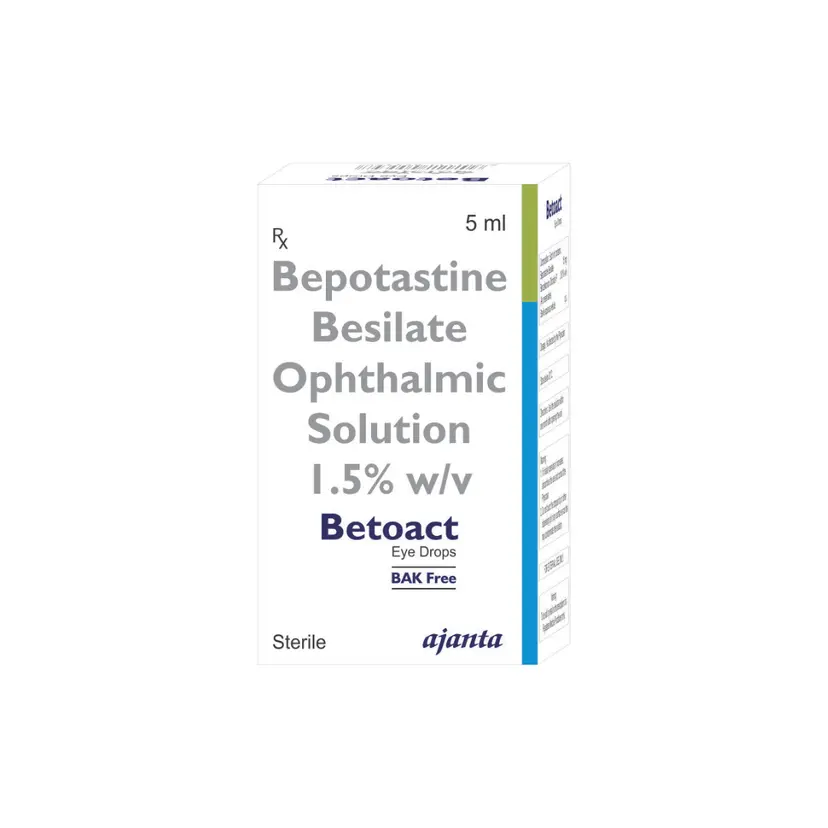

Dosage Form & Strength
Instill one drop into the affected eye(s) twice a day. Remove contact lenses prior to instillation
Betoact is indicated for the treatment of Ocular Allergies
The most common adverse reaction occurring in approximately 25% of patients was a mild taste following instillation. Other adverse reactions which occurred in 2-5% of subjects were eye irritation, headache, and nasopharyngitis.
Bepotastine is a topically active, direct H1receptor antagonist and an inhibitor of the release of histamine from mast cells.
The half life of Beptastine in Betoact is y 3 hours (mean half life range: 2.3–3.3 hours)
Absorption: Following one drop of bepotastine besilate ophthalmic solution to both eyes four times daily (QID) for 7 days, bepotastine plasma concentrations peaked at approximately 1 to 2 hours post-instillation. Maximum plasma concentrations for the 1% and 1.5% strengths were 5.1 ± 2.5 ng/mL and 7.3 ± 1.9 ng/mL, respectively. Plasma concentrations at 24 hours post-instillation were below the quantifiable limit (2 ng/mL) in 11/12 subjects in the two dose groups. Distribution: The extent of protein binding of bepotastine is approximately 55% and independent of bepotastine concentration. Metabolism: In vitro metabolism studies with human liver microsomes demonstrated that bepotastine is minimally metabolized by CYP450 isozymes. In vitro studies demonstrated that bepotastine besilate does not inhibit the metabolism of various cytochrome P450 substrates via inhibition of CYP3A4, CYP2C9, and CYP2C19. Bepotastine besilate has a low potential for drug interaction via inhibition of CYP3A4, CYP2C9, and CYP2C19. Excretion: The main route of elimination of bepotastine besilate is urinary excretion (with approximately 75-90% excreted unchanged in urine).
Pregnancy and Lactation: There are no adequate and well-controlled studies of bepotastine besilate in pregnant women. Because animal reproduction studies are not always predictive of human response, bepotastine besilate ophthalmic solution 1.5% should be used during pregnancy only if the potential benefit justifies the potential risk to the fetus. It is not known if bepotastine besilate is excreted in human milk. Caution should be exercised when bepotastine besilate ophthalmic solution 1.5% is administered to a nursing woman
Safety and efficacy of Bepreve (bepotastine besilate ophthalmic solution) 1.5% have notbeen established in pediatric patients under 2 years of age. Efficacy in pediatric patients under 10 years of age was extrapolated from clinical trials conducted in pediatric patients greater than 10 years of age and from adults.
Geriatric Use No overall difference in safety or effectiveness has been observed between elderly and younger patients.
Subscribe to our newsletter and be the first to receive insights, updates, and expert tips on optimizing your financial management.