Searching...
Can't find what you're looking for. Try different keywords.


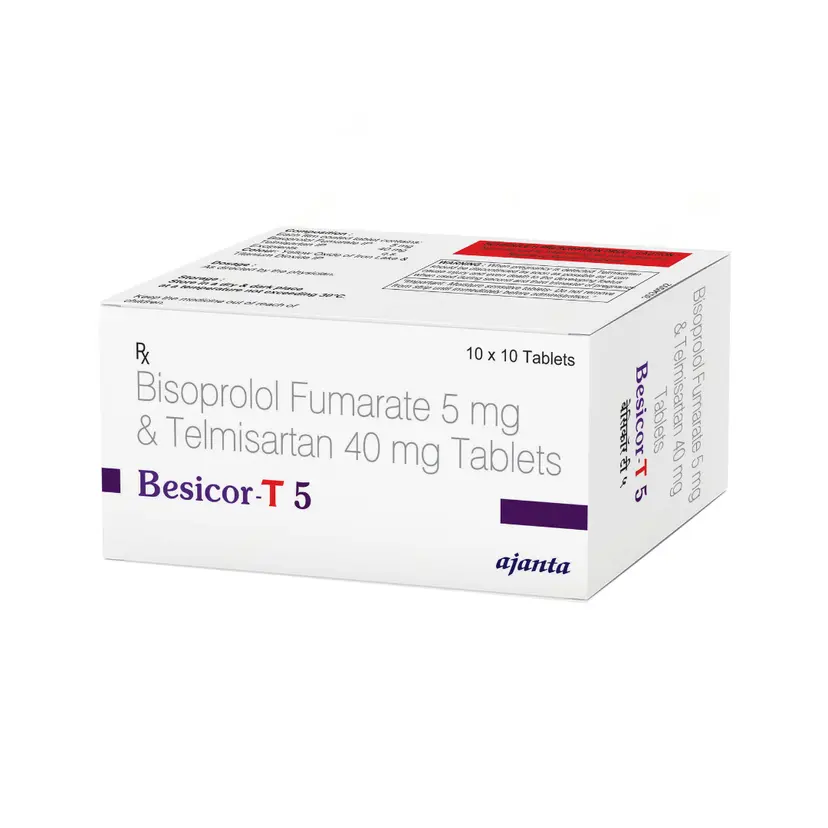

Bisoprolol
2.5 mg / 5 mg
Telmisartan
40mg
Dosage Form & Strength
The recommended dose of this combination is one tablet per day.
Treatment of essential hypertension in adults.
This combination is contraindicated in • Hypersensitivity to bisoprolol or telmisartan or to any of the excipients listed • Chronic heart failure patients • Acute heart failure or during episodes of heart failure decompensation requiring i.v. inotropic therapy • Cardiogenic shock • Second or third degree AV block • Sick sinus syndrome • Sinoatrial block • Symptomatic bradycardia • Symptomatic hypotension • Severe bronchial asthma • Severe forms of peripheral arterial occlusive disease or severe forms of Raynaud’s syndrome • Untreated phaeochromocytoma • Metabolic acidosis • Second and third trimesters of pregnancy • Biliary obstructive disorders • Severe hepatic impairment • The concomitant use of telmisartan with aliskiren-containing products is contraindicated in patients with diabetes mellitus or renal impairment (GFR < 60 ml/min/1.73 m2).
Serious adverse drug reactions include anaphylactic reaction and angioedema which may occur rarely (≥1/10,000 to <1/1,000), and acute renal failure. The overall incidence of adverse reactions reported with telmisartan was usually comparable to placebo (41.4 % vs 43.9 %) in controlled trials in patients treated for hypertension. The incidence of adverse reactions was not dose related and showed no correlation with gender, age or race of the patients. The safety profile of telmisartan in patients treated for the reduction of cardiovascular morbidity was consistent with that obtained in hypertensive patients. The adverse reactions listed below have been accumulated from controlled clinical trials in patients treated for hypertension and from post-marketing reports. The listing also takes into account serious adverse reactions and adverse reactions leading to discontinuation reported in three clinical long-term studies including 21,642 patients treated with telmisartan for the reduction of cardiovascular morbidity for up to six years.
The initiation and cessation of treatment with bisoprolol necessitates regular monitoring.In patients undergoing general anaesthesia beta-blockade reduces the incidence of arrhythmias and myocardial ischemia during induction and intubation, and the post-operative period. It is currently recommended that maintenance beta-blockade be continued peri-operatively. The anaesthetist must be aware of beta-blockade because of the potential for interactions with other drugs, resulting in bradyarrhythmias, attenuation of the reflex tachycardia and the decreased reflex ability to compensate for blood loss. If it is thought necessary to withdraw beta-blocker therapy before surgery, this should be done gradually and completed about 48 hours before anaesthesia. Combination of bisoprolol with calcium antagonists of the verapamil or diltiazem type, with Class I antiarrhythmic drugs and with centrally acting antihypertensive drugs is generally not recommended.Patients with psoriasis or with a history of psoriasis should only be given beta-blockers (e.g. bisoprolol) after carefully balancing the benefits against the risks. In patients with phaeochromocytoma bisoprolol must not be administered until after alpha-receptor blockade. Under treatment with bisoprolol the symptoms of a thyreotoxicosis may be masked. When Telmisartan is used in patients with impaired renal function, periodic monitoring of potassium and creatinine serum levels is recommended. There is no experience regarding the administration of Telmisartan in patients with recent kidney transplantation.Symptomatic hypotension, especially after the first dose of Telmisartan, may occur in patients who are volume and/or sodium depleted by vigorous diuretic therapy, dietary salt restriction, diarrhoea, or vomiting. Such conditions should be corrected before the administration of Telmisartan. Volume and/or sodium depletion should be corrected prior to administration of Telmisartan.
Bisoprolol Bisoprolol is a highly beta1-selective-adrenoceptor blocking agent, lacking intrinsic stimulating and relevant membrane stabilising activity. It only shows low affinity to the beta2-receptor of the smooth muscles of bronchi and vessels as well as to the beta2-receptors concerned with metabolic regulation. Therefore, bisoprolol is generally not to be expected to influence the airway resistance and beta2-mediated metabolic effects. Its beta1-selectivity extends beyond the therapeutic dose range. Bisoprolol reduces the heart rate and stroke volume and thus the cardiac output and oxygen consumption. In chronic administration the initially elevated peripheral resistance decreases. Telmisartan Telmisartan is an orally active and specific angiotensin II receptor (type AT1) antagonist. Telmisartan displaces angiotensin II with very high affinity from its binding site at the AT1 receptor subtype, which is responsible for the known actions of angiotensin II. Telmisartan does not exhibit any partial agonist activity at the AT1 receptor. Telmisartan selectively binds the AT1 receptor. The binding is long-lasting. Telmisartan does not show affinity for other receptors, including AT2 and other less characterised AT receptors. The functional role of these receptors is not known, nor is the effect of their possible overstimulation by angiotensin II, whose levels are increased by telmisartan. Plasma aldosterone levels are decreased by telmisartan. Telmisartan does not inhibit human plasma renin or block ion channels. Telmisartan does not inhibit angiotensin converting enzyme (kininase II), the enzyme which also degrades bradykinin. Therefore it is not expected to potentiate bradykinin-mediated adverse effects. In human, an 80 mg dose of telmisartan almost completely inhibits the angiotensin II evoked blood pressure increase. The inhibitory effect is maintained over 24 hours and still measurable up to 48 hours.
Bisoprolol-The half-life in plasma is 10-12 hours Telmisartan has a terminal elimination half-life of >20 hours.
Absorption: Bisoprolol is absorbed and has a biological availability of about 90% after oral administration. Absorption of telmisartan is rapid although the amount absorbed varies. The mean absolute bioavailability for telmisartan is about 50 %. When telmisartan is taken with food, the reduction in the area under the plasma concentration-time curve (AUC0-∞) of telmisartan varies from approximately 6 % (40 mg dose) to approximately 19 % (160 mg dose). By 3 hours after administration, plasma concentrations are similar whether telmisartan is taken fasting or with food. Bioavailability: The mean absolute bioavailability for telmisartan is about 50 %. Bisoprolol has a high bioavailability of around 90% Metabolism: Bisoprolol is excreted from the body by two routes. 50% is metabolised by the liver to inactive metabolites which are then excreted by the kidneys. Telmisartan is metabolized by conjugation to the glucuronide of the parent compound. No pharmacological activity has been shown for the conjugate. Excretion: Bisoprolol is excreted from the body by two routes. 50% is metabolised by the liver to inactive metabolites which are then excreted by the kidneys. The remaining 50% is excreted by the kidneys in an unmetabolised form. Total clearance is approximately 15 l/h. After oral (and intravenous) administration, telmisartan is nearly exclusively excreted with the faeces, mainly as unchanged compound. Cumulative urinary excretion is <1 % of dose. Total plasma clearance (Cltot) is high (approximately 1,000 ml/min) compared with hepatic blood flow (about 1,500 ml/min).
Subscribe to our newsletter and be the first to receive insights, updates, and expert tips on optimizing your financial management.