


Capital Gains Checklist for Doctors
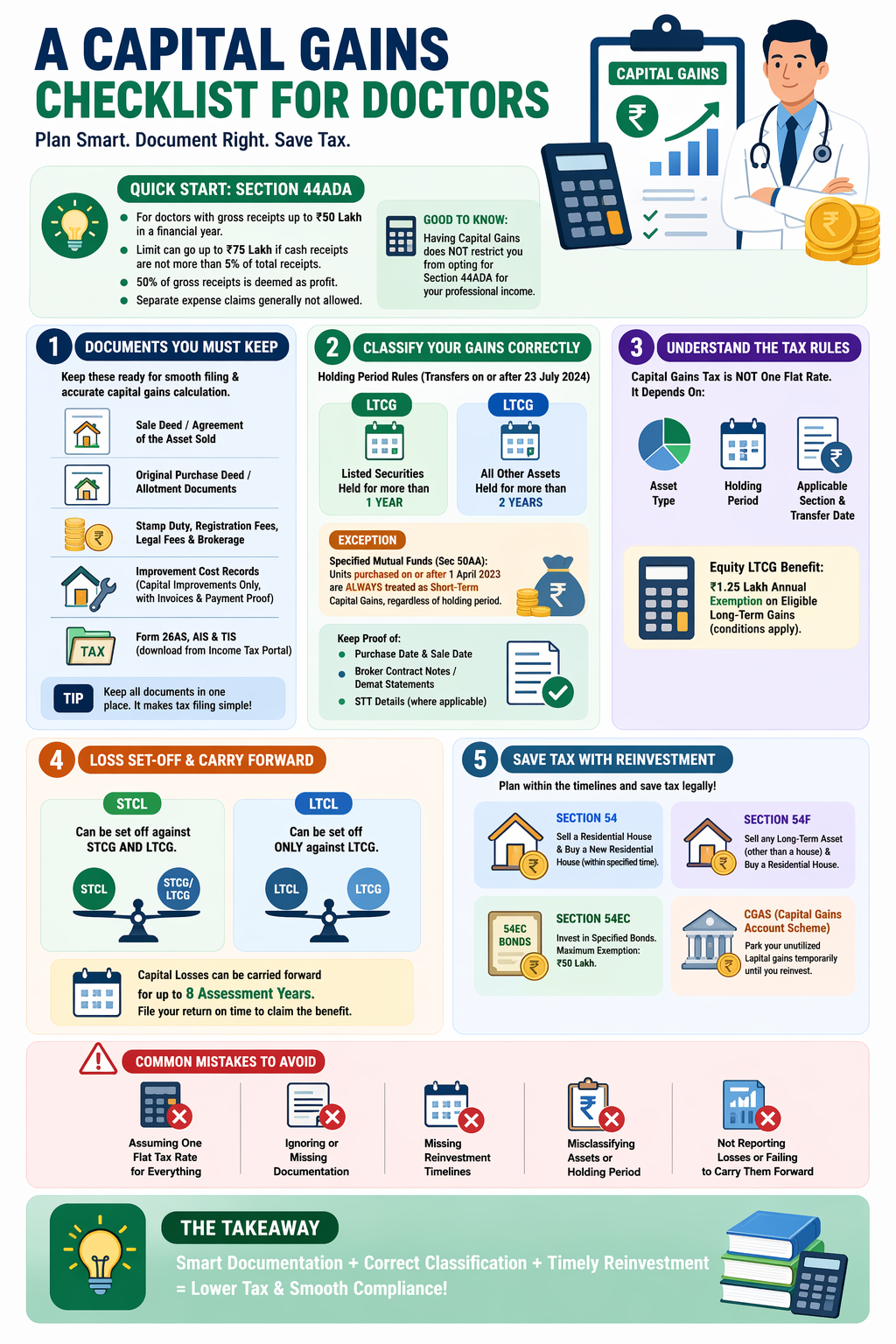
PRESUMPTIVE SCHEME – A BOON FOR DOCTORS
If you are just starting off your career as a doctor, the presumptive income tax scheme under Section 44ADA can be useful for your professional income.
Under this scheme, resident individual doctors with gross receipts up to ₹50 lakh in a financial year can opt for presumptive taxation. The limit can go up to ₹75 lakh if cash receipts are not more than 5% of total gross receipts (so non-cash receipts are at least 95%).
Under Section 44ADA, 50% of gross receipts is deemed as taxable profit (or you may declare a higher profit). Since profit is presumed, separate expense claims are generally not allowed under the presumptive method.
This can reduce record-keeping and audit burden, but note that if you declare profit lower than the presumptive rate, different compliance requirements may apply (including maintaining books and possible audit, depending on your case).
Can a doctor opt for 44ADA even if they have capital gains?
Yes. Capital gains do not stop you from using Section 44ADA for your professional income.
The key practical point is the ITR form. If you have capital gains, first check whether you are eligible to file ITR-4 (Sugam). If you are not eligible for ITR-4, a doctor with professional income generally files ITR-3 (instead of ITR-2).
Doctors commonly have capital gains from sale of land, house, clinic property, equities, mutual funds, bonds, etc. Below is a quick checklist.
CHECKLIST 1 – DOCUMENTS TO BE COLLATED FOR CAPITAL GAINS
When a doctor has gains from sale of a capital asset, capital gains tax may apply. Before calculating, collate these documents for filing returns:
- Copy of the sale deed / agreement for sale of land, apartment, building, clinic etc. For immovable property, a registered instrument is the standard primary proof of transfer.
- Copy of the original purchase deed / allotment documents (as applicable) to establish cost of purchase for capital gains computation.
- Receipts/records of stamp duty and registration fees, and other transfer-related costs like legal fees and brokerage, where applicable. These are commonly relevant while computing net capital gains.
- Improvement cost records (only capital improvements): keep invoices/payment proof for capital nature improvements (for example, structural additions or major renovations). Avoid treating routine repairs and regular maintenance as “cost of improvement” unless clearly capital in nature and well evidenced.
- Municipal taxes are generally not treated as cost of acquisition or cost of improvement for capital gains, but keep records to show there are no statutory dues.
- Also keep: Form 26AS, AIS, and TIS (latest available), downloadable from the Income Tax portal, to reconcile reported transactions.
Keeping all documentation in a single place makes capital gains reporting far simpler.
CHECKLIST 2: EVIDENCING ASSET CLASSIFICATION AND GAINS
The Income Tax Act classifies gains into short-term and long-term, mainly based on the holding period and the type of asset.
Holding period (post 23 July 2024 changes for transfers on/after this date)
- There are now two holding periods for deciding LTCG vs STCG:
- Listed securities: LTCG if held for more than 1 year
- All other assets: LTCG if held for more than 2 years
To evidence classification, keep transaction proofs showing:
- purchase date and sale date
- broker contract notes / demat statements for securities (where relevant)
- STT details where applicable for equity transactions
Important exception: “Specified Mutual Funds” (Section 50AA)
For units of “specified mutual funds” acquired on or after 1 April 2023, gains are deemed short-term capital gains, irrespective of holding period. A “specified mutual fund” (for this purpose) is one where not more than 35% of its total proceeds is invested in equity shares of domestic companies.
So, do not assume “debt fund = 2 years = long term”. For these specified funds, the tax treatment is different.
Equity LTCG threshold and rates depend on the applicable section and transfer date
For listed equity / equity-oriented funds covered under the relevant equity capital gains provisions, the framework includes an annual exemption threshold of ₹1.25 lakh for eligible long-term gains, and rates depend on the applicable section and the transfer date (especially because the new capital gains regime applies to transfers on/after 23 July 2024).
Avoid the “one flat rate for everything” assumption
Capital gains tax rates are not one single rate across all asset classes. The rate depends on:
- the asset type
- the applicable section (for example, equity vs non-equity rules)
- whether the transfer is on/after 23 July 2024 under the new regime
Loss set-off and carry-forward (quick reminder)
- Capital losses can be set off and/or carried forward for up to 8 assessment years.
- Short-term capital loss (STCL) can generally be set off against STCG and LTCG.
- Long-term capital loss (LTCL) can generally be set off only against LTCG.
Carry-forward generally requires that the loss is properly reported in the return, typically by filing within the prescribed timelines.
CHECKLIST 3: BENEFITS ON REINVESTMENT OF LONG-TERM CAPITAL GAINS
To encourage reinvestment, the Act provides exemptions subject to conditions and timelines.
- Section 54 (sale of a residential house property)
- Under Section 54, exemption can apply (subject to conditions) when long-term capital gains from sale of a residential house property are invested in a new residential house within the specified time limits.
- Section 54F (sale of non-residential asset, investment into a residential house)
- Under Section 54F, exemption can apply when LTCG from transfer of a long-term capital asset other than a residential house is invested into a residential house, subject to conditions.
- Section 54EC (capital gain bonds)
- Under Section 54EC, exemption can apply on eligible LTCG when you invest in specified bonds (commonly NHAI/REC and other notified issuers) within 6 months of transfer, subject to limits. The commonly referenced cap is ₹50 lakh (often applied per financial year, subject to how the section/provisos apply to the facts).
- Capital Gains Account Scheme (CGAS)
- If the amount meant for reinvestment is not utilised immediately, you can use the Capital Gains Account Scheme (CGAS) to park the unutilised amount.
The key timing point is not “within the financial year”. The deposit is generally linked to the due date for filing the return under section 139(1), and then the amount must be utilised within the section’s specified time limit (for example, purchase/construction windows under Section 54/54F).