

Clinic Setup Guide for Doctors: Renting vs Owning – What is Better?
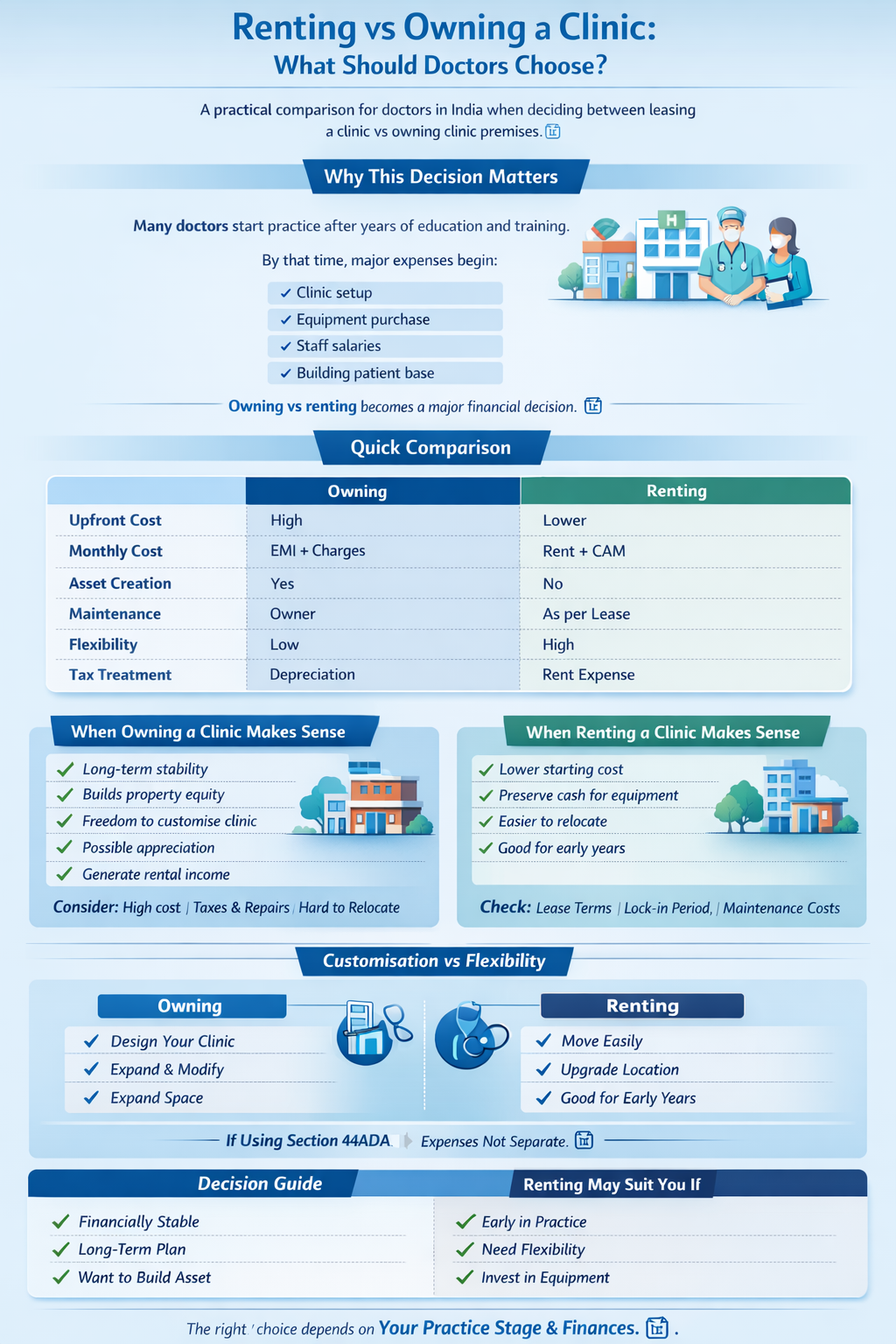
A common debate for doctors in India is whether to own the clinic premises or lease it and pay rent. It is not a simple decision, and it has practical, legal, and cash-flow implications. Here is a structured comparison.
| Feature | Owning Your Clinic | Leasing Your Clinic |
| Upfront Cost | High (Down payment + registration + possible EMI) | Lower (Deposit + advance rent, as per lease) |
| Monthly Cost | Loan EMI (fixed/variable) + society/common charges | Rent + CAM/other pass-through charges (as per lease) |
| Asset Value | Builds equity and potential appreciation | No equity in property (expense for use) |
| Maintenance | Owner generally bears major upkeep and long-term repairs | Split depends on lease; tenant often bears interior upkeep + CAM |
| Flexibility | Low (harder to move) | High (easier to move post lock-in/notice) |
| Non-Cash (Tax) | Depreciation may apply on owned assets used for profession | No building depreciation; depreciation may apply on tenant-owned fit-outs/equipment |
For most doctors, medical education takes time. By the time practice begins, many are close to 30 or beyond. Then comes the grind of starting the clinic, building footfalls, investing in equipment, and paying staff. Because of this, the own-versus-lease call becomes a major financial decision.
A DIFFICULT CHOICE, WITH MERITS EITHER WAY
One key decision is how you use your capital early in your practice.
When does owning the clinic make sense?
Ownership is usually a long-term wealth-building move. It can mean a significant upfront outlay and ongoing ownership costs like property tax, long-term repairs, and upkeep. Owning the clinic can convert what would have been “rent outgo” into an asset in your name. It may also benefit if the location and demand supports property value appreciation. If things work well, the premises can also support rental income later, including post-retirement.
Is there a case for leasing at all?
Yes.
Leasing is often about prioritising liquidity over asset creation. The upfront cost is usually lower, and the monthly outgo is largely the rent plus charges as per the lease. In many commercial leases, the landlord and tenant split maintenance and outgoings based on contract structure, so the doctor must read the clauses carefully.
Leasing does not create property equity, but it can offer flexibility and can be a better fit in the early years when equipment and working capital are the priority.
ARE YOU LOOKING AT CUSTOMISATION OR AGILITY?
For many doctors, the clinic is also a reflection of their practice style. So the choice often becomes: customisation versus agility.
Ownership gives more freedom to redesign, renovate, and expand (subject to building rules and permissions). You can tailor layout and patient flow to match how you want to run the practice.
Leasing, on the other hand, can give agility. If patient demographics change, your practice grows beyond the current space, or you want to shift geographies, moving out can be easier (subject to lock-in, notice, and restoration clauses). Flexibility is usually higher when you lease rather than own.
Now let’s map this decision to your ITR.
HOW TO TREAT THIS IN YOUR ITR (QUICK MAP)
Decide if you are using Section 44ADA or not:
- If you opt for 44ADA: You declare presumptive profit and you generally do not claim separate deductions like clinic rent, depreciation on clinic premises, repairs, or loan interest as line items. So owning vs renting affects your cashflow, but usually does not change your taxable income line-by-line.
- If you do not opt for 44ADA: then owning vs renting changes what you can claim as professional expenses and depreciation.
If you OWN the clinic premises (non-44ADA):
- Depreciation may apply on the clinic premises (if owned and used for practice) and on equipment/fixtures.
- Interest on a loan used for the clinic can be deductible as a professional expense, subject to “put to use” rules and documentation.
If you RENT the clinic (non-44ADA):
- Rent paid for professional use is generally claimed as a professional expense with agreement and payment proof.
- Check if TDS on rent applies in your case.
- No depreciation on the building, but depreciation may apply on tenant-owned fit-outs/equipment if capitalised and used.
CHOICE HAS TO BE BASED ON WHAT SUITS YOU BEST
Both routes have legal and compliance work.
If you own the premises, you typically deal with title due diligence, local land-use/commercial-use compliance, society/building rules, and documentation related to the property.
If you lease, you must understand core lease terms like lock-in, escalation, renewal options, restoration/handback obligations, and who pays which outgoings. Some commercial leases are structured like net / “NNN-style” leases where multiple costs shift to the tenant, so clause reading matters.
On taxation and registrations, avoid blanket assumptions. Many doctors providing only exempt healthcare services are not required to take GST registration, but GST can become relevant if taxable supplies exist and thresholds/triggers are met.
So, here is the practical framing:
- You may lean towards owning if you have financial backing, you want location stability, and you expect to stay put long-term (many people use a 7–10 year style horizon as a rule of thumb, not a rule).
- You may lean towards leasing if you want to preserve cash for equipment, technology, manpower, and you want flexibility to upgrade or relocate.
- However, evaluate both financial and tax implimentations befor deciding wheter to rent or buy.