

Modulating the Oral Microbiome: A New Approach to Dental Caries Prevention
From Oral Microbial Homeostasis to Cariogenic Dysbiosis
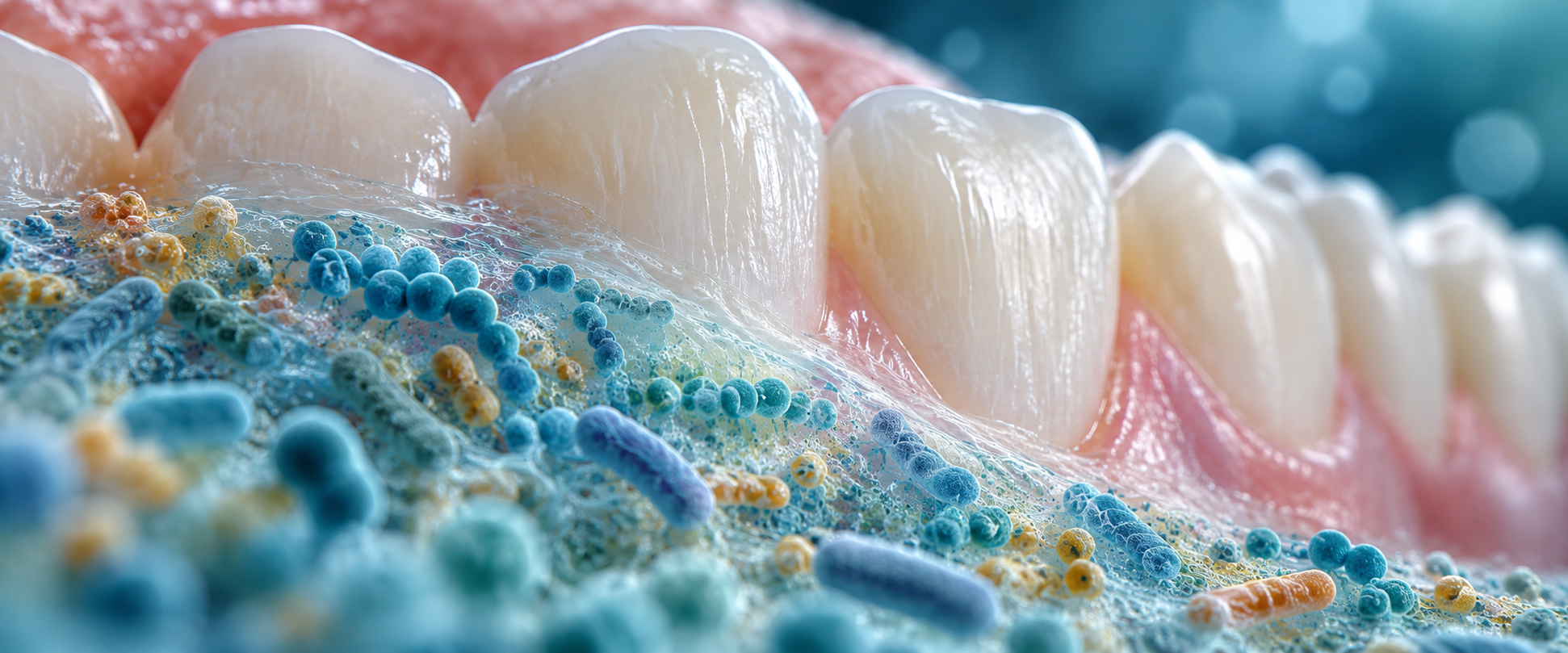
The oral cavity hosts the second most diverse microbiome in the human body. Even in generally healthy individuals the oral microbiome can have an impact far beyond the oral cavity. The development of dental caries is highly associated with the microbiota in the oral cavity.
Dental caries is one of the most common conditions worldwide, affecting individuals of all age groups. Key cariogenic bacteria causing low pH in the dental environment include Streptococcus mutans, lactobacillus species, Scardovia wiggsiae, Bifidobacterium dentium & Veillonella species.
Dental caries was once viewed as a consequence of poor oral hygiene and high sugar consumption but is now understood as a complex, biofilm-mediated disease rooted in microbial dysbiosis. This transition involves a shift in the ecological balance of the dental plaque biofilm, wherein acid-producing bacteria dominate causing localized low-pH environments leading to enamel demineralization.
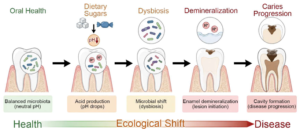
Mechanisms underlying Cariogenic Biofilm Development
Caries arises from interactions among multiple microbial species through metabolic cross-feeding, extracellular matrix formation, quorum sensing and ecological adaptation, rather than from the activity of a single organism.
- EPS production & biofilm architecture: The progression of dental caries is closely linked to the architecture of biofilms formed by cariogenic microbes, particularly Streptococcus mutans [15]. EPSs are produced in high quantities during the metabolism of fermentable carbohydrates, particularly sucrose. The resulting biofilm architecture allows for the formation of dense, structured communities that enhance bacterial adhesion to tooth surfaces and facilitate the retention of nutrients, further promoting an environment conducive to cariogenic activity.
- Suppression of Alkali-producing Species: Dental caries develops more rapidly when alkali-producing bacterial species in the oral microbiome are suppressed. This is due to the fact that the advancement of caries is associated with an increase in acidogenic bacteria, which thrive in low-pH environments and contribute to the demineralization of tooth structures.
- Quorum sensing (QS) & Biofilm resilience: QS facilitates communication among Streptococcus mutans populations, allowing them to coordinate virulence factor production and biofilm formation in response to the density of their bacterial community. The resilient nature of dental biofilms is attributed to the structural complexity of these microbial communities, which provide a protective environment for Streptococcus mutans, allowing it to thrive in acidic conditions that occur from carbohydrate fermentation.
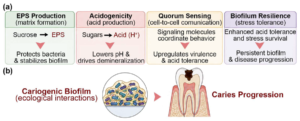
(a) Major mechanisms promoting cariogenic biofilm formation, including EPS production, acidogenicity, quorum sensing, and biofilm resilience. (b) Their synergistic interactions drive caries progression. EPS, exopolysaccharide.
Strategies for Modulating the Oral Microbiome
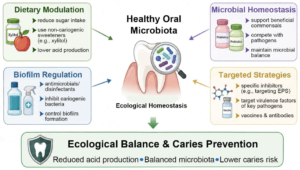
Microbiota based preventive intervention
| Agent/Intervention | Category | Mechanism of Action |
| Xylitol | Dietary polyol | Inhibits Streptococcus
mutans adhesion, reduces acid production |
| Arginine | Prebiotic | Promotes alkali
production, stabilizes plaque pH |
| Polyphenols
(e.g., tea, cranberry) |
Dietary
phytochemicals |
Inhibit EPS synthesis,
downregulate virulence factors |
| Fluoride | Topical agent | Enhances
remineralization, suppresses acidogenicity |
| Probiotics
(L. rhamnosus, S. salivarius) |
Microbiota-based | Reduce Streptococcus
mutans colonization, shift microbiota composition |
| Synbiotics | Microbiota-based | Combined
probiotic–prebiotic effects |
| Cetylpyridinium chloride | Antiseptic | Targets Streptococcus
mutans while preserving commensals |
| Enzyme based/
nano-silver gels |
Emerging hygiene | Selectively inhibit
cariogenic species without disrupting microbiota |
Dietary Modulation
- Reducing fermentable carbohydrates: The metabolism of these carbohydrates by cariogenic bacteria, such as Streptococcus mutans, leads to the production of organic acids, creating an acidic microenvironment that facilitates tooth enamel demineralization. The integration of dietary interventions to limit the intake of fermentable carbohydrates, particularly sugars, is critical to microbiota centered prevention methodologies
- Functional dietary agents: Strategies that use microbiota for dental health have become increasingly popular, with an emphasis on functional dietary substances like xylitol, arginine, and polyphenols to support oral health and help prevent cavities. Xylitol, a five-carbon sugar alcohol, is recognized for its ability to reduce the levels of Streptococcus mutans, a key bacterium associated with dental caries. Arginine, on the other hand, is noted for its prebiotic properties, contributing to the alkalinization of the oral environment, which may discourage acidogenic bacterium growth. Polyphenols, derived mainly from plant sources, have shown antimicrobial properties that can inhibit the growth of harmful bacteria while simultaneously promoting the growth of beneficial microorganisms.
Oral hygiene practices
Microbiota-based prevention strategies in dental health emphasize the importance of maintaining a balanced oral microbiota through effective oral hygiene practices, particularly tooth brushing. Regular and effective tooth brushing disrupts pathogenic biofilm formation on teeth, which is essential for preventing dental caries & periodontal diseases. Research highlights that inadequate oral hygiene can alter the oral microbiota, resulting in increased caries due to the proliferation of cariogenic bacteria. The mechanical removal of plaque through brushing is considered the “gold standard” for preventing both caries and periodontal diseases, as it effectively manages biofilm accumulation and maintains a healthier oral environment.
Conclusion
Modulating the oral microbiota represents a biologically grounded and sustainable strategy for preventing dental caries. By leveraging advances in microbial ecology, diagnostics, and materials science, dentistry is transitioning from reactive restoration to proactive prevention. Although microbiota-based preventive and diagnostic strategies have demonstrated considerable promise, their levels of clinical evidence and readiness for implementation vary substantially. Continues interdisciplinary research will be vital in realizing the full potential of personalized, microbiota-centered care.
References:
- Lee, Yu-Chen et al. “Modulating Oral Microbiota to Prevent Dental Caries: A Microbial Ecology Approach.” Dentistry journal vol. 14,8 477. 4 Aug. 2026, doi:10.3390/dj14080477
- Guo, Kitty, and David Edwards. “Interpreting oral microbiome research in clinical dentistry: terminology, limitations and clinical implications.” British dental journal vol. 241,4 (2026): 236-241. doi:10.1038/s41415-026-9896-z