

Choosing the Right Toothpaste for Root Caries
Root Caries:
Root caries is common, with nearly 33 % of the older population being affected globally. Evidence demonstrates that the prevalence of root caries has increased over time, even among healthy older adults. Root surfaces are more sensitive in acidic conditions to demineralization in comparison to enamel. High levels of carbonate and magnesium in apatite can lead to the development of root caries due to their presence in exposed surface areas and dentine tubular structures.
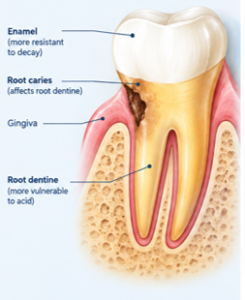
Fig: Root caries
The conventional approach of ’drilling and filling’ remains clinically challenging due to the high organic content of root dentine, proximity to both gingivae and dental pulp, difficulty in obtaining direct access in some cases and moisture control. Therefore, it is imperative to establish cost-effective and efficient management strategies for root caries.
This raises an important clinical question:
Are all fluoride toothpastes equivalent when it comes to managing root caries—or does the active ingredient and its concentration influence clinical outcomes?
A 2026 systematic review with network meta-analysis published in the Journal of Dentistry evaluated the available evidence on toothpastes containing different active ingredients for the management of root caries. Network meta-analysis allows interventions that have not been directly compared in head-to-head trials to be assessed indirectly through a common comparator.
The clinical network was largely based on indirect comparisons, as head-to-head trials between the different active ingredients were limited.
Which active ingredients in toothpastes were evaluated?
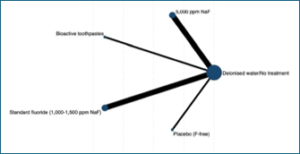
Fig: Network map of different active ingredients in toothpastes in comparison to deionised water/no treatment with respect to lesion depth.
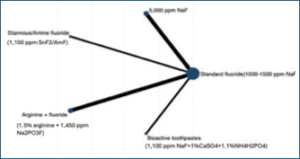
Fig: Network map of different active ingredients in toothpastes in comparison to standard fluoride with respect to lesion hardness
Study results:
In clinical studies, the use of toothpastes containing high concentration of sodium fluoride (5000 ppm) or 1.5 % arginine plus 1450 ppm Na2PO3F, when compared with standard toothpastes containing 1450 ppm sodium fluoride appeared to be effective for hardening/ arrest of root carious lesions.
The pooled estimates reported that root carious lesions became hard following the use of bioactive toothpaste (1100 ppm NaF + 1 % CaSO4 + 1.1 % NH4H2PO4) in comparison to the standard toothpastes.
Clinical relevance:
The use of toothpaste containing high concentration of sodium fluoride as active ingredient by prescription only can be considered as the first-line non-invasive therapy for arresting active root caries. Alternatively, over-the-counter toothpastes either containing fluoride with arginine or bioactive ingredients could potentially be an optimum option for patients who cannot tolerate or decline to use high-fluoride prescriptions.
Conclusion:
The study identified that toothpaste with sodium fluoride as an active ingredient in high concentration was the most effective at reducing lesion depth, improving lesion hardness, and preventing new caries. The incorporation of bioactive components that deliver calcium and phosphate (bioactive toothpaste) and the adjunctive use of fluoride with arginine may potentially manage these lesions in comparison to the standard toothpaste containing 1450 ppm sodium fluoride which might be insufficient to arrest active root caries in high-risk patients.
Key takeaways:
- Fluoride remains central to the non-invasive management of root caries
- Concentration and formulation may matter, particularly in patients at high risk of root caries
- 5000 ppm sodium fluoride showed the strongest overall performance among the evaluated interventions
- Arginine-containing fluoride and bioactive calcium/phosphate formulations showed promising results
References:
Chen, Haoran et al. “The use of toothpastes containing different active agents in managing root caries: A systematic review with network meta-analysis.” Journal of dentistry vol. 168 (2026): 106582. doi:10.1016/j.jdent.2026.106582