Searching...
Can't find what you're looking for. Try different keywords.


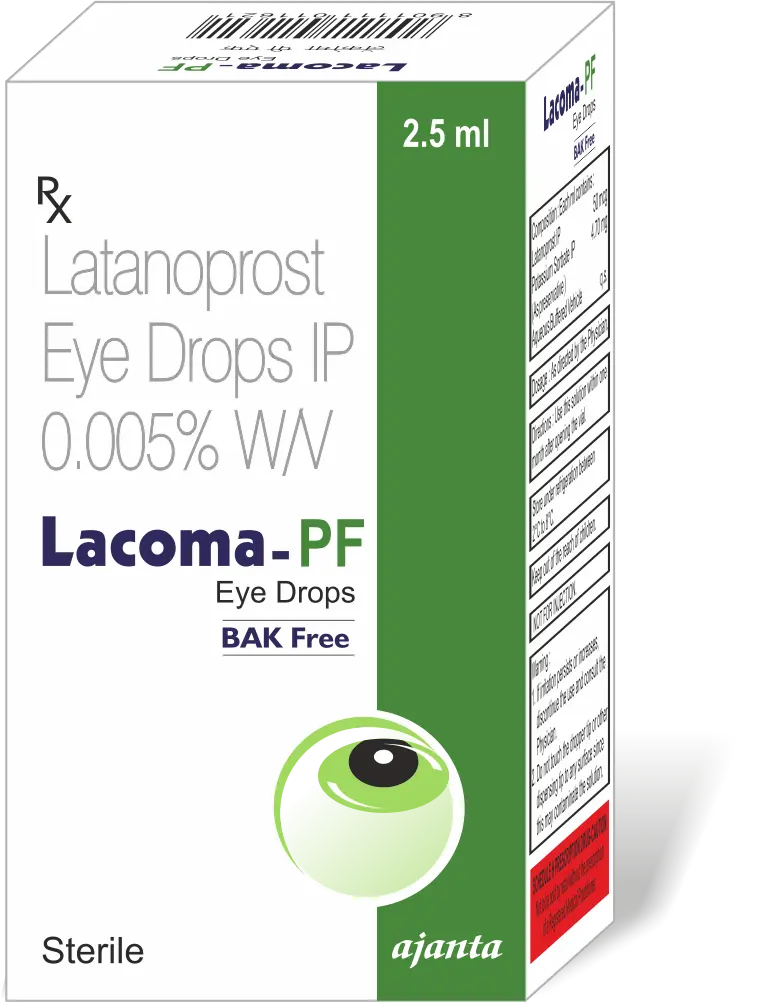

Latonoprost
0.005%
Dosage Form & Strength
**Adults & ≥6 yrs: 1 drop in affected eye(s) once daily, preferably evening**
Lacoma PF is indicated for the treatment of Glaucoma & ocular hypertension
Most common adverse reactions (5-15%) from clinical trials are blurred vision, burning and stinging, conjunctival hyperemia, foreign body sensation, itching, increased pigmentation of the iris, and punctate keratitis
Definitive drug interaction data are not available. There have been reports of paradoxical elevations in IOP following the concomitant ophthalmic administration of two prostaglandin analogues. Therefore, the use of two or more prostaglandins, prostaglandin analogues or prostaglandinderivatives is not recommended
Latanoprost, a prostaglandin F 2α analogue, is a selective prostanoid FP receptor agonist that reduces the IOP byincreasing the outflow of aqueous humour. The main mechanism of action is increased uveoscleral outflow. Additionally,some increase in outflow facility (decrease in trabecular outflow resistance) has been reported in man. Latanoprost hasno significant effect on the production of aqueous humour, the blood-aqueous barrier or the intraocular blood circulation.Chronic treatment with latanoprost in monkey eyes, which had undergone extracapsular lens extraction did not affect theretinal blood vessels as determined by fluorescein angiography. Latanoprost has not induced fluorescein leakage in theposterior segment of pseudophakic human eyes during short term treatment.
The half life of Latanoprost in Lacoma PF is 17 minutes
Latanoprost is an isopropyl ester prodrug which per se is inactive, but after hydrolysis to the acid of latanoprost becomes biologically active. The prodrug is well absorbed through the cornea and all drug that enters the aqueous humour is hydrolysed during the passage through the cornea. Studies in man indicate that the peak concentration in the aqueous humour is reached about two hours after topical administration. After topical application in monkeys, latanoprost is distributed primarily in the anterior segment, the conjunctivae and the eyelids. Only minute quantities of the drug reach the posterior segment. There is practically no metabolism of the acid of latanoprost in the eye. The main metabolism occurs in the liver. The half life in plasma is 17 minutes in man. The main metabolites, the 1,2-dinor and 1,2,3,4-tetranor metabolites, exert no or only weak biological activity in animal studies and are excreted primarily in the urine.
Fertility Latanoprost has not been found to have any effect on male or female fertility in animal studies. Pregnancy The safety of this medicinal product for use in human pregnancy has not been established. It has potential hazardous pharmacological effects with respect to the course of pregnancy, to the unborn or the neonate. Therefore, Latanoprost eye drops should not be used during pregnancy. Breast-feeding Latanoprost and its metabolites may pass into breast milk and Latanoprost eye drops should therefore not be used in nursing women or breast feeding should be stopped.
Paediatric population Efficacy and safety data in the age group < 1 year (4 patients) are very limited. No data are available for preterm infants (less than 36 weeks gestational age). In children from 0 to < 3 years old that mainly suffer from PCG (primary congenital glaucoma), surgery (e.g. trabeculotomy/goniotomy) remains the first line treatment. Long-term safety in children has not yet been established.
Lacoma PF is indicated in adults (including the elderly) for the reduction of intraocular pressure (IOP) in patients with openangle glaucoma and ocular hypertension who are insufficiently responsive to topical beta-blockers or prostaglandinanalogues.
Subscribe to our newsletter and be the first to receive insights, updates, and expert tips on optimizing your financial management.