Searching...
Can't find what you're looking for. Try different keywords.


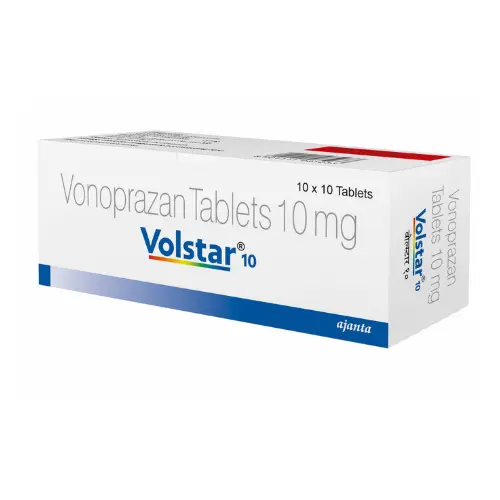

Vonoprazan Tablets
10 mg/20 mg
Recommended Dosage: • Healing of Erosive Esophagitis: 20mg once daily for 8 weeks. • Maintenance of Healed Erosive Esophagitis:10 mg once daily for up to 6 months. • Relief of Heartburn Associated with Non- Erosive Gastroesophageal Reflux Disease: 10 mg once daily for 4 weeks.
• For the healing of all grades of Erosive Esophagitis (Erosive Gastroesophageal Reflux Disease or Erosive GERD) and relief of heartburn associated with Erosive GERD in adults • Treatment of Gastric Ulcers • Treatment of Duodenal ulcers • Prevention or recurrence of gastric/ duodenal ulcers during NSAIDs / low dose aspirin • In combination with amoxicillin and clarithromycin for the treatment of Helicobacter pylori (H. pylori) infection in adults
•Vonoprazan is contraindicated in patients with a known hypersensitivity to vonoprazan or any component of Vonoprazan. Reactions have included anaphylactic shock. •Vonoprazan is contraindicated with rilpivirine-containing products. •For information about contraindications of antibacterial agents (clarithromycin and amoxicillin) indicated in combination with Vonoprazan, refer to the Contraindications section of the corresponding prescribing information.
Most common adverse reactions in vonoprazan-treated patients are: • Healing of Erosive Esophagitis (≥2%): gastritis, diarrhea, abdominal distension, abdominal pain, and nausea. • Maintenance of Healed Erosive Esophagitis (≥3%): gastritis, abdominal pain, dyspepsia, hypertension, and urinary tract infection. • Relief of Heartburn Associated with Non-Erosive Gastroesophageal Reflux Disease (≥2%): abdominal pain, constipation, diarrhea, nausea, and urinary tract infection. • Treatment of H. pylori Infection (≥2%): diarrhea, dysgeusia, vulvovaginal candidiasis, abdominal pain, headache, hypertension, and nasopharyngitis
Acute tubulointerstitial nephritis reported; if suspected, discontinue drug and evaluate patient Severe cutaneous adverse reactions, including Stevens-Johnson syndrome (SJS) and toxic epidermal necrolysis (TEN) reported; discontinue drug at first signs or symptoms of severe cutaneous adverse reactions or other signs of hypersensitivity and consider further evaluation Long-term use of acid-suppressing drugs can lead to malabsorption of Vitamin B12 caused by hypo- or achlorhydria; vitamin B12 deficiency has been reported postmarketing with vonoprazan; consider further workup if clinical symptoms consistent with vitamin B12 deficiency observed
Drugs with clinically important drug interactions and interaction with diagnostics when administered concomitantly with Vonoprazan and instructions for preventing or managing them. These recommendations are based on either drug interaction trials or predicted interactions due to the expected magnitude of interaction and potential for serious adverse reactions or loss of efficacy. Consult the labelling of concomitantly used drugs to obtain further information about interactions with Vonoprazan.
Vonoprazan is a potassium competitive acid blocker (PCAB) and inhibits H+, K+-ATPase in a reversible and potassium-competitive manner. It does not require activation by acid. Vonoprazan is a strong base with a high affinity for the acid pump of gastric cells inhibiting gastric acid production
The mean apparent terminal half-life of vonoprazan is approximately 7.7 hours in healthy adults
Absorption: Vonoprazan exhibits time independent pharmacokinetics and steady state concentrations are achieved by Day 3 to 4. After multiple doses of vonoprazan ranging from 10 to 40 mg (twice the maximum recommended dose) once daily for 7 days in healthy subjects, Cmax and area under the plasma concentration time curve (AUC) values for vonoprazan increased in an approximately dose-proportional manner. There is little accumulation in plasma after once daily multiple doses, with an accumulation index ratio of less than 1.2 based on AUC for doses ranging from 10 to 40 mg (twice the maximum recommended dose). metabolism: Vonoprazan is metabolized mainly by hepatic drug-metabolizing enzyme CYP3A4 and partially by CYP2B6, CYP2C19 and CYP2D6. Vonoprazan is also metabolized by sulfotransferase SULT2A1 (in vitro). Vonoprazan exhibits time-dependent inhibitory effect on CYP2B6, CYP2C19 and CYP3A4/5 (in vitro). In addition, vonoprazan shows a slight concentration-dependent inductive effect on CYP1A2, but it shows little inductive effect on CYP2B6 and CYP3A4/5 (in vitro). Excretion: When radioactive-labelled drug (15 mg as vonoprazan) is orally administered to healthy adult male subjects, 98.5% of the radioactivity administered is excreted into urine and feces by 168 hours after administration: 67.4% into urine and 31.1% into feces
Pregnancy: No clinical studies have been conducted to date to evaluate vonoprazan in subjects who are pregnant. In a rat toxicology study, embryo-foetal toxicity was observed following exposure of more than approximately 28 times of the exposure (AUC) at the maximum clinical dose (40 mg/day) of vonoprazan. As a precaution, vonoprazan should not be administered to women who are or may be pregnant, unless the expected therapeutic benefit is thought to outweigh any possible risk.
Pediatric: The safety and effectiveness of vonoprazan have not been established in pediatric patients.
Subscribe to our newsletter and be the first to receive insights, updates, and expert tips on optimizing your financial management.