Searching...
Can't find what you're looking for. Try different keywords.


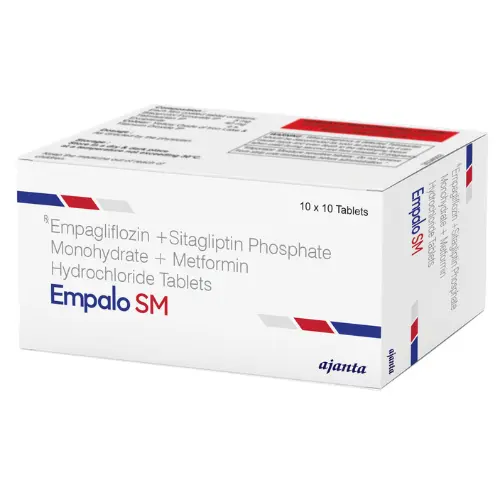

Empagliflozin
10 mg
Sitagliptin
100 mg
Metformin
1000 mg
Dosage Form & Strength
One tablet once daily, taken orally, preferably with a meal or as directed by the physician.
1. Empagliflozin + Metformin: Innovator Brand: Synjardy 2. Sitagliptin Innovator brand: Januvia
1. Empalo SM 10/100/1000 Empagliflozin 10 mg Sitagliptin 100 mg Metformin 1000 mg 2. Empalo SM 25/100/1000 Empagliflozin 25 mg Sitagliptin 100 mg Metformin 1000 mg
Because of the potential for serious adverse reactions in a breastfed infant, Empalo SM is not recommended when breastfeeding Half Life: Empagliflozin: The apparent terminal elimination half-life of empagliflozin was estimated to be 12.4 h Sitagliptin: The apparent terminal t 1/2 following a 100 mg oral dose of sitagliptin is approximately 12.4 hours Metformin: The plasma elimination half-life of metformin is approximately 6.2 hours
“1. As an adjunct to diet and exercise to improve glycemic control in adults with type 2 diabetes Mellitus. 2. To reduce the risk of cardiovascular death and hospitalization for heart failure in adults with heart failure. 3. To reduce the risk of cardiovascular death in adults with type 2 diabetes mellitus and established cardiovascular disease.
1. Hypersensitivity to empagliflozin, sitagliptin, metformin or any of the excipients in Empalo SM 2. Patient on dialysis 3. Empalo is not recommended in patients with an eGFR less than 30 mL/min/1.73m2.
Empagliflozin: 1. Urinary tract infections 2. Female genital mycotic infections 3. Ketoacidosis 4. Volume depletion 5. Urosepsis and Pyelonephritis 6. Hypoglycemia with concomitant use with Insulin and Insulin Secretagogues 7. Necrotizing Fasciitis of the Perineum (Fournier’s Gangrene) 8. Hypersensitivity Reactions Sitagliptin: 1. Upper respiratory tract infection 2. Nasopharyngitis 3. Headache Metformin: 1. Diarrhea 2. Nausea/vomiting 3. Flatulence 4. Abdominal discomfort 5. Indigestion 6. Asthenia 7. Headache
1. Ketoacidosis: Assess patients who present with signs and symptoms of metabolic acidosis for ketoacidosis, regardless of blood glucose level. If suspected, discontinue Empalo, evaluate and treat promptly. Before initiating Empalo, consider risk factors for ketoacidosis. Patients on Empalo S may require monitoring and temporary discontinuation of therapy in clinical situations known to predispose to ketoacidosis. 2. Volume Depletion: Before initiating Empalo, assess volume status and renal function in patients with impaired renal function, elderly patients, or patients on loop diuretics. Monitor for signs and symptoms during therapy. 3. Urosepsis and Pyelonephritis: Evaluate patients for signs and symptoms of urinary tract infections and treat promptly, if indicated. 4. Hypoglycemia: Consider lowering the dose of insulin secretagogue or insulin to reduce the risk of hypoglycemia when initiating Empalo S. 5. Necrotizing Fasciitis of the Perineum (Fournier’s Gangrene): Serious life-threatening cases have occurred in both females and males. Assess patients presenting with pain or tenderness, erythema, or swelling in the genital or perineal area, along with fever or malaise. If suspected, institute prompt treatment. 6. Genital Mycotic Infections: Monitor and treat as appropriate 7. Hypersensitivity Reactions: Serious hypersensitivity reactions (e.g., angioedema) have occurred with Empalo S. If hypersensitivity reactions occur, discontinue Empalo S, treat promptly, and monitor until signs and symptoms resolve. 8. There have been post marketing reports of acute pancreatitis, including fatal and non-fatal hemorrhagic or necrotizing pancreatitis. If pancreatitis is suspected, promptly discontinue Empalo S. 9. There have been post marketing reports of acute renal failure, sometimes requiring dialysis. Dosage adjustment is recommended in patients with moderate or severe renal insufficiency and in patients with ESRD. Assessment of renal function is recommended prior to initiating Empalo S and periodically thereafter. 10. Post marketing cases of metformin-associated lactic acidosis have resulted in death, hypothermia, hypotension, and resistant bradyarrhythmias. Symptoms included malaise, myalgias, respiratory distress, somnolence, and abdominal pain. Laboratory abnormalities included elevated blood lactate levels, anion gap acidosis, increased lactate/pyruvate ratio; and metformin plasma levels generally >5 mcg/mL. 11. Vitamin B12 deficiency: Metformin may lower vitamin B12 levels. Monitor hematologic parameters annually. 12. Discontinue Empalo SM at the time of, or prior to, an iodinated contrast imaging procedure in patients with an eGFR between 45 and 60 mL/min/1.73 m2; in patients with a history of liver disease, alcoholism or heart failure; or in patients who will be administered intra-arterial iodinated contrast. Re-evaluate eGFR 48 hours after the imaging procedure; restart Empalo SM if renal function is stable. 13. If lactic acidosis is suspected, discontinue Empalo SM and institute general supportive measures in a hospital setting. Prompt hemodialysis is recommended.
1. Diuretics: Coadministration of empagliflozin with diuretics resulted in increased urine volume and frequency of voids, which might enhance the potential for volume depletion. 2. Insulin or Insulin Secretagogues: The risk of hypoglycemia is increased when empagliflozin is used in combination with insulin secretagogues (e.g., sulfonylurea) or insulin. 3. Positive Urine Glucose Test: SGLT2 inhibitors increase urinary glucose excretion and will lead to positive urine glucose tests. 4. Interference with 1,5-anhydroglucitol Assay Measurements of 1,5-AG are unreliable in assessing glycemic control in patients taking SGLT2 inhibitors. 5. Digoxin: There was a slight increase in the area under the curve (AUC, 11%) and mean peak drug concentration (Cmax, 18%) of digoxin with the co-administration of 100 mg sitagliptin for 10 days. Patients receiving digoxin should be monitored appropriately. No dosage adjustment of digoxin or Empalo S is recommended. 6. Carbonic anhydrase inhibitors may increase risk of lactic acidosis. Consider more frequent monitoring. 7. Drugs that reduce metformin clearance (such as ranolazine, vandetanib, dolutegravir, and cimetidine) may increase the accumulation of metformin. Consider the benefits and risks of concomitant use. 8. Alcohol can potentiate the effect of metformin on lactate metabolism. Warn patients against excessive alcohol intake.
Empagliflozin: Empagliflozin is an inhibitor of the sodium-glucose co-transporter 2 (SGLT2), the predominant transporter responsible for reabsorption of glucose from the glomerular filtrate back into the circulation. By inhibiting SGLT2, empagliflozin reduces renal reabsorption of filtered glucose and lowers the renal threshold for glucose, and thereby increases urinary glucose excretion. Empagliflozin also reduces sodium reabsorption and increases the delivery of sodium to the distal tubule. This may influence several physiological functions such as lowering both pre-and afterload of the heart and downregulating sympathetic activity. Sitagliptin: Sitagliptin is a DPP-4 inhibitor, which is believed to exert its actions in patients with type 2 diabetes by slowing the inactivation of incretin hormones. Concentrations of the active intact hormones are increased by Sitagliptin, thereby increasing and prolonging the action of these hormones. Incretin hormones, including glucagon-like peptide-1 (GLP-1) and glucose-dependent insulinotropic polypeptide (GIP), are released by the intestine throughout the day, and levels are increased in response to a meal. These hormones are rapidly inactivated by the enzyme, DPP-4. The incretins are part of an endogenous system involved in the physiologic regulation of glucose homeostasis. When blood glucose concentrations are normal or elevated, GLP-1 and GIP increase insulin synthesis and release from pancreatic beta cells by intracellular signaling pathways involving cyclic AMP. GLP-1 also lowers glucagon secretion from pancreatic alpha cells, leading to reduced hepatic glucose production. By increasing and prolonging active incretin levels, Sitagliptin increases insulin release and decreases glucagon levels in the circulation in a glucose-dependent manner. Sitagliptin demonstrates selectivity for DPP-4 and does not inhibit DPP-8 or DPP-9 activity in vitro at concentrations approximating those from therapeutic doses. Metformin: Metformin is an antihyperglycemic agent which improves glucose tolerance in patients with type 2 diabetes mellitus, lowering both basal and postprandial plasma glucose. It is not chemically or pharmacologically related to any other classes of oral antihyperglycemic agents. Metformin decreases hepatic glucose production, decreases intestinal absorption of glucose, and improves insulin sensitivity by increasing peripheral glucose uptake and utilization. With metformin therapy, insulin secretion remains unchanged while fasting insulin levels and day-long plasma insulin response may actually decrease.
Empagliflozin: 1. Absorption After oral administration, peak plasma concentrations of empagliflozin were reached at 1.5 hours post-dose. Systemic exposure of empagliflozin increased in a dose proportional manner in the therapeutic dose range. The single-dose and steady-state pharmacokinetic parameters of empagliflozin were similar, suggesting linear pharmacokinetics with respect to time. Empagliflozin may be administered with or without food. 2. Distribution: The apparent steady-state volume of distribution was estimated to be 73.8 L based on a population pharmacokinetic analysis. Following administration of an oral [14C]-empagliflozin solution to healthy subjects, the red blood cell partitioning was approximately 36.8% and plasma protein binding was 86.2%. 3. Metabolism: No major metabolites of empagliflozin were detected in human plasma and the most abundant metabolites were three glucuronide conjugates (2-O-, 3-O-, and 6-O-glucuronide). Systemic exposure of each metabolite was less than 10% of total drug-related material. In vitro studies suggested that the primary route of metabolism of empagliflozin in humans is glucuronidation by the uridine 5′-diphospho-glucuronosyltransferases UGT2B7, UGT1A3, UGT1A8, and UGT1A9. 4. Excretion: The apparent terminal elimination half-life of empagliflozin was estimated to be 12.4 h. Following administration of an oral [14C]-empagliflozin solution to healthy subjects, approximately 95.6% of the drug-related radioactivity was eliminated in feces (41.2%) or urine (54.4%). Sitagliptin: 1. Absorption: The absolute bioavailability of sitagliptin is approximately 87%. Because coadministration of a high-fat meal with Sitagliptin had no effect on the pharmacokinetics, SItagliptin may be administered with or without food. 2. Distribution: The mean volume of distribution at steady state following a single 100 mg intravenous dose of sitagliptin to healthy subjects is approximately 198 liters. The fraction of sitagliptin reversibly bound to plasma proteins is low (38%). 3. Metabolism: Approximately 79% of sitagliptin is excreted unchanged in the urine with metabolism being a minor pathway of elimination. 4. Excretion: Elimination of sitagliptin occurs primarily via renal excretion and involves active tubular secretion. The apparent terminal t 1/2 following a 100 mg oral dose of sitagliptin was approximately 12.4 hours and renal clearance was approximately 350 mL/min. Metformin: 1. Absorption: The absolute bioavailability of a metformin hydrochloride 500-mg tablet given under fasting conditions is approximately 50% to 60%. Studies using single oral doses of metformin hydrochloride tablets 500 mg to 1500 mg, and 850 mg to 2550 mg, indicate that there is a lack of dose proportionality with increasing doses, which is due to decreased absorption rather than an alteration in elimination. Food decreases the extent of and slightly delays the absorption of metformin, as shown by approximately a 40% lower Cmax, a 25% lower AUC, and a 35 minute prolongation of time to peak plasma concentration (Tmax) following administration of a single 850 mg tablet of metformin with food, compared to the same tablet strength administered fasting. 2. Distribution: The apparent volume of distribution (V/F) of metformin following single oral doses of immediate-release metformin hydrochloride tablets 850 mg averaged 654±358 L. Metformin is negligibly bound to plasma proteins, in contrast to SUs, which are more than 90% protein bound. Metformin partitions into erythrocytes, most likely as a function of time. At usual clinical doses and dosing schedules of metformin tablets, steady-state plasma concentrations of metformin are reached within 24 to 48 hours and are generally <1 mcg/mL. During controlled clinical trials of metformin, maximum metformin plasma levels did not exceed 5 mcg/mL, even at maximum doses. 3. Metabolism: Intravenous single-dose studies in normal subjects demonstrate that metformin is excreted unchanged in the urine and does not undergo hepatic metabolism (no metabolites have been identified in humans) nor biliary excretion. 4. Excretion: Renal clearance is approximately 3.5 times greater than creatinine clearance, which indicates that tubular secretion is the major route of metformin elimination. Following oral administration, approximately 90% of the absorbed drug is eliminated via the renal route within the first 24 hours, with a plasma elimination half-life of approximately 6.2 hours. In blood, the elimination half-life is approximately 17.6 hours, suggesting that the erythrocyte mass may be a compartment of distribution.
Absorption: Empagliflozin: After oral administration, peak plasma concentrations of empagliflozin were reached at 1.5 hours post-dose. Systemic exposure of empagliflozin increased in a dose proportional manner in the therapeutic dose range. The single-dose and steady-state pharmacokinetic parameters of empagliflozin were similar, suggesting linear pharmacokinetics with respect to time. Empagliflozin may be administered with or without food. Sitagliptin: The absolute bioavailability of sitagliptin is approximately 87%. Because coadministration of a high-fat meal with Sitagliptin had no effect on the pharmacokinetics, SItagliptin may be administered with or without food. Metformin: The absolute bioavailability of a metformin hydrochloride 500-mg tablet given under fasting conditions is approximately 50% to 60%. Studies using single oral doses of metformin hydrochloride tablets 500 mg to 1500 mg, and 850 mg to 2550 mg, indicate that there is a lack of dose proportionality with increasing doses, which is due to decreased absorption rather than an alteration in elimination. Food decreases the extent of and slightly delays the absorption of metformin, as shown by approximately a 40% lower Cmax, a 25% lower AUC, and a 35 minute prolongation of time to peak plasma concentration (Tmax) following administration of a single 850 mg tablet of metformin with food, compared to the same tablet strength administered fasting. —x-x— Bioavailability: Empagliflozin: The absolute oral bioavailability of empagliflozin is approximately 78%. Sitagliptin: The absolute bioavailability of sitagliptin is approximately 87%. Metformin: The absolute bioavailability of a metformin hydrochloride 500-mg tablet given under fasting conditions is approximately 50% to 60%. —x-x— Metabolism: Empagliflozin: No major metabolites of empagliflozin were detected in human plasma and the most abundant metabolites were three glucuronide conjugates (2-O-, 3-O-, and 6-O-glucuronide). Systemic exposure of each metabolite was less than 10% of total drug-related material. In vitro studies suggested that the primary route of metabolism of empagliflozin in humans is glucuronidation by the uridine 5′ Sitagliptin: Approximately 79% of sitagliptin is excreted unchanged in the urine with metabolism being a minor pathway of elimination. Metformin: Intravenous single-dose studies in normal subjects demonstrate that metformin is excreted unchanged in the urine and does not undergo hepatic metabolism (no metabolites have been identified in humans) nor biliary excretion. —x-x— Excretion: Empagliflozin: The apparent terminal elimination half-life of empagliflozin was estimated to be 12.4 h. Following administration of an oral [14C]-empagliflozin solution to healthy subjects, approximately 95.6% of the drug-related radioactivity was eliminated in feces (41.2%) or urine (54.4%). Sitagliptin: Elimination of sitagliptin occurs primarily via renal excretion and involves active tubular secretion. The apparent terminal t 1/2 following a 100 mg oral dose of sitagliptin is approximately 12.4 hours and renal clearance was approximately 350 mL/min. Metformin: Renal clearance is approximately 3.5 times greater than creatinine clearance, which indicates that tubular secretion is the major route of metformin elimination. Following oral administration, approximately 90% of the absorbed drug is eliminated via the renal route within the first 24 hours, with a plasma elimination half-life of approximately 6.2 hours. In blood, the elimination half-life is approximately 17.6 hours, suggesting that the erythrocyte mass may be a compartment of distribution.
Empalo SM is not recommended during the second and third trimesters of pregnancy.
Empagliflozin: The glucose lowering benefit of Empagliflozin 25 mg decreases in patients with worsening renal function. The risks of renal impairment, volume depletion adverse reactions and urinary tract infection-related adverse reactions increases with worsening renal function. Sitagliptin: 1. For patients with mild renal insufficiency (creatinine clearance [CrCl] ≥50 mL/min, approximately corresponding to serum creatinine levels of ≤1.7 mg/dL in men and ≤1.5 mg/dL in women), no dosage adjustment for Empalo S is required. 2. For patients with moderate renal insufficiency (CrCl ≥30 to <50 mL/min, approximately corresponding to serum creatinine levels of >1.7 to ≤3.0 mg/dL in men and >1.5 to ≤2.5 mg/dL in women), the dose of Sitagliptin is 50 mg once daily. 3. For patients with severe renal insufficiency (CrCl <30 mL/min, approximately corresponding to serum creatinine levels of >3.0 mg/dL in men and >2.5 mg/dL in women) or with end-stage renal disease (ESRD) requiring hemodialysis or peritoneal dialysis, the dose of Sitagliptin is 25 mg once daily. Empalo SM may be administered without regard to the timing of hemodialysis.
Avoid use in patients with hepatic impairment
Safety and effectiveness of Empalo SM in pediatric patients under 18 years of age have not been established.
Empalo SM is expected to have diminished glycemic efficacy in elderly patients with renal impairment. Sitagliptin is known to be substantially excreted by the kidney. Because elderly patients are more likely to have decreased renal function, care should be taken in dose selection in the elderly, and it may be useful to assess renal function in these patients prior to initiating dosing and periodically thereafter. The risk of metformin-associated lactic acidosis increases with the patient’s age because elderly patients have a greater likelihood of having hepatic, renal, or cardiac impairment than younger patients. Assess renal function more frequently in elderly patients
Subscribe to our newsletter and be the first to receive insights, updates, and expert tips on optimizing your financial management.