Searching...
Can't find what you're looking for. Try different keywords.


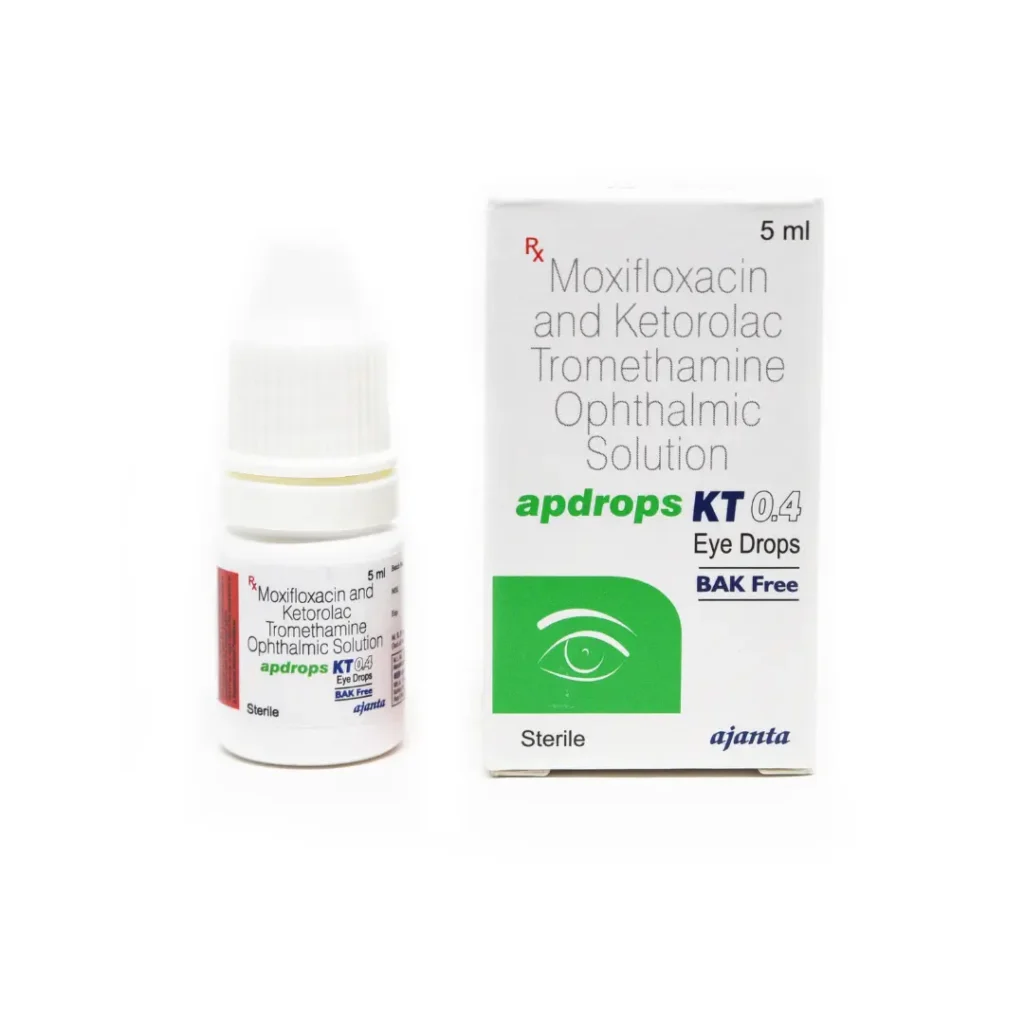

Moxifloxacin HCL
0.5%
Ketorolac tromethamine
0.4%
Dosage Form & Strength
TID or QD
Apdrops KT is indicated for the treatment of Post ocular surgery
Apdrops KT is contrainidicated in Hypersensitivity to the ingredients of this drug
Moxifloxacin The most frequently reported ocular adverse events were conjunctivitis, decreased visual acuity, dry eye, keratitis, ocular discomfort, ocular hyperemia, ocular pain, ocular pruritus, subconjunctival hemorrhage, and tearing. These events occurred in approximately 1-6% of patients. Nonocular adverse events reported at a rate of 1-4% were fever, increased cough, infection, otitis media, pharyngitis, rash, and rhinitis. Ketorolac The most frequent adverse reactions reported by up to 40% of patients participating in clinical trials have been transient stinging and burning on instillation.
Moxifloxacin:Drug-drug interaction studies have not been conducted with Moxifloxacin solution. In vitro studies indicate that moxifloxacin does not inhibit CYP3A4, CYP2D6, CYP2C9, CYP2C19, or CYP1A2 indicating that moxifloxacin is unlikely to alter the pharmacokinetics of drugs metabolized by these cytochrome P450 isozymes
Moxifloxacin, a fourth-generation fluoroquinolone, inhibits the DNA gyrase and topoisomerase IV required for bacterial DNA replication, repair, and recombination
Moxifloxacin Following topical ocular administration, moxifloxacin was absorbed into the systemic circulation. Plasma concentrations of moxifloxacin were measured in 21 male and female subjects who received bilateral topical ocular doses of the medicinal product 3 times a day for 4 days. The mean steady-state Cmax and AUC were 2.7 ng/ml and 41.9 ng·hr/ml, respectively. These exposure values are approximately 1,600 and 1,200 times lower than the mean Cmax and AUC reported after therapeutic 400 mg oral doses of moxifloxacin. The plasma half-life of moxifloxacin was estimated to be 13 hours. Ketorolac Tmax 3.38 hr Half-life 3.77 hr Absolute ocular bioavailability 3.7% Distribution After ophthalmic doses were administered to rabbits, peak concentrations of radioactivity were achieved within 1 hour in the ocular tissues and were highest in the cornea (6.06 mcg-eq/ml). At 1 hour, the majority of the radioactivity (0.9% of administered dose) was recovered from the sclera (0.58%) and cornea (0.24%), and smaller amounts were recovered from the aqueous humor (0.026%), vitreous humor (0.023%), retina-choroid (0.018%), iris-ciliary body (0.007%) and lens (0.002%).
Moxifloxacin: Pregnancy There are no adequate data from the use of Moxifloxacin in pregnant women. However, no effects on pregnancy are anticipated since the systemic exposure to moxifloxacin is negligible. The medicinal product can be used during pregnancy. Breastfeeding It is unknown whether moxifloxacin/metabolites are excreted in human milk. Animal studies have shown excretion of low levels in breast milk after oral administration of moxifloxacin. However, at therapeutic doses of Moxifloxacin no effects on the suckling child are anticipated. The medicinal product can be used during breastfeeding. Fertility Studies have not been performed to evaluate the effect of ocular administration of Moxifloxacin on fertility. Ketorolac Pregnancy There are no adequate data from the use of eye drops containing ketorolac trometamol in pregnant women. Studies in animals have shown reproductive toxicity. Inhibition of prostaglandin synthesis may negatively affect pregnancy and/or embryonal/foetal development and/ or postnatal development. Although a very low systemic exposure is expected after the use of ketorolac eye drops, Ketorolac trometamol 0.5% w/v eye drops is not recommended during pregnancy. Breast-feeding Ketorolac trometamol 0.5% w/v eye drops, solution should not be used during breast-feeding. Ketorolac trometamol is excreted in human milk after systemic administration. Fertility There are no adequate data from the use of ketorolac trometamol on fertility in humans.
Moxifloxacin: Use in hepatic and renal impairment No dosage adjustment is necessary.
Moxifloxacin: Use in hepatic and renal impairment No dosage adjustment is necessary.
Moxifloxacin: Paediatric patients No dosage adjustment is necessary. Ketorolac: Paediatric population There is no relevant use of Ketorolac trometamol 0.5% w/v eye drops, solution in the paediatric population in the indication: For the prophylaxis and reduction of inflammation following cataract surgery.
Moxifloxacin: Use in adults including the elderly (≥ 65 years) The dose is one drop in the affected eye(s) 3 times a day. The infection normally improves within 5 days and treatment should then be continued for a further 23 days. If no improvement is observed within 5 days of initiating therapy, the diagnosis and/or treatment should be reconsidered. The duration of treatment depends on the severity of the disorder and on the clinical and bacteriological course of infection.
Subscribe to our newsletter and be the first to receive insights, updates, and expert tips on optimizing your financial management.