

Cheating or Negligence? Dive into the Shocking High Court Ruling on the Pacemaker Scandal
Dr. Suresh Malhotra was well-known in his field of cardiology. Over the years, he had built a formidable reputation at a reputed private hospital, consistently treating patients with complex heart conditions. So when an elderly gentleman arrived with a long history of cardiac ailments, Dr. Malhotra recommended what he believed was the best course of treatment—implantation of a triple chamber pacemaker to help regulate the patient’s weakening heart.
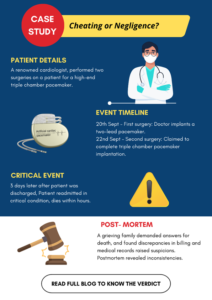
With complete trust in Dr. Malhotra’s expertise, the family deposited a substantial sum of around INR 4,50,000. The plan was to implant a high-end pacemaker that offered additional functionalities for the patient’s fragile condition. The first surgery was carried out on 20th September, and Dr. Malhotra reported that he had implanted a pacemaker with two leads in place. According to him, the surgery went smoothly, and the patient seemed to stabilize post-procedure.
However, just two days later, on 22nd September, Dr. Malhotra operated on the patient again. He explained that given the patient’s heart condition, a phased approach was necessary to allow him “ample rest” before attaching the third lead of the pacemaker. After this second surgery, the patient was discharged on 24th September, presumably having a fully functioning triple chamber pacemaker in his chest.
Unfortunately, the patient’s health declined drastically in the immediate days that followed. By 27th September, his condition had worsened so significantly that he was readmitted in an emergency. Within hours of returning to the hospital, he tragically passed away. Distraught and shocked, the patient’s family demanded answers. They insisted on a postmortem to understand what had gone wrong, and when the hospital hesitated, they created a scene, prompting the hospital to call in the police.
The postmortem was finally conducted at another facility, revealing myocardial infarction as the cause of death. Though such a finding might ordinarily be expected in someone with a history of heart disease, the family began to suspect discrepancies in the hospital’s explanation. Their suspicions focused on the pacemaker itself: Why had there been two surgeries within such a short span? Why did the hospital bill mention both a double chamber pacemaker and a high-end biventricular device costing INR 4,47,869.31? And how did the X-ray from 20th September show the presence of a conventional pacemaker instead of the more advanced triple chamber model?
When the matter reached the High Court, Dr. Malhotra and the hospital defended their actions, insisting that the two surgeries were performed purely out of concern for the patient’s frail health. Yet the court was not convinced. It took particular note of the hospital’s billing records, which included charges for both a conventional pacemaker costing INR 45,000 and the more expensive Bivent Pacemaker Allure Quadra CRTP. Moreover, a CD submitted by the hospital, intended to demonstrate transparency, contained only 23 short, edited clips totaling just over a minute of footage from the patient’s stay.
Ultimately, the High Court declared it not just a case of medical negligence but also of potential cheating and conspiracy, with Dr. Suresh Malhotra and the hospital found to be at fault. They were ordered to pay significant compensation to the grieving family. This tragic case stands as a stark reminder that honesty, thorough patient documentation, and ethical conduct must always guide medical care—even for specialists like Dr. Malhotra, whose responsibility is to serve and protect life at every turn.
Disclaimer: This blog is based on a real-life medical case, with personal details anonymized for privacy. It is for informational purposes only and not medical advice. We are not liable for any outcomes resulting from the use of this content.
Name of the court:The High Court of Punjab And Haryana At Chandigarh
Names of the parties: Max Super Speciality Hospital Another Vs State of Punjab And Another
Date of the judgment: 11.03.2024